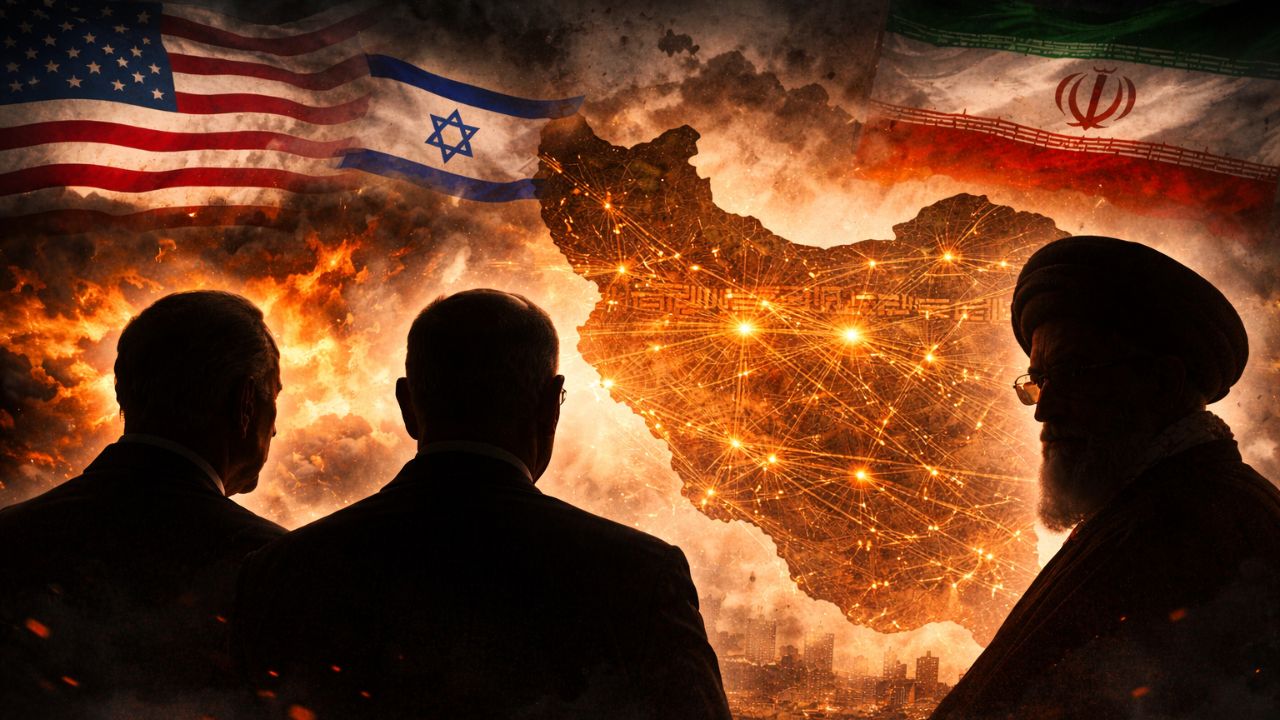
The United States and Israel launched a series of coordinated military strikes on targets across Iran early Saturday, February 28, 2026. President Donald Trump announced that “major combat operations” were underway, saying the goal was to wipe out what Washington calls immediate threats from Iran’s regime. Iran has retaliated with missiles and drones targeting Israel and at least four US military bases across the Middle East, sharply escalating an already volatile regional crisis.
What Happened
Israel initiated the operation in the early hours of Saturday, striking targets in and around Tehran, including areas near the offices of Supreme Leader Ayatollah Ali Khamenei, according to multiple reports. Several missiles struck University Street and the Jomhouri area in Tehran, and smoke was seen rising across the city.
A US official confirmed to multiple news agencies that the strikes were carried out as part of a joint military operation with Israel. The US Department of Defense named the mission “Operation Epic Fury.”
Unlike the previous US-Israel strikes on Iran in June 2025, which concluded within hours, sources told CNN that the US military is this time planning for several days of attacks.
Internet monitoring group NetBlocks confirmed that Iran was in the midst of a near-total internet blackout, with national connectivity at 4% of ordinary levels, shortly after the attacks began.
Why the US and Israel Acted
An Israeli military official said the decision to strike was taken after intelligence indicated an acceleration of Iran’s ballistic missile programme and that Iran was acting to conceal and fortify its nuclear programme to continue advancing it.
Trump, in a statement, said: “Operation Midnight Hammer last June obliterated the regime’s nuclear programme at Fordow and Isfahan. After that attack, we warned them never to resume their malicious pursuit of nuclear weapons, and we sought repeatedly to make a deal. But Iran refused.”
Trump stated that Iran had attempted to rebuild its nuclear programme and continue developing long-range ballistic missiles capable of threatening US allies in Europe and US troops stationed overseas.
The strikes came just two days after high-stakes US-Iran nuclear negotiations in Geneva, mediated by Oman, ended without a breakthrough, according to Al Jazeera.
What the US Military Objectives Are
According to Trump’s official statement, Washington’s stated military objectives for the operation include: destroying Iran’s missile capabilities, targeting Iran’s navy, disrupting Iran-backed armed groups operating in the region, and preventing Iran from obtaining a nuclear weapon.
Trump also directly addressed IRGC personnel, offering amnesty if they laid down their weapons, while warning of consequences if they did not.
Iran’s Retaliation
Iran’s paramilitary Revolutionary Guard launched what it described as a “first wave” of drones and missiles targeting Israel. Iran’s Supreme National Security Council said in a statement that its armed forces would give a “crushing response” to the US and Israeli attacks.
Iranian forces launched missiles at Al Udeid airbase in Qatar, Al-Salem airbase in Kuwait, Al-Dhafra airbase in the UAE, and the US Fifth Fleet headquarters in Bahrain.
The US Embassy in Bahrain announced it would close on Sunday, 1 March 2026, in light of the ongoing missile strikes.
Iran’s Foreign Minister Abbas Araghchi also warned neighbouring states not to allow US and Israeli forces to use their territory or facilities for operations against Iran, or risk becoming “legitimate targets,” according to semiofficial Iranian media.
Background and Context
This is not the first US military engagement with Iran’s nuclear infrastructure. On 13 June 2025, Israel launched major air strikes against Iranian nuclear and military facilities. The US followed on 22 June 2025, striking Iranian nuclear facilities at Natanz, Fordow, and Isfahan, which became known as the Twelve-Day War. Iran said at least 610 of its citizens were killed in that conflict.
IAEA Director General Rafael Grossi said in an interview posted 10 days before Saturday’s strikes that most of Iran’s enriched uranium had remained intact after the June 2025 US attacks, though he said there was no indication Iran was working to develop an actual nuclear weapon.
Following the June 2025 war, Iran halted cooperation with the IAEA and resumed enrichment after what officials described as “serious damage.” Multiple rounds of indirect negotiations, facilitated by Oman and involving the UK, France, and Germany, failed to produce a binding agreement.
Official Statements: Who Said What
Israeli Prime Minister Benjamin Netanyahu said the operation aimed to remove an “existential threat,” adding that joint action by Israel and the US would “create the conditions for the brave Iranian people to take their fate into their own hands.”
French President Emmanuel Macron said the outbreak of war carries “grave consequences” and called for an urgent meeting of the UN Security Council, stating: “The ongoing escalation is dangerous for all. It must stop.”
Russia condemned the strikes as an “unprovoked act of armed aggression against a sovereign state,” saying the scale of preparations left no doubt the attack was pre-planned.
Iran’s Ministry of Foreign Affairs said the attacks were a “gross violation” of Iran’s territorial integrity and national sovereignty.
Economic and Strategic Implications
The strikes carry major implications for global energy markets. More than 14 million barrels per day of oil passed through the Strait of Hormuz in 2025, approximately one-third of all worldwide oil exports transported by sea. A disruption to the strait could have significant consequences for global oil supply.
Iran-backed Houthi forces in Yemen also vowed to resume attacks on Red Sea shipping routes, according to PBS News, citing two senior Houthi officials.
What Happens Next
US has described this as a “multiday operation,” according to Reuters. Congress is preparing a war powers resolution vote to determine whether Trump had legal authority under the US Constitution to authorise military action without Congressional approval, according to PBS News.
UN Security Council is expected to convene at France’s request. Iran has stated it will continue retaliatory strikes as long as US and Israeli operations continue, according to state media.
The situation remains rapidly evolving. Casualty figures, damage assessments, and the full scope of targeted sites have not yet been independently verified.
About the Author
