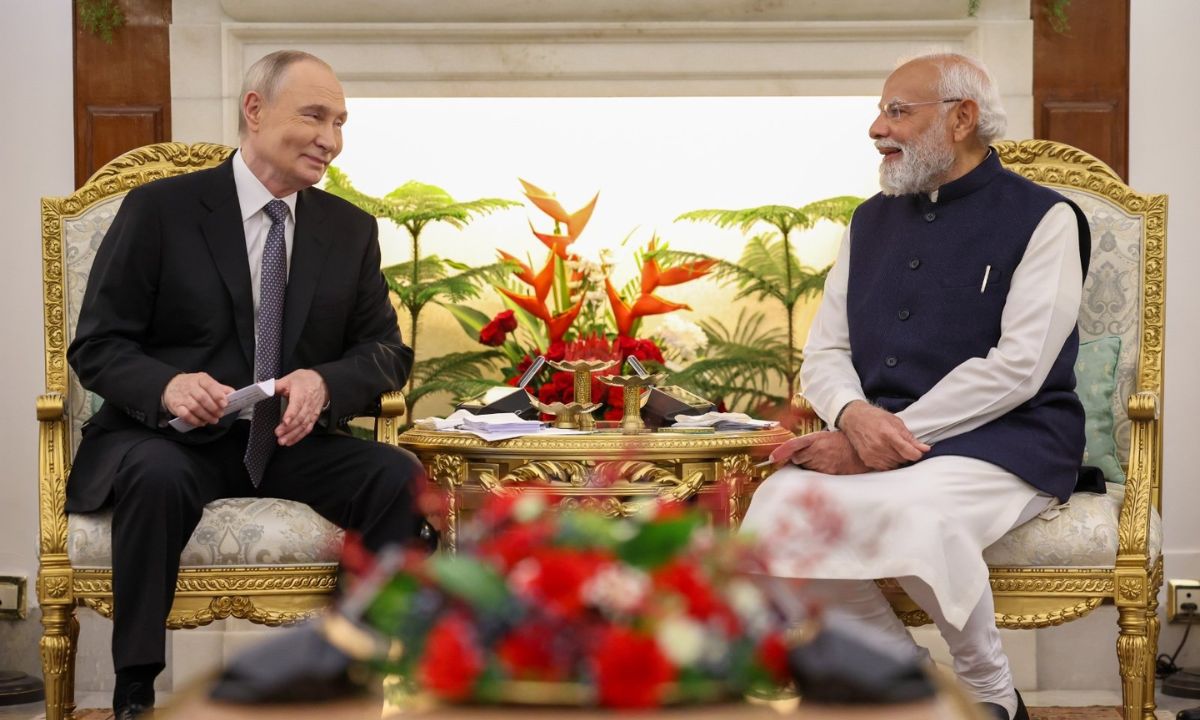
On December 4-5, 2025, Russian President Vladimir Putin paid a two-day State visit to India at the invitation of Prime Minister Narendra Modi. The visit coincided with the 23rd India-Russia Annual Summit, underscoring the enduring “Special and Privileged Strategic Partnership” between the two countries – a relationship formally anchored since 2000.
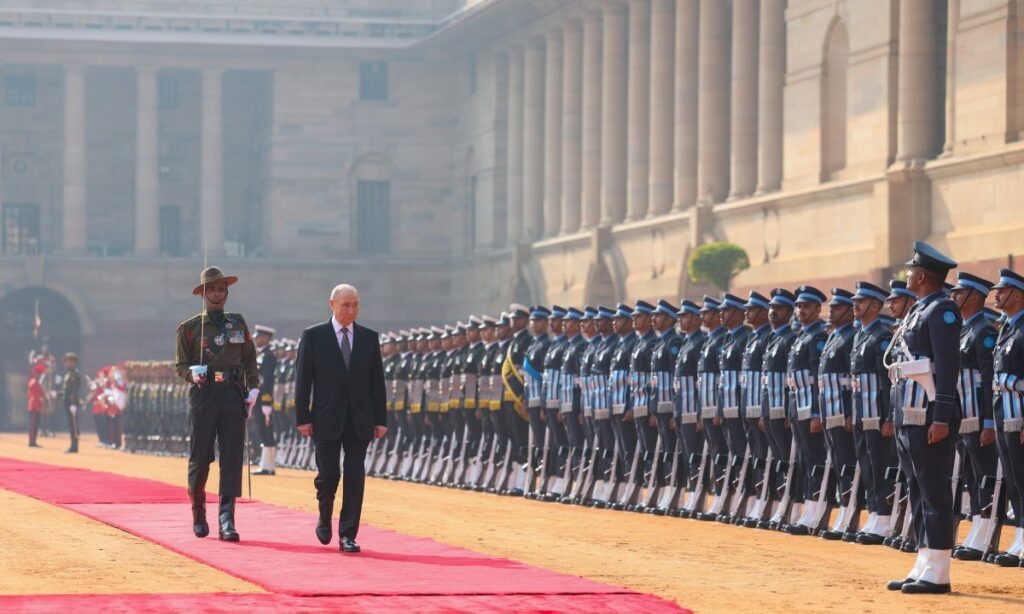
Upon arrival, President Putin received a warm welcome from PM Modi, who later wrote on X:
“Delighted to welcome my friend, President Putin to India… India Russia friendship is a time tested one that has greatly benefitted our people.”
PM Modi presented President Putin a copy of the Bhagavad Gita in Russian, noting that its teachings inspire millions across the world – a carefully chosen cultural gesture underlining the civilizational depth of the relationship.
Rashtrapati Bhavan Banquet: Marking 25 Years of Strategic Partnership
On December 5, President of India Droupadi Murmu received President Vladimir Putin at Rashtrapati Bhavan and hosted a banquet in his honour.
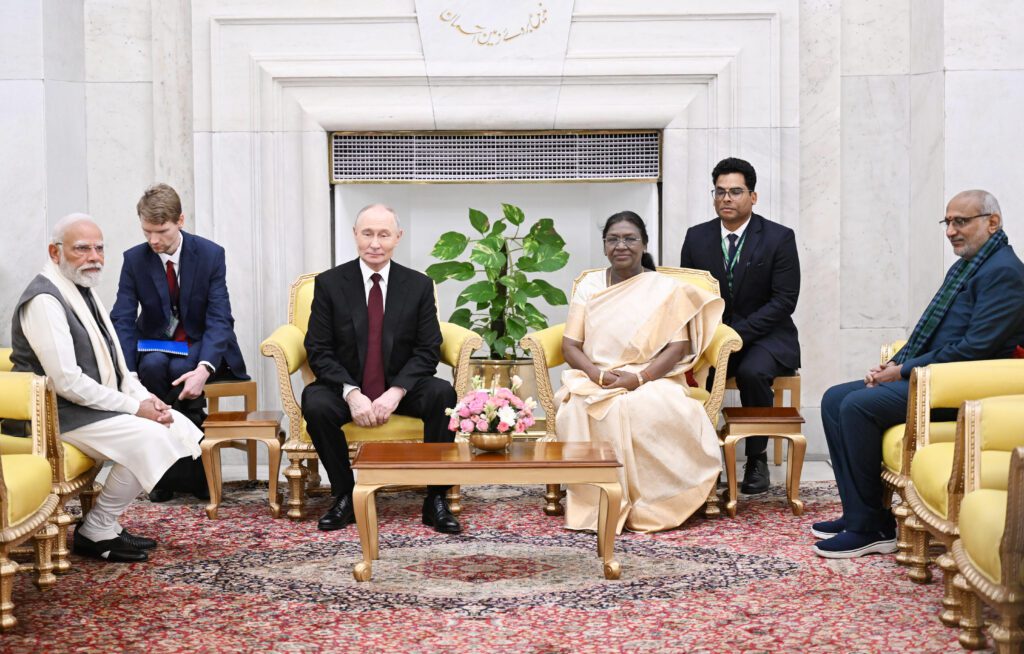
Welcoming him and the Russian delegation, she underlined that this visit marks an important milestone: the 25th anniversary of the India–Russia Strategic Partnership, established in October 2000 during Putin’s first State visit to India as President.
President Murmu:
- Appreciated President Putin’s personal commitment to the “Special and Privileged Strategic Partnership”;
- Noted that the partnership is guided by a shared commitment to peace, stability, and mutual socio-economic and technological advancement;
- Pointed out that 2025 has been “especially fruitful” for this multifaceted partnership, with progress in high-level political exchanges, trade and economy, defence, civil nuclear cooperation, space, science and technology, education, culture, and vibrant people-to-people exchanges.
She highlighted that the Joint Statement of the 23rd India–Russia Annual Summit reflects the special nature of the ties and offers a comprehensive framework for deepening them further.
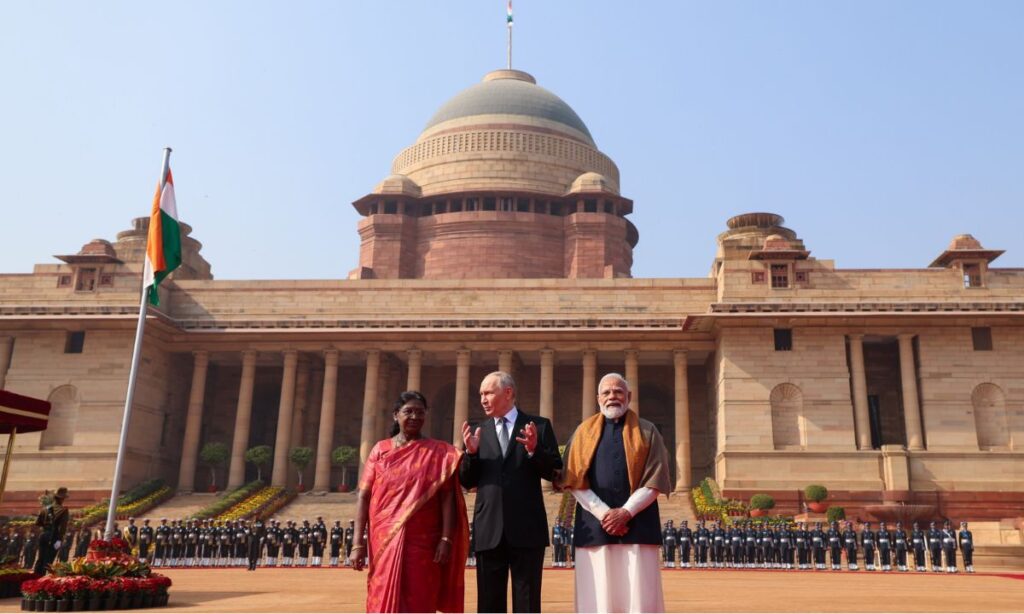
Recalling centuries-old cultural dialogue – from ancient trade routes to the famous correspondence between Mahatma Gandhi and Leo Tolstoy and mutual admiration for each other’s literature and arts – President Murmu stressed that these civilizational linkages continue to shape contemporary ties. Both leaders expressed confidence that the steadfast friendship between India and Russia will continue to prosper in the years ahead.
Landmark Agreements & Broad-Based Cooperation
During the summit, both sides reaffirmed their commitment to deepen cooperation across a wide spectrum: political, strategic, military, energy, trade and investment, science and technology, culture, education and humanitarian domains.
A substantial “List of Outcomes” and multiple MoUs/agreements were concluded, including in:
- Migration and mobility – Agreements on temporary labour activity and cooperation to combat irregular migration;
- Health and food safety – Cooperation in healthcare, medical education and science, and a pact between FSSAI and Russia’s consumer protection authority on food safety;
- Maritime and polar cooperation – MoUs on training specialists for ships operating in polar waters and enhanced maritime cooperation;
- Fertilizers – MoU between UralChem and Indian PSUs for long-term fertilizer cooperation;
- Customs and commerce – Protocol on exchange of pre-arrival customs information and a bilateral agreement between India Post and Russian Post;
- Academic collaboration – MoUs between Defence Institute of Advanced Technology, Pune and Tomsk State University; and between the University of Mumbai, Moscow State University and RDIF’s management company;
- Media collaboration – Multiple MoUs between Prasar Bharati and leading Russian media houses, including Gazprom-Media, National Media Group, BIG ASIA, TV BRICS and TV-Novosti.
Announcements included the Programme for the Development of Strategic Areas of India–Russia Economic Cooperation till 2030, Russia’s decision to join the International Big Cat Alliance, a major textile-heritage exhibition “India. Fabric of Time” in Moscow, and 30-day e-Tourist and group tourist visas on a gratis basis for Russian nationals on a reciprocal basis.
Economics, Energy & Trade: A Roadmap to USD 100 Billion
A central theme of the summit was economic cooperation. The two countries committed to expanding bilateral trade in a balanced, sustainable manner and reiterated their ambition to raise trade volume to USD 100 billion by 2030.
To reach that target, both sides emphasized:
- Strengthening industrial cooperation and investment, especially in advanced and high-technology sectors;
- Addressing tariff and non-tariff barriers;
- Removing logistics bottlenecks and promoting new connectivity corridors;
- Ensuring smooth and predictable payment mechanisms.
India and Russia agreed to continue developing systems for bilateral settlements in national currencies, and to explore interoperability between their national payment systems, financial messaging systems and even central bank digital currency (CBDC) platforms.
Energy remains a pillar of the partnership. The two sides commended wide-ranging cooperation in:
- Oil and oil products, refining and petrochemicals;
- LNG and LPG infrastructure;
- Underground coal gasification and other upstream technologies;
- Nuclear power and related high-technology projects.
They also agreed to fast-track the resolution of issues affecting ongoing and proposed investments in the energy sector, underlining energy security as a shared strategic priority.
Transport, Connectivity and the Russian Far East
The summit outcomes give a strong push to connectivity and logistics:
- Both sides will deepen cooperation on the International North–South Transport Corridor (INSTC), the Chennai–Vladivostok Eastern Maritime Corridor, and the Northern Sea Route.
- A new MoU on training specialists for ships operating in polar waters and maritime cooperation reinforces India’s growing role in the Arctic and polar shipping ecosystem.
In the Russian Far East and Arctic, both countries reaffirmed readiness to intensify trade and investment. The Programme of India–Russia Cooperation in Trade, Economic and Investment Spheres in the Russian Far East (2024–2029) provides a framework for collaboration in agriculture, energy, mining, manpower, diamonds, pharmaceuticals and maritime transport. Regular consultations on Arctic issues and cooperation on the Northern Sea Route signal long-term strategic alignment in the region.
Civil Nuclear Cooperation and Space Partnership
The sides confirmed their intention to broaden civil nuclear cooperation, including:
- Fuel-cycle and life-cycle support for the Kudankulam Nuclear Power Plant (KKNPP);
- Timely implementation of ongoing units at Kudankulam;
- Discussions on identifying and finalising a second NPP site in India for Russian-designed reactors;
- Localization and joint manufacturing of nuclear equipment and fuel assemblies for large capacity Russian-designed NPPs.
In space, the partnership between ISRO and Roscosmos is set to deepen in:
- Human spaceflight programmes;
- Satellite navigation and planetary exploration;
- Rocket engine development, production and use.
This expands India–Russia collaboration beyond traditional domains into future-oriented strategic technologies.
Defence, Military-Technical and Technology Cooperation
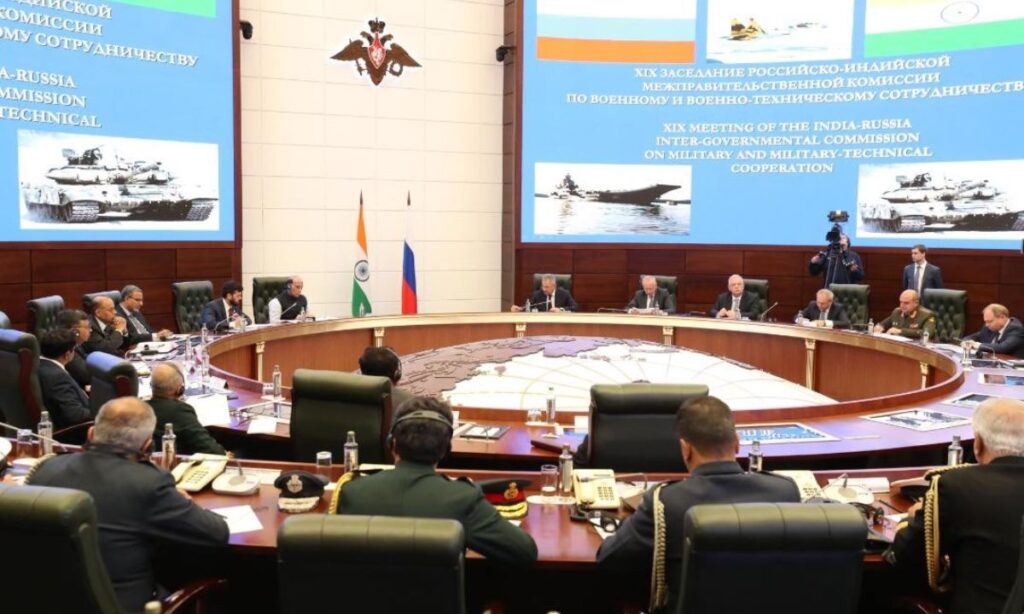
Defence and military-technical ties remain a vital pillar of the relationship. The 22nd session of the Intergovernmental Commission on Military & Military-Technical Cooperation (IRIGC-M&MTC), held in New Delhi on December 4, 2025, charted a path for:
- Joint research and development;
- Co-development and co-production of advanced defence systems;
- Joint manufacturing in India of spare parts, components and aggregates for Russian-origin platforms under ‘Make in India’, with an eye on exports to friendly third countries.
Both sides welcomed regular military contacts, including defence ministers’ meetings and INDRA joint exercises, and committed to maintaining the momentum of high-level military engagement.
In science, technology and innovation, the two sides called for ramped-up collaboration between governments, academia and private sectors, particularly in:
- Critical and emerging technologies;
- Critical minerals and rare earths – from exploration to processing and recycling;
- Digital technologies, cybersecurity and protection of critical infrastructure;
- Startup ecosystems and SME-driven innovation, with soft-support programmes for joint R&D and co-development.
Culture, Education, Tourism and People-to-People Ties
Building on President Murmu’s remarks about the centuries-old cultural dialogue – from Gandhian ideals to Tolstoy’s legacy – cultural and people-to-people exchanges were given a strong push:
- Both sides agreed to organise Cultural Exchange Festivals on a parity basis, showcasing each other’s art, music, cinema and heritage;
- Expansion of cooperation in the film industry, joint productions and mutual participation in film festivals;
- Enhanced university partnerships, academic mobility programs, joint research and specialised conferences;
- A major museum collaboration for the exhibition “India. Fabric of Time” in Moscow.
Tourism got a concrete boost with the announcement of 30-day gratis e-Tourist visas and group tourist visas for Russian nationals, reciprocated by Russia. This is expected to significantly increase tourist flows, especially on the back of improved air connectivity and cultural curiosity on both sides.
Both sides appreciated ongoing efforts to ensure the well-being of Indian students in Russia and committed to deepening educational linkages.
Multilateral Cooperation and Global Issues
India and Russia reaffirmed close coordination in multilateral fora such as the United Nations, G20, BRICS and SCO, including:
- Support for UN Security Council reform, with Russia reiterating its strong backing for India’s permanent membership;
- Continued alignment on reformed multilateralism, reform of international financial institutions and multilateral development banks;
- Cooperation on climate change, including the Joint Working Group on climate and low-carbon development and mechanisms under Article 6 of the Paris Agreement;
- Joint efforts on non-proliferation, outer space security, and export controls that balance security and commercial considerations.
On regional issues – from Afghanistan to West Asia and Gaza – both sides called for dialogue, humanitarian assistance, respect for international law and de-escalation of tensions. They reiterated their commitment to combating terrorism, extremism, cross-border terror, terror financing and radicalisation, and underscored the need for a zero-tolerance approach.
What This Summit Signals
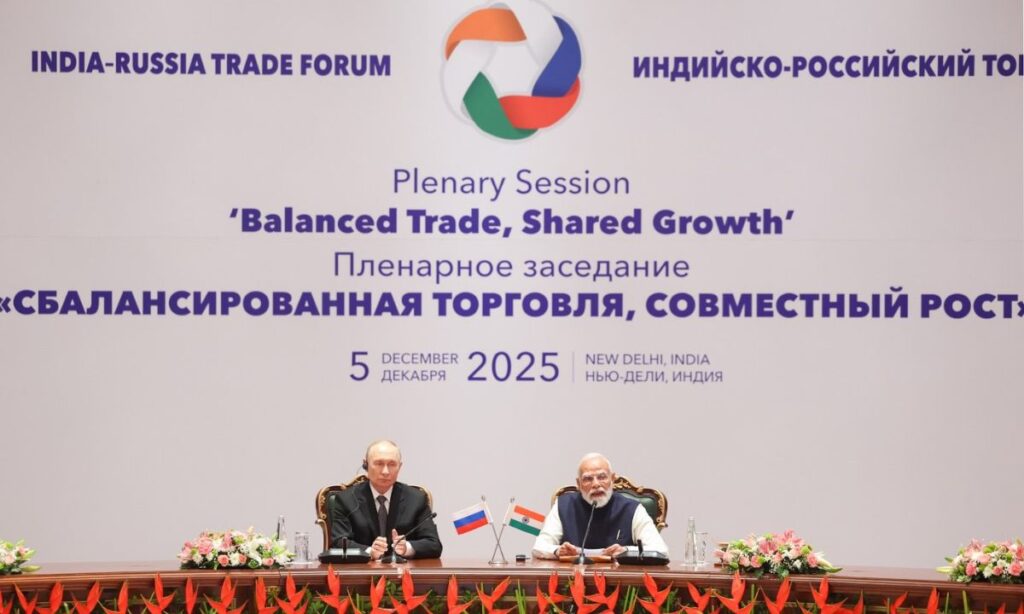
The 23rd India–Russia Annual Summit, reinforced by President Murmu’s banquet diplomacy at Rashtrapati Bhavan, sends a clear message:
- The 25-year-old Strategic Partnership is not just being commemorated but actively upgraded for a new era;
- The relationship is expanding from traditional pillars like defence and energy into technology, connectivity, climate action, education, culture and people-centric mobility;
- Both sides see their partnership as an anchor of stability in an increasingly complex, multipolar world.
For India, the visit underlines strategic autonomy and diversified partnerships, securing long-term energy, technology and economic interests. For Russia, it reaffirms a trusted partner in Asia and the Global South, with whom it can co-shape a multipolar global order.
Both governments appear confident that the friendship, described by the leaders as “time-tested” and “steadfast”, will continue not only to endure global headwinds but also to define new avenues of cooperation in the decades ahead.