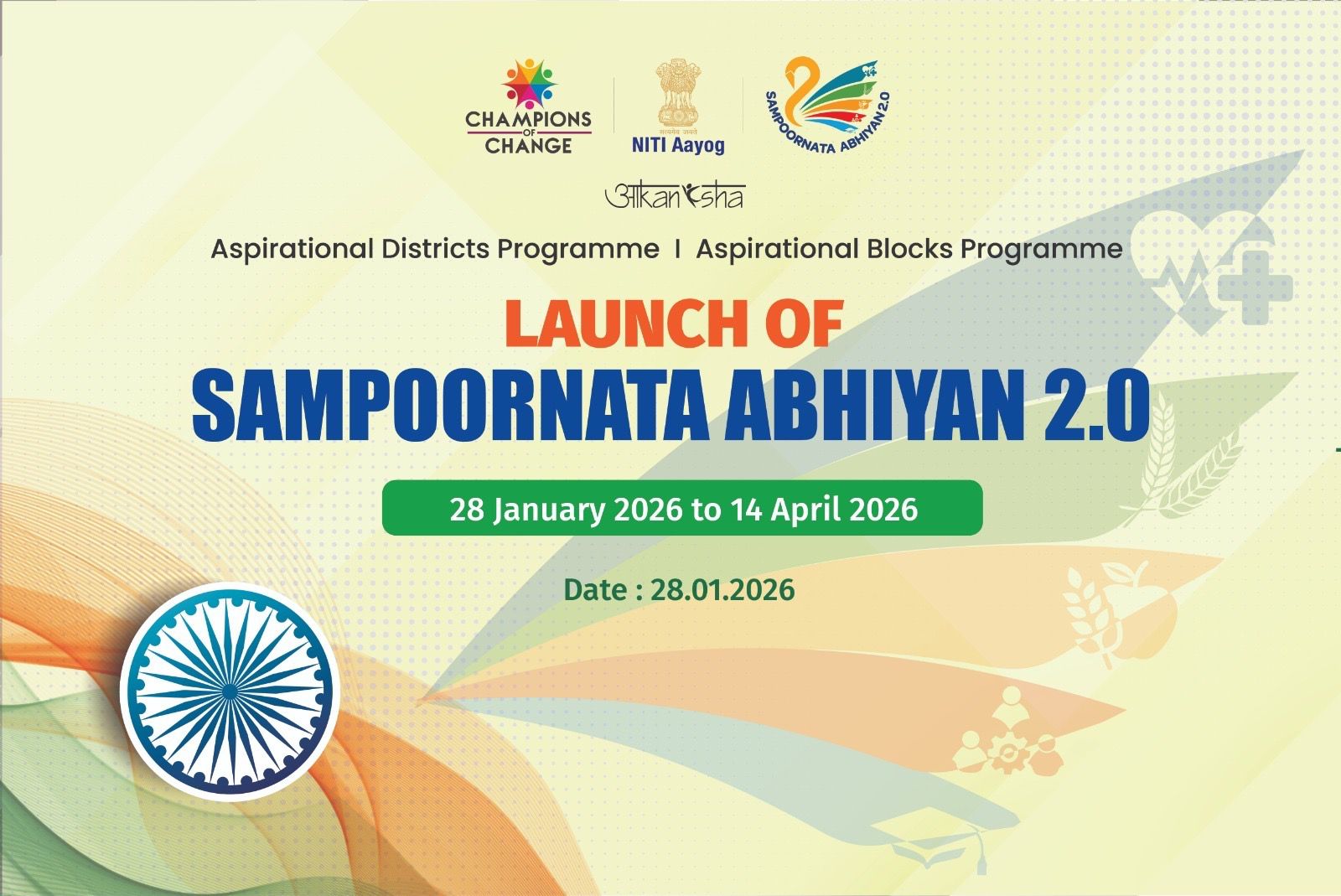
NITI Aayog has rolled out a renewed nationwide development campaign, Sampoornata Abhiyan 2.0, aimed at ensuring complete delivery of essential public services in India’s most underdeveloped districts and blocks. The three-month initiative, which began on January 28, 2026, will continue until April 14, 2026, focusing on critical sectors such as health, nutrition, sanitation, education and animal vaccination.
The primary goal of the campaign is to achieve “full saturation” of selected government services. This approach seeks to eliminate last-mile gaps by ensuring that every eligible citizen receives the benefits meant for them. Unlike long-term reform programmes that bring gradual progress, Sampoornata Abhiyan 2.0 adopts a time-bound mission mode to generate fast and measurable outcomes at the grassroots level.
The initiative builds upon the achievements of the earlier Sampoornata drive conducted in 2024, which showed that concentrated efforts within a short timeframe could significantly improve service delivery. It also reflects NITI Aayog’s emphasis on outcome-based governance, prioritising real-world improvements over procedural formalities.
Key Focus Areas for Aspirational Blocks
For Aspirational Blocks, six Key Performance Indicators (KPIs) have been selected under the campaign. These include regular distribution of supplementary nutrition to children under the Integrated Child Development Services (ICDS) scheme, accurate growth monitoring at Anganwadi Centres, availability of functional toilets and safe drinking water in Anganwadis, sufficient girls’ toilet facilities in schools, and vaccination of bovine animals against Foot and Mouth Disease.
These indicators are directly linked to child health, hygiene, education access and rural economic stability. By strengthening such foundational services, the programme aims to bring immediate and lasting benefits to communities where development gaps are most visible.
Targets for Aspirational Districts
In Aspirational Districts, the campaign will concentrate on five KPIs. These include weighing all newborn babies at birth, improving tuberculosis case notification from both public and private healthcare facilities, regular organisation of Village and Urban Health, Sanitation and Nutrition Days, ensuring functional girls’ toilets in schools, and increasing animal vaccination coverage.
These measures focus on improving healthcare systems, disease monitoring, sanitation awareness and education infrastructure at the district level. Progress in these areas is expected to push districts closer to national development standards while strengthening coordination among various government departments.
Strategy for Rapid Implementation
Each participating district and block will prepare a detailed three-month action plan to achieve complete coverage of the selected indicators. Progress will be reviewed monthly using digital dashboards that provide real-time data insights.
Community involvement will play a crucial role, with awareness campaigns and behaviour-change activities designed to encourage participation and demand for services. District officials will conduct regular field visits to monitor implementation and resolve challenges quickly.
NITI Aayog will coordinate closely with central ministries, state governments and development partners to support planning, capacity building and rapid troubleshooting. This integrated approach is meant to ensure accountability and timely results.
Part of India’s Aspirational Development Model
Sampoornata Abhiyan 2.0 is rooted in India’s aspirational development strategy. The Aspirational Districts Programme, launched in 2018, covers 112 districts and focuses on improving key sectors such as health, education, agriculture, financial inclusion and infrastructure through data-driven monitoring and competitive performance.
Expanding this model further, the Aspirational Blocks Programme was introduced in 2023 and now includes 513 blocks nationwide. Both initiatives rely on real-time data, cooperation and targeted interventions to accelerate development in underserved regions.
Through Sampoornata Abhiyan 2.0, NITI Aayog aims to reinforce this framework by ensuring that essential services reach every eligible citizen. If successful, the campaign could set a benchmark for rapid, results-oriented governance and bring tangible improvements to millions living in India’s most vulnerable areas.
About the Author
