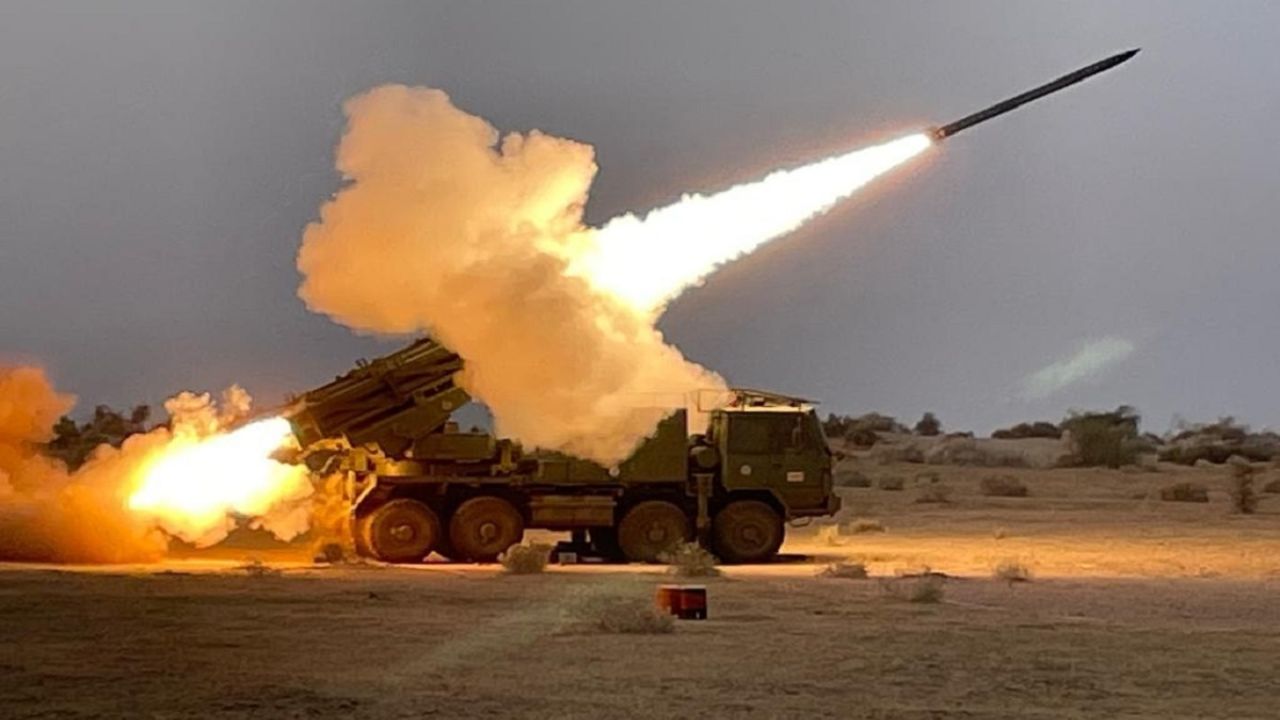
In a major milestone for India’s defence research programme, the Defence Research and Development Organisation (DRDO) on Tuesday successfully demonstrated the Solid Fuel Ducted Ramjet (SFDR) propulsion technology, a critical system for next-generation long-range missiles. The test was carried out at the Integrated Test Range (ITR) in Chandipur, off the Odisha coast, at around 10.45 am.
According to an official statement, the successful flight test places India among a select group of countries that have mastered this advanced propulsion technology. SFDR is considered essential for developing long-range air-to-air missiles that can significantly enhance the combat effectiveness of the Indian Air Force.
The demonstration involved the smooth functioning of all key subsystems, including the nozzle-less booster, the solid fuel ducted ramjet motor and the fuel flow controller. Initially, the missile was accelerated to the required supersonic speed using a ground booster motor. Once the desired Mach number was achieved, the SFDR system took over to sustain high-speed flight.
Performance data was recorded through several tracking instruments deployed along the Bay of Bengal coastline, confirming the system’s reliability and efficiency during the test. Senior scientists from various DRDO laboratories such as the Defence Research and Development Laboratory (DRDL), High Energy Materials Research Laboratory (HEMRL), Research Centre Imarat (RCI) and ITR closely monitored the launch.
Defence Minister Rajnath Singh congratulated DRDO scientists and industry partners for the achievement, calling it a crucial step towards strengthening India’s indigenous missile development capabilities. DRDO Chairman and Secretary, Department of Defence R&D, Samir V Kamat also praised the teams for the successful demonstration.
The SFDR system is a cutting-edge propulsion technology that uses atmospheric oxygen to sustain combustion during flight. Unlike traditional solid rocket motors that burn out quickly after launch, SFDR-powered missiles continue to generate thrust over a longer period. This allows them to maintain high supersonic speeds for extended durations, increasing both range and manoeuvrability.
Experts say missiles equipped with SFDR technology can engage highly agile aerial targets at distances ranging from 50 km to over 300 km, while flying at speeds between Mach 2 and Mach 3.8. The system also enables operations across a wide altitude range — from near sea level up to around 20 km — providing greater flexibility during combat situations.
One of the major advantages of SFDR-powered missiles is the larger “no-escape zone,” which makes it extremely difficult for enemy aircraft to evade once targeted. The propulsion system also enhances tail-chase capability and allows high ‘g’ manoeuvres, offering a tactical edge in beyond-visual-range engagements.
The SFDR propulsion system comprises several indigenously developed components. The nozzle-less booster rapidly accelerates the missile to supersonic speed within a few seconds after launch. Following this, a high-energy solid fuel sustainer based on boron takes over, burning partially within the fuel chamber while completing combustion inside the ramjet using atmospheric oxygen.
A sophisticated hot gas valve controls the flow of combustion gases depending on speed and altitude. Designed to withstand extreme temperatures, the valve incorporates advanced materials such as carbon composites and specialised alloys. The system also includes titanium air intakes that compress incoming air efficiently, ensuring steady oxygen supply to the combustion chamber.
Modern onboard guidance and control systems further enhance the missile’s effectiveness. These include an inertial navigation system, radio-frequency seeker, jam-resistant data link, high-performance actuators and compact thermal batteries. For destructive capability, the missile carries a proximity fuse along with a fragmentation warhead.
Defence analysts view the successful SFDR demonstration as a significant leap towards self-reliance in advanced missile propulsion. The technology is expected not only to strengthen India’s long-range air-to-air missile programme but also to be adapted for future surface-to-air defence systems.
With this achievement, India moves closer to fielding next-generation missile systems capable of meeting evolving aerial threats and maintaining strategic superiority in the region.
About the Author
