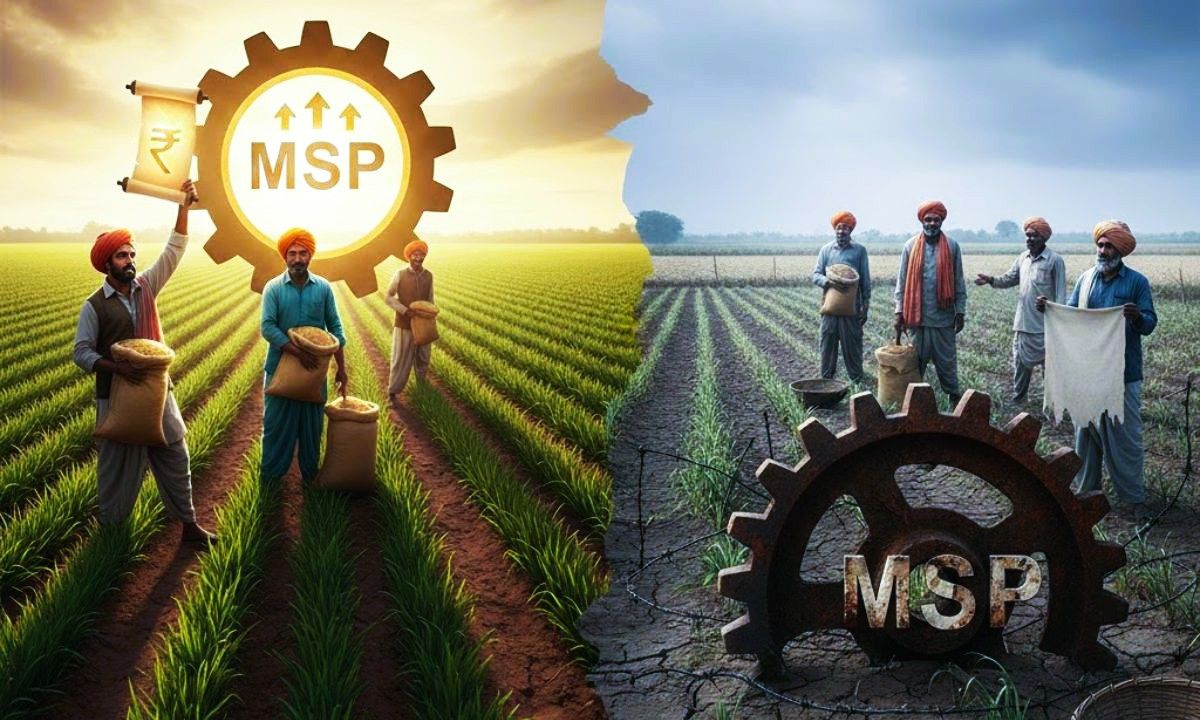
The Minimum Support Price – or MSP – is among the most visible and politically charged agricultural instruments in India. Announced before each sowing season, MSP is pitched as the safety net that ensures farmers will get a minimum guaranteed price for their crop, even if market rates collapse. It promises protection from distress sales, stabilises incomes, and underwrites the dignity of those who till the land. Over decades, MSP has become a powerful symbol of governmental commitment to farmer welfare, food security, and rural livelihoods.
For many rural households, MSP is shorthand for security; for political parties, it is proof of pro-farmer credentials; for voters, a promise of protection against market chaos. But as the policy evolves, as climate stress intensifies, and agrarian demography changes – the critical question is whether MSP as narrative continues to deliver meaningfully on its promise. Does MSP guarantee incomes, or simply uphold a political symbol?
Although political messaging around MSP creates the perception of broad protection, data from government and academic evaluations shows that the benefits reach only a limited segment of farmers. Procurement coverage, regional imbalance and crop concentration expose structural constraints that sharply contrast with the narrative of MSP as a universal safety net. Studies by the NSO, CACP and several state procurement assessments reveal that only a small proportion of farmers are actually able to sell their produce at MSP, with procurement heavily concentrated in a few states and on a handful of crops. Meanwhile, rising input costs, increasing indebtedness and frequent climate shocks continue to erode farm margins, limiting MSP’s ability to function as an effective income-security mechanism.
For MSP to remain meaningful, it must evolve from a price-support mechanism into a comprehensive livelihood-security framework built on income stability, crop diversification, market access, and value-chain development. Without such structural reform, it risks becoming a political symbol rather than a tool of agrarian transformation.
Context: How the MSP Narrative Was Built
Institutional Origins and the Making of MSP
MSP’s roots trace back to the 1960s, when India, reeling from food shortages, sought to protect farmers and ensure foodgrain security. The Commission for Agricultural Costs and Prices (CACP), first formed as the Agricultural Prices Commission in 1965, was tasked with advising on prices, costs and procurement. By 1966–67, MSP was formalised for select crops – a key plank of the Green Revolution’s policy mix.
Over time, MSP became institutionalised: before each sowing season, CACP recommends MSPs; the government approves; state procurement agencies and central bodies such as Food Corporation of India (FCI) and National Agricultural Co‑operative Marketing Federation (NAFED) conduct procurement; buffer stocks and public distribution rely heavily on MSP-driven procurement.
Political and Symbolic Construction
MSP gained symbolic power because it offered a simple, emotionally resonant promise: whether monsoon failed or market collapsed, the farmer wouldn’t be left stranded. Over successive budgets and election cycles, MSP hikes have become headline announcements, widely covered in media and public rallies, reinforcing the image of the “pro-farmer state.” Whether red-bandhal flags, procurement-centre photos, or paddy-cart parades, the imagery signals state solidarity with farmers – messaging that resonates deeply in agrarian constituencies.
Political parties across the spectrum – regardless of ideology – have embraced MSP as a badge of their commitment to rural welfare. The result: MSP became more than an economic policy; it became a political narrative, a promise, a symbol.
Narrative vs Reality: Divergences in Coverage, Outcome and Incentives
What MSP Still Delivers
- Price-floor protection for select crops: For staples like paddy and wheat in states with functional procurement systems, MSP has indeed provided a safety net. When market prices collapse or global supply shocks appear, government procurement at MSP ensures farmers get a guaranteed return.
- Food security and buffer stocks: MSP-based procurement supplies the public distribution system (PDS), buffer stocks for price stabilisation, and drought mitigation – helping the nation maintain food security and stabilise prices.
- Political and social stability: The narrative – and reality – of MSP gives many farmers and rural voters a sense of protection and identity, reducing uncertainty in certain regions and among certain cultivator groups.
Even recently, governments have repeatedly reaffirmed MSP’s centrality to India’s agricultural support architecture. The latest MSP announcements for the 2025–26 and 2026–27 sowing cycles continued the trend of steady increases across major crops, with hikes ranging from approximately 5% to 12% depending on the crop category, according to official procurement briefings. Procurement targets for wheat, paddy and oilseeds published through Ministry of Agriculture updates indicate sustained government commitment to absorbing significant volumes into buffer stock operations, reinforcing MSP as a strategic tool for price stability and food-security planning. Budget figures and Food Corporation of India (FCI) data also show that procurement volumes for wheat and rice remain robust, underscoring the continued relevance of MSP as a key policy plank in stabilising farm incomes and supporting national food reserves.
How Are Crops Selected for MSP? The Decision Framework Behind the 22 Mandated Crops
The Government of India currently fixes Minimum Support Price (MSP) for 22 mandated agricultural crops (14 Kharif + 6 Rabi + 2 commercial crops), based on the recommendations of the Commission for Agricultural Costs & Prices (CACP), along with inputs from State Governments and relevant Central Ministries and departments. According to a February 2024 release by the Press Information Bureau (PIB), the Union Government reiterated that MSP determination follows a pre-determined principle announced in the 2018–19 Union Budget, ensuring MSP levels are kept at least 1.5 times the cost of production. This benchmark is based on comprehensive cost estimates, including paid-out costs (A2), imputed family labour (FL), and broader cost calculations (C2), forming a structured basis for MSP recommendations.
The criteria used by CACP while recommending which crops receive MSP and at what level include:
- Cost of production estimates under A2, A2+FL and C2 cost concepts
- Supply–demand trends and price stabilisation needs
- Food security requirements and PDS buffer stock demands
- Inter-crop price parity to ensure balanced incentives across crops
- Import substitution priorities, particularly for pulses and oilseeds
- Regional suitability and agro-ecological considerations
- Market competitiveness and international price comparison
This framework explains why MSP is officially declared for 22 crops, yet procurement remains highly skewed toward wheat and paddy in a handful of states, while many other MSP crops- such as pulses, oilseeds, coarse cereals and horticulture- receive limited procurement support. The gap between MSP coverage on paper and actual procurement in practice is one of the core fractures in the MSP narrative.
Where the Narrative Breaks Down – Inherent Distortions and Exclusions
Despite these strengths, a growing body of evidence shows MSP’s limited reach and structural distortions:
1. Limited Coverage and Selective Benefit
- Official data shows MSP is declared for around 22–23 crops (cereals, pulses, oilseeds, some commercial crops).
- But effective procurement – especially at scale – remains concentrated on just a few crops (largely paddy and wheat) and a few states (Punjab, Haryana, parts of Uttar Pradesh, MP, Telangana). Many crops (pulses, oilseeds, coarse cereals, horticulture) get negligible procurement support.
- Recent analyses indicate that MSP procurement benefits only a limited share of farmers. A 2025 CACP assessment found that just 17.3% of paddy farmers sold their produce at MSP, while a policy study by the Research & Information System for Developing Countries (RIS) estimates that only about 6% of India’s total farmers benefit from MSP procurement in practice. A 2024 research paper further notes that MSP price support tends to be skewed toward crops with larger cultivation areas, often rewarding entrenched political-economic interests rather than ensuring equitable distribution across regions and farm sizes.
- As a result, a large majority of small, marginal, rain-fed, or non-traditional-crop farmers remain outside MSP’s protection – despite being among the most vulnerable. This sharply contradicts the universalist narrative of MSP as a safety net for all farmers. As farmer unions argue, “MSP may be announced in Delhi, but the price a farmer receives is decided in the mandi” – revealing the gap between narrative promise and marketplace reality.
2. Cropping Distortions & Environmental Costs
MSP’s focus on staples – especially paddy and wheat – has shaped cropping patterns for decades. This has had ecological and agrarian consequences:
- Monoculture and repeated paddy–wheat cycles have strained groundwater, depleted soil health, increased fertiliser dependency, and contributed to air pollution via crop residue burning. Critics argue these are direct outcomes of MSP-driven incentives.
- The relative neglect of pulses, oilseeds, coarse cereals, horticulture, and other regionally suitable crops undermines crop diversity, soil health, nutritional security, and climate resilience. This lock-in contradicts evolving agrarian challenges such as climate change, water stress, and demand for crop diversification.
3. Fiscal, Market and Consumer Costs: Evidence From Institutional Research
MSP is not free. It carries heavy fiscal and market costs:
- Guaranteed procurement even during bumper seasons leads to bulging buffer stocks, storage burden, subsidy dependency, and pressure on public finances. Several think-tanks warn that indefinite expansion or legalisation of MSP without structural reforms would be fiscally unsustainable.
- Higher MSPs for staples can drive up food-grain prices by creating price floors, contributing to inflation – particularly food inflation – which affects consumers. This raises the classic trade-off between farmer support and food affordability.
- Over time, price support may stifle market reforms – weak mandi systems, weak supply-chain infrastructure, limited private-sector engagement – because procurement becomes a default rather than incentive for market innovation.
To illustrate these concerns, the table below summarises key insights from government-linked institutions, national policy think-tanks and peer-reviewed research studies that examine MSP’s fiscal pressure, market distortions and long-term sustainability risks:
Evidence From Institutional Research on MSP-Driven Fiscal and Structural Burdens
| Institution / Report | Key Insight |
| OECD–ICRIER: Agricultural Policies in India (2018 Review) | Notes heavy fiscal pressure, market distortions and subsidy dependence created by MSP-procurement-buffer stock model; warns of unsustainable expansion without systemic reform. |
| NABARD (2024) – State of Affairs in Indian Agriculture Report | Highlights bottlenecks in storage, marketing, procurement efficiency and value-chain support, calling for integrated reforms beyond price support. |
| World Bank (2023) – Transforming Agriculture for Climate Resilience | Warns that high procurement commitments and subsidy growth limit fiscal space for diversification, climate adaptation, and research investments. |
| NITI Aayog (2023) – Crop Diversification Policy Paper | Calls for reducing dependency on MSP-driven paddy–wheat cycles, citing soil degradation, water depletion, and fiscal stress. |
| Indian Journal of Agricultural Economics Research (Sharma & Singh, 2024) | Finds regional concentration and limited coverage weaken MSP’s redistribution and equity objectives; procurement benefits a small share of farmers. |
These institutional findings underline a central tension: while MSP supports procurement and food security, relying on it as the primary mechanism for farmer income growth carries structural and fiscal risks that must be acknowledged and reformed.
4. Income Instability Despite MSP – Debt and Cost Pressures
Even for farmers who grow MSP crops, income stability is not guaranteed. Rising cultivation costs, input inflation, debt, and land fragmentation erode gains:
- A 2025 systematic review shows that in many cases, the MSP does not sufficiently cover actual comprehensive costs (C2 + 50%), especially for kharif crops and pulses – undermining the notion of “minimum remunerative price.”
- Small and marginal farmers, often indebted, struggle to invest in quality inputs; even MSP earnings may not offset debt servicing and recurring costs.
- Given inflation in diesel, fertilisers, labour etc., many farmers report that MSP income barely suffices – forcing them to migrate, take loans, or abandon farming.
Thus, while MSP offers a buffer, for many it does not guarantee stability or prosperity – a sharp divergence from the political narrative.
Competition of Narratives: Who Gets to Define “Support”?
Government & Pro-MSP Narrative
Policymakers and political parties continue to present MSP as a moral and economic guarantee – the bedrock of agricultural justice. Recent MSP hikes are advertised as proof of consistent commitment to farmers. MSP remains central to electoral politics, rural messaging, and social contract between state and countryside.
Farmer Unions and Civil Society
In recent years, farmers’ organisations across multiple states have intensified demands for a legal guarantee of MSP, arguing that without statutory backing, MSP remains merely an announcement rather than an assured income floor. The 2024–25 nationwide marches and protest mobilisations called for MSP to be converted from a discretionary policy into a legally enforceable right, with coverage extended to all major crops and transparent, accountable procurement mechanisms to protect farmers from volatile market prices.
These groups argue that as climate risk, input costs and price volatility grow, only a legally binding MSP – combined with systemic reforms – can protect vulnerable cultivators.
Economists, Policy Analysts & Environmental Critics
Critics of MSP warn that it has distorted cropping patterns, burdened public finances, inflated food prices, discouraged crop diversification, and undermined long-term sustainability. They call for a shift toward income security models, crop insurance, value-chain support, and market reforms rather than price controls.
Environmentalists highlight the ecological cost of MSP-induced monoculture; many call for MSP to be complemented with incentives for sustainable farming, crop rotation, water-saving crops, soil health – not merely volume-based procurement.
The result is a complex, contested space where narratives clash: political safety net vs economic reform; price floor vs market efficiency; short-term security vs long-term sustainability.
Forward View: How the Narrative Around MSP Must Evolve
For MSP to remain relevant – and just – in the next 10–15 years, its narrative must shift fundamentally. Below are elements of what a future-ready MSP narrative should entail:
1. From “Price Guarantee for Staple Crops” to “Livelihood Security for All Farmers & Crops”
MSP should evolve from a narrow price-floor for staples to a broader income-security framework that supports pulses, oilseeds, coarse cereals, horticulture, and regionally appropriate crops. Government procurement or compensation models (like price-deficiency payments) must apply across major crops to ensure equity.
2. From Monoculture Incentives to Crop Diversification & Sustainability
To enable this transition sustainably, the government can gradually shift a portion of procurement and subsidy spending toward incentives for diversified crops, climate-smart practices and localised value chains. Support through targeted financial incentives, carbon-farming payments, and infrastructure such as storage, processing and irrigation efficiency can make diversification economically viable for farmers without overwhelming fiscal resources.
3. From Procurement Dependence to Value-Chain, Market, and Supply-Chain Infrastructure
Support must shift toward building rural storage, cold-chain, agro-processing, linkages to markets, FPOs and farmer-collectives. The narrative should emphasise market access, value addition, and supply-chain integration as central to farmer welfare – not just guaranteed procurement.
4. From Political Symbolism to Transparency, Data & Accountability
MSP narratives must be backed with transparent data on procurement, volumes, inclusion, income outcomes, cost-benefit analyses, ecological impacts. Public dashboards, periodic audits, and inclusive data-sharing can help rebuild trust and move beyond slogans.
5. From Yearly Announcements to Structural Policy Stability
Rather than episodic MSP hikes tied to political calendars, MSP must become part of a stable, predictable, long-term agricultural policy – integrated with insurance, credit, climate resilience, and rural livelihoods.
Political Narratives: Inspiration or Illusion?
MSP is a vivid example of how deeply political narratives can shape public perceptions of policy. Over decades, it has grown into a symbol of state assurance and rural dignity – a promise that the nation stands with its farmers. It has brought real benefits where procurement systems function well, and it remains emotionally powerful across rural India.
Yet the distance between the story and the lived reality is widening. When the political narrative becomes louder than the policy architecture beneath it, cracks begin to show. MSP now sits at a decisive moment: it can continue as a rallying cry and electoral headline, or it can evolve into a serious instrument of income security and sustainable agricultural transformation.
The challenge ahead is not to romanticise MSP or defend it as it exists, but to rebuild it with honesty and ambition. That means aligning political promise with economic feasibility, environmental responsibility, and the everyday struggles of farmers navigating climate uncertainty and market volatility.
If MSP is to remain meaningful to the millions who depend on agriculture, it must shift from being a price guarantee for a select set of crops to becoming part of a larger framework of livelihood stability, diversification, value-chain access, and resilience. Only then will it move from symbolism to substance.
For the next decade, the test is simple: Will MSP remain a slogan shouted from stages – or become a foundation that farmers can stand on with dignity and confidence?
References
- Commission for Agricultural Costs and Prices. (2023). Reports on price policy for kharif and rabi crops: 2018–2023. Ministry of Agriculture & Farmers Welfare, Government of India.
- Economic Survey of India. (2024). State of the Economy and Agriculture Chapter. Ministry of Finance, Government of India.
- Government of India. (2024). Lok Sabha Unstarred Question No. XXXX: Status of claims under PMFBY (2022–2024). Ministry of Agriculture & Farmers Welfare.
- IPCC. (2023). Climate Change 2023: Impacts, Adaptation and Vulnerability. Intergovernmental Panel on Climate Change.
- Ministry of Agriculture & Farmers Welfare. (2025). Pradhan Mantri Fasal Bima Yojana Progress Report 2016–2025. Government of India.
- National Bank for Agriculture and Rural Development. (2022). All India Rural Financial Inclusion Survey (NAFIS 2021–22). NABARD.
- National Statistical Office. (2021). Situation Assessment of Agricultural Households and Land Holdings (SAS 2019). Ministry of Statistics and Programme Implementation, Government of India.
- NITI Aayog. (2023). Policy paper on agricultural reform, crop diversification and future food systems in India. Government of India.
- Punjab State Agriculture Department. (2024). Analysis of PMFBY claims: 2016–2024 performance review. Government of Punjab.
- Reserve Bank of India. (2024). Report on Agricultural Credit and Rural Financial Markets 2023–24. RBI.
- Sharma, R., & Singh, A. (2024). Evaluating procurement efficiency under MSP: A regional assessment. Indian Journal of Agricultural Economics, 79(2), 145–162.
- World Bank. (2023). Transforming India’s agriculture for climate resilience and economic opportunity. World Bank Publications.
About the Author
