
India and Japan have reaffirmed their commitment to elevating their Special Strategic and Global Partnership by unveiling a broad roadmap covering defence, economic security, clean energy, artificial intelligence, infrastructure, and regional cooperation during the 16th India-Japan Annual Summit held in New Delhi.
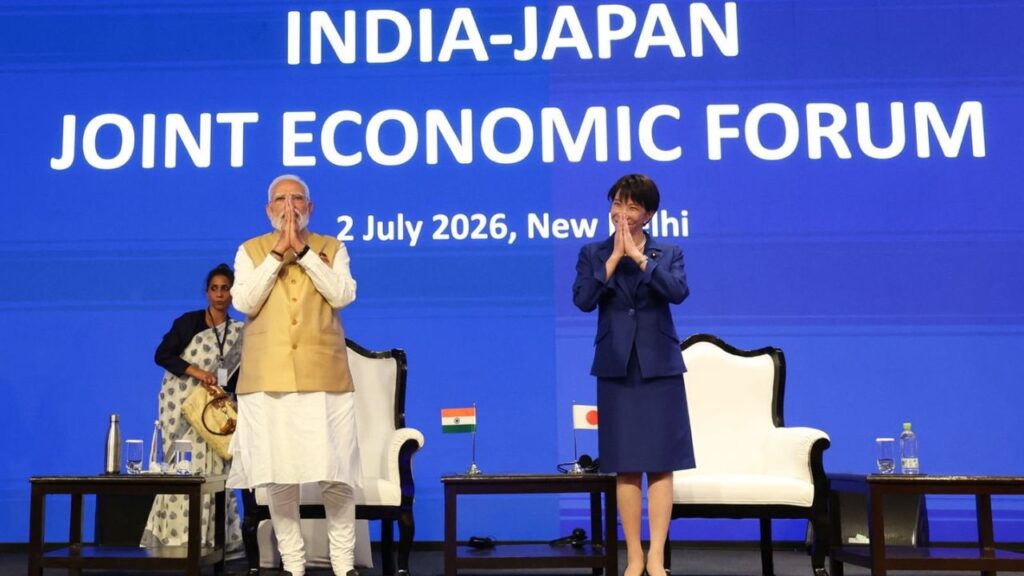
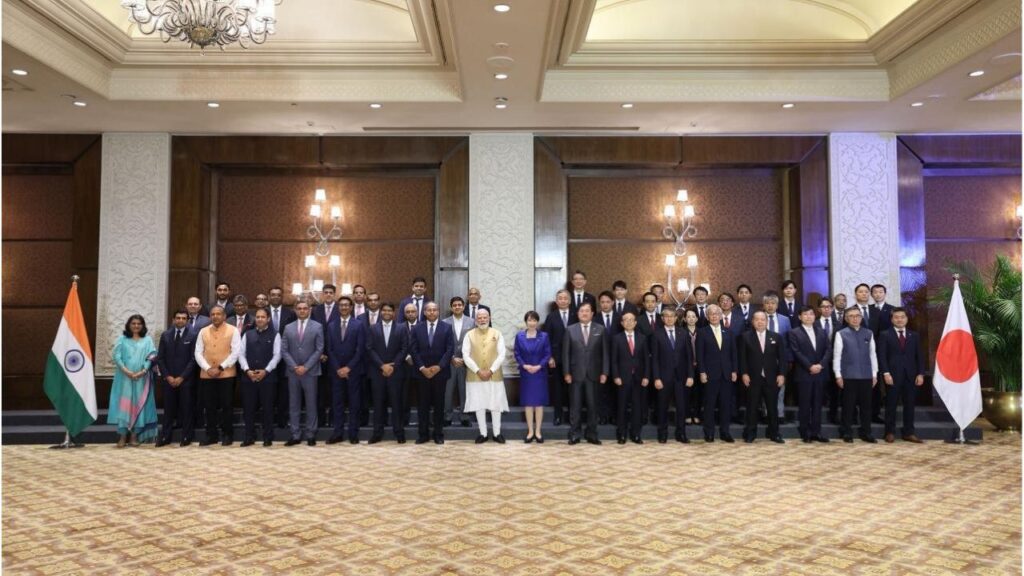
Japanese Prime Minister Sanae Takaichi, on her first official visit to India from July 1 to 3, held extensive discussions with Prime Minister Narendra Modi. The summit reviewed progress in bilateral ties and outlined new initiatives aimed at strengthening cooperation amid evolving geopolitical and economic challenges in the Indo-Pacific region.
Both leaders agreed that India and Japan are indispensable partners in promoting a free, open, and rules-based international order. They emphasized closer alignment between Japan’s updated Free and Open Indo-Pacific vision and India’s Indo-Pacific Oceans’ Initiative and MAHASAGAR framework to ensure regional stability and prosperity.
Defence and security cooperation emerged as a key pillar of the summit. The two Prime Ministers welcomed growing military engagement, including the successful conduct of naval exercises and Japan’s participation in India’s International Fleet Review 2026. They directed their ministers to convene the fourth India-Japan 2+2 Ministerial Meeting in Tokyo later this year and agreed to deepen cooperation in maritime security, satellite-based maritime domain awareness, defence manufacturing, maintenance, repair and overhaul (MRO), and defence technology under India’s “Make in India” initiative.
The leaders also welcomed progress on the Unified Complex Radio Antenna (UNICORN) project and expressed optimism about early implementation while exploring additional defence technology collaborations.
Economic security featured prominently in the discussions as both countries pledged to strengthen resilient supply chains for semiconductors, critical minerals, pharmaceuticals, information technology and clean energy. A Joint Declaration on Economic Security Cooperation was adopted to promote project-based collaboration in these strategic sectors while addressing concerns over economic coercion, export restrictions and supply chain vulnerabilities.
Recognizing growing volatility in global energy markets, India and Japan committed to enhancing cooperation on energy security. They agreed to explore joint investments in maritime energy transport, strengthen collaboration on strategic petroleum reserves and expand cooperation in clean energy technologies, including hydrogen, ammonia, solar energy and nuclear power. Japan also reaffirmed its support for India’s membership in the International Energy Agency.
A significant outcome of the summit was the launch of the India-Japan Cooperative Biogas for Growth Initiative, designed to support India’s ambitious expansion of biogas production. The two sides also endorsed continued cooperation on a landmark clean ammonia project in Odisha.
Artificial intelligence and emerging technologies received considerable attention. Both countries agreed to strengthen collaboration on trusted AI, resilient digital infrastructure and innovation while balancing technological advancement with responsible governance. The inaugural India-Japan AI Strategic Dialogue and a Joint Statement on AI Cooperation aim to promote research, innovation and secure AI supply chains.
Economic ties also received a major boost as both leaders welcomed steady progress towards Japan’s investment target of 10 trillion yen in India. They agreed to accelerate the review of the India-Japan Comprehensive Economic Partnership Agreement (CEPA), improve the business environment and strengthen cooperation across logistics, agriculture, textiles, healthcare, financial services and digital payments.
Infrastructure cooperation continues to remain a flagship aspect of bilateral relations. Both leaders reaffirmed their commitment to the Mumbai-Ahmedabad High-Speed Rail project, with Japan expressing support for India’s goal of commencing commercial operations on priority sections in 2027. They also agreed to explore cooperation on future high-speed rail corridors as India advances its vision of a nationwide high-speed rail network.
The summit highlighted expanding collaboration in science, technology and education through quantum research, space cooperation, student exchanges and academic partnerships. Progress on the joint Lunar Polar Exploration Mission (LUPEX) and a new Letter of Intent on Quantum Technologies underscored growing scientific engagement.
On regional and global issues, India and Japan reiterated support for the Quad, ASEAN centrality, United Nations Security Council reforms and a rules-based Indo-Pacific. They expressed concern over developments in the East and South China Seas, North Korea’s nuclear programme, instability in Myanmar and the Middle East, while supporting diplomatic efforts for peace in Ukraine.
The two leaders strongly condemned terrorism in all forms, including cross-border terrorism, and called for decisive global action against terrorist groups, their financing networks and safe havens.
Marking 75 years of diplomatic relations as the India-Japan Year of Shared Horizons, both Prime Ministers reaffirmed their commitment to further strengthening bilateral ties. Prime Minister Takaichi also invited Prime Minister Modi to Japan for the 17th India-Japan Annual Summit next year, an invitation that was accepted.
About the Author
