
India-EU FTA: India and the European Union announced the conclusion of negotiations for a comprehensive Free Trade Agreement on Tuesday (January 27, 2026), marking the end of nearly two decades of talks and creating what officials describe as one of the world’s largest trading blocs.
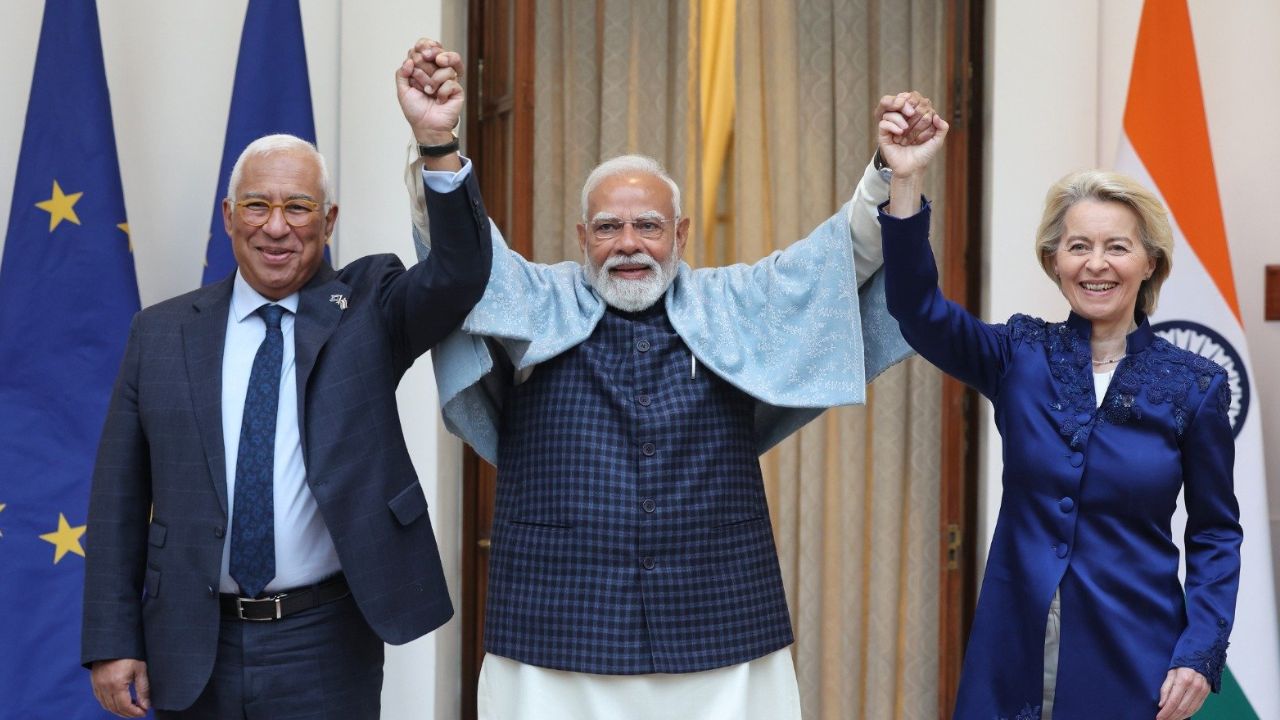
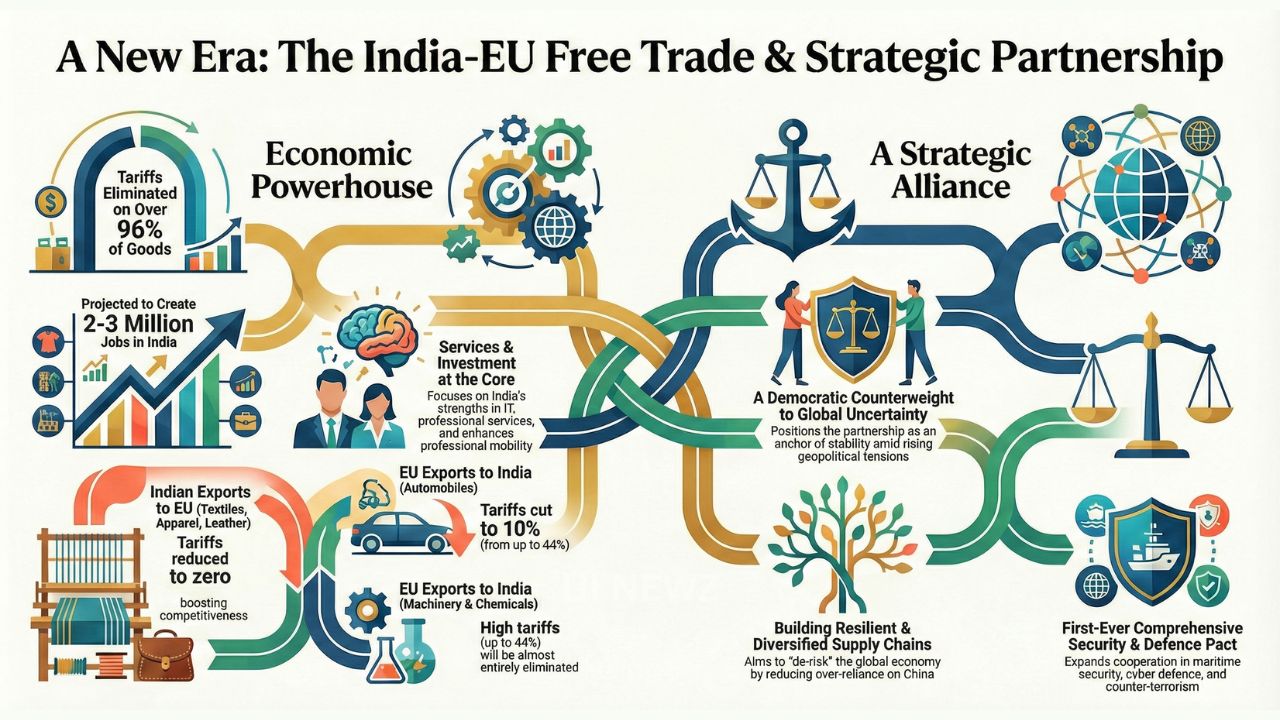
Prime Minister Narendra Modi, along with European Commission President Ursula von der Leyen and European Council President Antonio Costa, jointly announced the agreement at the 16th India-EU Summit in New Delhi. The pact, which negotiators call the “mother of all deals,” will eliminate or reduce tariffs on over 96% of goods traded between the two economies.
Indo-EU FTA: What the Agreement Covers
The India-EU Free Trade Agreement spans 24 chapters covering goods, services, investment, digital trade, small and medium enterprises, and regulatory cooperation. According to Commerce Secretary Rajesh Agrawal, official-level negotiations concluded on January 26, with both sides describing the deal as balanced and forward-looking.
Trade Impact and Projections
India’s bilateral trade with the EU stood at $136.53 billion in 2024-25, including exports worth $75.85 billion and imports of $60.68 billion, according to government data. The EU is currently India’s largest goods trading partner, accounting for approximately 11.5% of total Indian trade.
EU officials estimate the agreement will potentially double EU goods exports to India by 2032, saving European exporters up to €4 billion annually in duties. For India, foreign affairs experts project exports could increase from $130 billion to approximately $200 billion, while EU exports to India may rise from $80 billion to around $150 billion.
Tariff Reductions: Sector-by-Sector Breakdown
The agreement provides significant tariff cuts across multiple sectors:
For Indian Exports:
- Textiles, apparel, leather and footwear: Tariffs reduced to zero on approximately $33 billion worth of exports
- Gems and jewellery, handicrafts, and engineering goods: Enhanced market access
- Marine products and processed foods: Improved competitiveness
- Agricultural commodities, including tea, coffee, spices, fruits and vegetables: Stronger market positions
For EU Exports to India:
- Machinery: High tariffs of up to 44% will be largely eliminated
- Chemicals: Import duties of up to 22% mostly removed for nearly all products
- Pharmaceuticals: Duties of up to 11% face near-total elimination
- Automobiles: Tariffs gradually reduced to 10% with an annual quota of 250,000 vehicles
- Aircraft and spacecraft: Tariffs eliminated for almost all products
- Wine: Duties lowered to 20-30%
- Beer: Tariffs reduced to 50%
- Spirits: Cut to 40%
According to European Commission data, over 90% of EU goods exports to India will face reduced or zero tariffs under the agreement.
Employment and Economic Growth: Job Creation Forecast
Industry leaders and analysts project substantial employment gains from the trade deal. Foreign affairs expert Robinder Sachdev stated that the FTA is expected to create between 2 million and 3 million jobs in India as export volumes expand.
Labour-Intensive Sectors to Benefit
Raymond Group Managing Director Gautam Singhania highlighted textiles as a major beneficiary, noting the sector remains among India’s largest employers. Zero-duty access to the EU market would benefit both the sector and the broader economy, he stated.
The agreement particularly supports workers in labour-intensive industries, including textiles, leather goods, footwear manufacturing, gems and jewellery, and engineering sectors. These industries employ millions across India and are expected to see enhanced competitiveness in European markets.
Services Sector and Professional Mobility
The FTA includes a comprehensive framework for business mobility covering short-term, temporary and business travel in both directions. The EU has offered commitments in 37 sectors for Contractual Service Suppliers and 17 sectors for Independent Professionals, including computer services, research and development, and education services.
Indian services exports to the EU, estimated at $45-50 billion annually, are concentrated in information technology, professional services, engineering, and business services. The agreement provides entry and working rights for dependents and family members of Intra-Corporate Transferees.
India has also secured a framework to engage on Social Security Agreements over a five-year period, along with provisions supporting student mobility and post-study work opportunities.
Background: Nearly Two Decades of Negotiations
Trade talks between India and the EU began in 2007 but stalled in 2013 due to disagreements over automobiles, dairy products, intellectual property rights, labour standards, and data protection. Negotiations remained suspended for nearly a decade.
The talks formally relaunched in June 2022, with renewed political commitment from both sides. Since then, multiple rounds of high-level engagements accelerated progress, including meetings between Prime Minister Modi and EU leaders at G7, G20 summits and bilateral visits.
In February 2025, the EU College of Commissioners, led by President von der Leyen, visited New Delhi, the first-ever such visit to a bilateral partner outside Europe. This demonstrated the elevated strategic priority both sides assigned to the relationship.
Sensitive Sectors Protected
India has safeguarded certain sensitive agricultural sectors, including dairy, cereals, poultry, soymeal, and select fruits and vegetables. The EU similarly protected its beef, sugar and rice markets. These exclusions balanced export growth objectives with domestic economic priorities.
Strategic and Geopolitical Significance
The India-EU FTA arrives amid rising global trade tensions and shifting geopolitical alignments. The agreement carries significance beyond commerce, positioning both partners as anchors of stability in an increasingly fragmented world economy.
Countering Trade Uncertainty
The deal provides India with an alternative anchor amid US tariff pressures. Since the United States imposed tariffs of up to 50% on certain Indian exports, New Delhi has actively diversified its export markets. The EU agreement follows trade pacts with the United Kingdom, Oman and New Zealand signed in recent months.
Strategic affairs analyst Brahma Chellaney described the pact as strategic insurance, positioning India and the EU as a democratic counterweight to China’s state-centric trade model while blunting the impact of weaponized tariffs. India seeks to reduce overreliance on both the US and China amid chronic tariff uncertainty, he stated.
For the EU, the agreement secures access to the world’s fastest-growing major economy while supporting efforts to de-risk from China and diversify trading partners.
China Factor and Supply Chain Resilience
Both New Delhi and Brussels face structural economic exposure to China. For Europe, this spans rare earths, clean technologies and advanced manufacturing inputs. India’s exposure is embedded across electronics, industrial components and digital ecosystems, with Chinese production accounting for nearly 40% of India’s electronics and telecommunications imports.
The FTA supports efforts by both sides to reduce dependence on China-centric supply chains and build more resilient economic networks. External Affairs Minister S Jaishankar stated that stronger India-EU relations could help de-risk the global economy through cooperation on resilient supply chains.
Democratic Alliance in Uncertain Times
EU Council President Antonio Costa described the agreement as sending a clear message: “At a time when the global order is being fundamentally reshaped, the European Union and India stand together as strategic and reliable partners.”
The partnership rests on shared values including democracy, rule of law, pluralism, and commitment to a rules-based international order. President von der Leyen stated at the World Economic Forum that Europe and India were choosing “fair trade over tariffs, partnership over isolation, and sustainability over exploitation.”
Security and Defence Partnership: New Strategic Framework
Alongside the trade agreement, India and the EU signed a comprehensive Security and Defence Partnership on January 27, 2026. EU High Representative for Foreign Affairs Kaja Kallas and Defence Minister Rajnath Singh exchanged documents establishing the first overarching defence and security framework between the two sides.
Cooperation Areas
The partnership establishes an annual EU-India Security and Defence Dialogue and expands cooperation across:
- Maritime security, including counter-piracy operations
- Defence industry and technology collaboration
- Cyber and hybrid threats
- Space cooperation
- Counterterrorism and counter-radicalization
- Non-proliferation
- Peace operations and crisis management
According to a draft document, the EU and India will explore possibilities for Indian participation in European defence initiatives where there is mutual interest and alignment of security priorities.
The partnership builds on existing cooperation, including joint maritime activities between Indian naval forces and EU Naval Force focused on counter-piracy efforts conducted in June 2025. India participated in the EU project ‘Enhancing Security Cooperation in and with Asia and the Indo-Pacific’ (ESIWA+).
Strategic Context
The partnership responds to what officials describe as an increasingly challenging strategic environment. While Russia defines Europe’s immediate security concern and China shapes India’s strategic calculations, both face shared pressures, including weaponized interdependence and a fraying rules-based system.
The security agreement places India’s defence ties with the 27-member EU bloc on par with partnerships the EU maintains with Japan and South Korea.
What Happens Next: Implementation Timeline
The political conclusion announced on January 27 marks a significant milestone, but several procedural steps remain before the agreement enters into force.
Legal and Ratification Process
The legal text will now undergo technical scrutiny and translation into all EU languages. In India, the Union Cabinet must approve the final agreement. In the EU, the deal requires approval from the European Parliament and ratification by all 27 member states.
Officials from both sides indicated the agreement is expected to be signed later in 2026 and could enter into force in early 2027, subject to completion of all approval processes.
Parallel Agreements
Beyond the FTA, India and the EU are negotiating separate agreements on:
- Investment Protection Agreement
- Geographical Indications Agreement (to protect cultural and culinary heritage products)
- Security of Information Agreement (to facilitate the exchange of classified information)
Trade and Technology Council
The second ministerial meeting of the India-EU Trade and Technology Council took place in February 2025 in New Delhi, fostering cooperation in digital technologies, green technologies, and emerging tech sectors. This platform will continue guiding the implementation of technology-related provisions.
Broader Strategic Roadmap: Beyond Trade
The 16th India-EU Summit adopted a new Joint Comprehensive Strategic Agenda to guide the partnership beyond the existing ‘India-EU Strategic Partnership: A Roadmap to 2025’ framework established in 2020.
Clean Energy and Climate Partnership
Phase III of the India-EU Clean Energy and Climate Partnership was adopted in November 2024. The EU committed €500 million over the next two years to support India’s greenhouse gas emission reduction efforts.
The European Investment Bank finances sustainable transport and urban mobility projects in select Indian cities. The EU has been a partner organization of the International Solar Alliance since 2018 and joined the Coalition for Disaster Resilient Infrastructure in March 2021.
Connectivity Initiatives
The India-EU Connectivity Partnership launched in 2021 strengthens cooperation across transport, digital infrastructure, and energy networks. In June 2025, both sides agreed on an administrative arrangement to advance trilateral development cooperation, enabling joint implementation of development projects in third countries.
India is a key partner in the India-Middle East-Europe Economic Corridor (IMEC), announced in September 2023 at the G20 Leaders’ Summit in New Delhi. The corridor involves collaboration with the United States, France, Germany, Italy, Saudi Arabia, and the UAE.
People-to-People Ties
As of 2024, approximately 931,607 Indian citizens resided in the EU. Indian professionals accounted for 20.8% of all EU Blue Cards issued in 2024 (16,268 cards). Over the past 20 years, more than 6,000 Indian students received Erasmus Mundus scholarships.
The ninth India-EU High-Level Dialogue on Migration and Mobility took place in November 2025, proposing a pilot European Legal Gateway Office in India for ICT professionals and exploring comprehensive mobility frameworks for young professionals.
Expert Analysis: Long-term Economic Impact
Trade economists and policy analysts view the India-EU FTA as a structural enabler of India’s economic growth ambitions rather than a short-term boost.
Scale and Scope
The European Union represents a $17 trillion economy spanning 27 countries with approximately 450 million people. India has not previously concluded a trade agreement with an economic bloc of comparable scale, regulatory integration, or purchasing power.
The pact represents approximately 25% of global GDP and one-third of global trade, according to Prime Minister Modi. This scale distinguishes it from India’s recent agreements with the UAE (goods trade around $85-90 billion), Australia (approximately $25-30 billion), or EFTA countries (under $20 billion combined).
Services at the Core
Unlike agreements focused primarily on tariff reductions in goods, the India-EU FTA places services and investment at its centre. India’s services exports to the EU far exceed services trade with Australia or the UAE, concentrated in IT, professional services, engineering, and business services.
This focus aligns with India’s comparative advantages and supports the country’s transition toward a more services-oriented economy.
Market Diversification
For Indian exporters, the agreement reduces dependence on the US market. India’s total exports to six major EU markets, the Netherlands, Germany, Italy, Spain, France and Belgium, were $43.8 billion in the nine months ending December 2025, compared to $65.88 billion for the US alone during the same period.
While the EU agreement does not replace the strategic importance of US-India trade relations, it provides valuable diversification at a time of heightened trade policy uncertainty.
Challenges and Considerations
Despite the optimistic outlook, analysts identify several challenges for effective implementation.
Regulatory Compliance
Indian exporters will need to meet stringent European standards on product quality, labour conditions, environmental protection, and food safety. Companies lacking capacity for compliance documentation may face barriers despite tariff reductions.
Competition Concerns
Increased European access to India’s services sectors, particularly financial and maritime services, may intensify competitive pressures on domestic providers. Some analysts express concern about the impacts on small-scale Indian businesses.
Agricultural Sensitivities
While the agreement excludes certain sensitive agricultural products, concerns remain about subsidized European agricultural products affecting Indian farmers. The balance between export opportunities and protecting domestic agriculture will require careful monitoring.
Implementation Timeline
The gap between political conclusion and actual implementation, potentially extending into 2027, means benefits will materialize gradually rather than immediately. Businesses must plan for transitional periods and phased tariff reductions.
Conclusion
The India-EU Free Trade Agreement represents more than a commercial pact. It establishes India and the European Union as anchor partners in a rapidly changing global order, bound by shared democratic values, economic complementarity, and strategic interests.
For India, the agreement supports economic integration with a major developed market, provides alternatives amid global trade tensions, and reinforces its position as a key supplier of goods, services and talent. The projected 2-3 million new jobs and doubling of bilateral trade volumes promise substantial economic benefits.
For the EU, the pact secures long-term access to one of the world’s fastest-growing economies, supports de-risking from China, and strengthens partnerships with like-minded democracies.
The simultaneous signing of the Security and Defence Partnership underscores the multidimensional nature of the relationship, extending cooperation from commerce to strategic security domains, including maritime security, cyber defence, and counterterrorism.
As Commerce and Industry Minister Piyush Goyal stated, this is indeed the “mother of all deals” not only in scale but in strategic significance. The successful conclusion of negotiations after nearly 20 years of starts and stops demonstrates both sides’ commitment to a long-term partnership despite short-term differences.
Implementation success will depend on effective regulatory cooperation, business adaptation to new opportunities, and sustained political commitment to the vision of a strong, stable, and prosperous India-EU partnership for the 21st century.
About the Author
