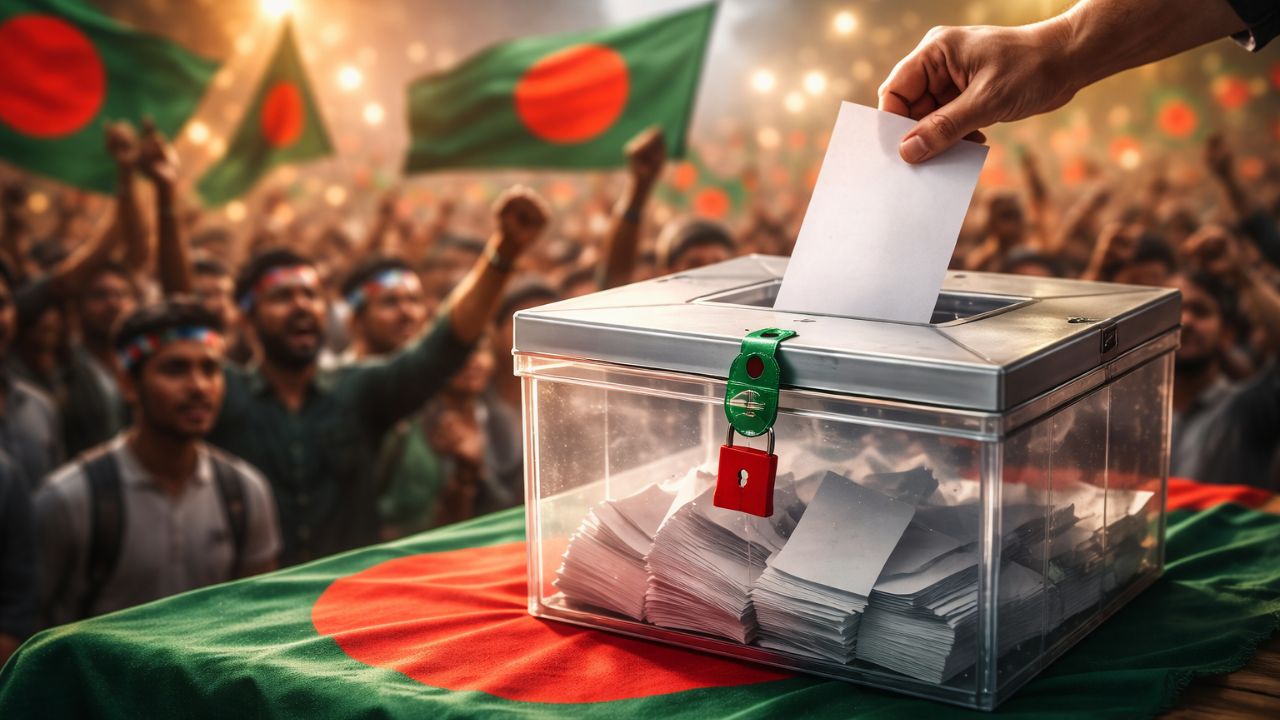
Bangladesh Election 2026: Eighteen months ago, students in Bangladesh took to the streets demanding reform of a job quota system. By August 2024, their protests had evolved into a nationwide revolution that forced Prime Minister Sheikh Hasina to flee the country, ending her 15-year authoritarian rule. On February 12, 2026, Bangladeshis went to the polls in what many describe as their first genuinely democratic election in over a decade, a historic moment shaped by sacrifice, hope, and the promise of political transformation.
Nearly 127 million eligible voters elected the next prime minister and parliament for a five-year term, making this the “biggest democratic exercise of the year”. But to understand why this election matters, one must first understand the revolutionary journey that made it possible.
How Did Bangladesh Get Here? The July Revolution
The story begins not with politics, but with protest. In early June 2024, the High Court Division of the Supreme Court invalidated a 2018 government circular, effectively restoring quotas in government jobs, including a 30 percent reservation for descendants of liberation war fighters. For students already struggling with high unemployment and limited opportunities, this felt like a betrayal of merit-based principles.
What started as peaceful campus demonstrations quickly escalated after Prime Minister Sheikh Hasina referred to protesting students as “Razakars”, collaborators with Pakistan, a deeply inflammatory term in Bangladesh’s independence narrative. Government law enforcement agencies and members of the ruling party conducted widespread suppression, resulting in numerous protester deaths in what became known as the July massacre.
According to the Office of the United Nations High Commissioner for Human Rights, protest-related deaths between July 15 and August 5, 2024, could be as high as approximately 1,400. Among the total reported deaths, 66 were children. The violence transformed what began as a quota reform movement into a full-scale uprising demanding Hasina’s immediate resignation.
By early August, the movement had evolved into a non-cooperation campaign. On August 5, 2024, Sheikh Hasina resigned as large crowds of demonstrators surrounded the prime minister’s residence, and she fled to India. Her resignation was announced by the Chief of the Army Staff, who confirmed the military would not fire on protesters.
Interim Government: Muhammad Yunus Takes Charge
Following Hasina’s departure, Nobel laureate Muhammad Yunus was appointed as Chief Adviser to head an interim government on August 8, 2024. The Yunus-led administration faced enormous challenges: restoring order, addressing demands for justice, implementing reforms, and preparing for credible elections.
The interim government established multiple reform mechanisms. Six reform commissions were created covering the judiciary, election system, public administration, police, Anti-Corruption Commission, and constitution. Additionally, the government drafted the July Charter, endorsed by 30 political parties, proposing constitutional, administrative, and electoral reforms.
Perhaps most significantly, the government revived the International Crimes Tribunal to address human rights abuses from the Hasina era. In November 2025, a court in Dhaka sentenced Hasina to death in absentia for her role in the unrest.
Who Is Running in the 2026 Election?
The February 12, 2026, election represents a dramatically transformed political landscape. The Awami League’s registration was suspended by the election commission, nullifying its ability to field candidates in the polls, leaving Hasina’s party, winner of the previous four elections, absent from the contest.
In total, 1,981 candidates are contesting, including 249 independent ones, from 51 participating parties. The race has shaped up as a direct contest between Tarique Rahman’s Bangladesh Nationalist Party and a coalition of 11 parties led by the resurgent Jamaat-e-Islami party’s chief, Shafiqur Rahman.
Bangladesh Nationalist Party (BNP): Led by Tarique Rahman, son of the late former Prime Minister Khaleda Zia, the centre-right BNP leads a coalition of 10 parties. Opinion polls suggest Tarique Rahman is the frontrunner for prime minister. The BNP boycotted the controversial 2024 election that gave Hasina her fifth term, making this their first real electoral contest in years.
Jamaat-e-Islami Alliance: The Islamist party, previously banned under Hasina, is now fielding candidates across the country. Their alliance includes the National Citizen Party (NCP), formed by student leaders from the 2024 uprising. However, this alliance has generated controversy, as Jamaat-e-Islami has not put forward a single woman candidate, disappointing many who participated in the revolution.
Constitutional Referendum: Dual Ballot Papers
Alongside parliamentary elections, voters participated in a constitutional referendum on the July Charter using pink ballots, while white ballots were used for parliamentary voting. The referendum proposes significant institutional changes, including the creation of a bicameral legislature, limits on prime ministerial tenure, and constitutional recognition of the 2024 uprising.
Election officials noted that the vote count may take longer this time as it involves both the white parliamentary voting ballot and the pink ballots for the referendum.
How Did Voting Day Unfold?
Votes were cast across 42,761 polling centres in 64 districts for 300 parliamentary constituencies, with voting held in 299 constituencies after one election was cancelled following a candidate’s death. An additional 50 seats are allotted for women’s representation, distributed based on proportional representation.
Election Commission Senior Secretary Akhtar Ahmed reported that voter turnout stood at 47.91 percent by 2:00 pm on February 12. Official voting hours were from 7:30 am to 4:30 pm, though voters who had already entered polling centre premises were allowed to cast their votes after closing time.
Security was unprecedented. Bangladesh deployed massive security with approximately one million personnel, including the army, police, and paramilitary forces. The Election Commission utilized body cameras, drones, and IT-based systems for monitoring.
This election also marked a historic first: postal voting was facilitated for the first time, benefiting about 15 million overseas workers whose remittances form a vital part of the Bangladeshi economy.
Despite heavy security, several incidents occurred. Authorities arrested five people after a crude bomb explosion near a polling centre, and more than 100 pre-stamped ballot papers were recovered in one district, with two individuals detained. Jamaat-e-Islami accused fake voting at multiple polling stations in three parliamentary seats and demanded an immediate stop to proceedings.
What’s Different About This Election?
For Bangladeshis, the contrast with recent electoral history is stark. The 2024 election that brought Hasina’s fifth term was widely condemned internationally. The United States Department of State stated the January 2024 election was “not free and fair,” while the UK termed it “lacking the preconditions of democracy”. According to The Economist, Bangladesh “effectively became a one-party state” through that election.
The 2001 election marked the last clear transfer of power between major parties, when BNP secured 193 seats against the Awami League’s 62. Since the Awami League’s landslide victory in 2008, the party consolidated dominance through elections that opposition parties boycotted or that were marred by allegations of rigging.
International observers monitored the 2026 election extensively. A European Union mission led by Ivars Ijabs included 200 observers from 27 EU member states, Canada, Norway, and Switzerland, alongside observers from 45 countries in total.
Chief Adviser Professor Muhammad Yunus extended his congratulations and gratitude to the nation as voting concluded “in a peaceful, orderly, and festive environment”, stating that “the spontaneous participation of voters, the responsible conduct of political parties, the restraint shown by candidates, and the professionalism of all institutions involved demonstrated that our commitment to democracy remains unwavering”.
Why Does This Election Matter?
The 2026 Bangladesh election represents more than just choosing a government. It tests whether a student-led revolution can successfully transition a country from authoritarianism to democracy, a question with implications far beyond Bangladesh’s borders.
For the students who risked their lives, the stakes are deeply personal. Student protester Mirza Shakil told CNN the “revolution showed the power of what Gen Z can achieve”. Yet many also express concern that the two candidates most likely to lead Bangladesh are far from those who risked everything on the barricades, one is a 60-year-old political dynasty scion, the other a 67-year-old Islamist leader.
The new government will inherit significant challenges. Bangladesh’s economy, while recovering under the interim administration, faces persistent issues with inflation and unemployment. Roughly half of Bangladesh’s population is under 30, many struggling to find jobs matching their education, the very frustration that fueled the July Revolution.
Political reconciliation poses another challenge. From exile, deposed Prime Minister Sheikh Hasina has demanded cancellation of the elections, previously warning that excluding her party disenfranchises millions and risks instability. Her Awami League, despite being banned, still commands significant support among certain segments of society.
What Happens Next?
Vote counting began immediately after polls closed at 4:30 pm on February 12. A survey conducted by Eminence Associates for Social Development projects the BNP-led alliance could secure around 208 of the 300 directly elected seats, with the Jamaat-e-Islami-led alliance expected to win 46 seats. However, these are projections; official results will determine the outcome.
Early trends indicate a closely fought contest between BNP and Jamaat-e-Islami, with both sides neck and neck across several constituencies, though BNP Chairman Tarique Rahman is leading comfortably in his constituency.
Results are expected to emerge in the coming hours and days, marking the conclusion of Bangladesh’s most consequential election in over a decade. Whatever the outcome, this vote represents a remarkable journey from streets filled with protesters to polling stations filled with voters, a transition made possible by sacrifice, sustained by hope, and tested now by the complex realities of democratic governance.
For Bangladesh’s 127 million voters, particularly the young generation who led the revolution, this election is not just about choosing leaders. It is about reclaiming their country’s democratic future.
About the Author
