
Step outside in Bhagalpur, Talcher, or Asansol this April and the air itself feels hostile. Thermometers nudged 44°C. The tar on roads softens underfoot. School children are warned not to stand in the sun during assembly. And yet, when global weather monitors pulled together their lists of the world’s hottest places on a single April afternoon this year, they found something jaw-dropping: 95 of the planet’s 100 hottest cities were located inside one country – India.
This is not a freak statistic. It is the culmination of a decades-long collision between climate change, catastrophic urban planning, the systematic clearing of forests, and now the looming shadow of what scientists are calling a once-in-a-century climate event: a Super El Niño.

The Numbers That Should Alarm Every Indian
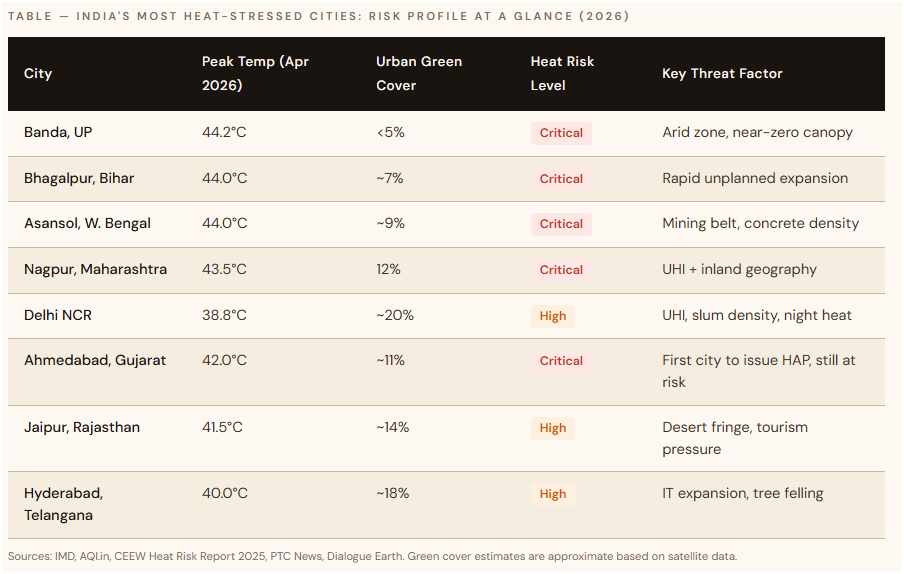
Data released by AQI.in on April 21, 2026 showed 19 of the 20 hottest places on earth were inside India that day. The India Meteorological Department had already sounded alerts – heatwave conditions were expected to persist across large swathes of the country, with temperatures likely to climb to 43°C across several regions. Bihar’s Bhagalpur, Odisha’s Talcher, and West Bengal’s Asansol led the charts at 44°C. Uttar Pradesh’s Banda touched 44.2°C.
These are not just weather readings. Behind each number is a story of a city that was built without thinking about heat – where concrete replaced trees, where pavements replaced wetlands, and where the poor were pushed into dense, airless slums with no cooling and no shade.
The Council on Energy, Environment and Water (CEEW), one of India’s foremost climate think-tanks, put it starkly in a landmark 2025 report: 57% of Indian districts – home to over three-quarters of the population – are now classified as being at high to very high risk from extreme heat. Risk, as the report defines it, is a combination of hazard, exposure, and vulnerability. By all three measures, India’s cities are failing their residents.
Urban Heat Island Trap: Concrete’s Deadly Arithmetic
Walk from a park into an Indian city’s dense commercial core and you can feel the temperature shift in your body within minutes. This is the Urban Heat Island (UHI) effect – and it is reshaping India’s liveability crisis one square kilometre at a time.
Cities in northern and central India – Delhi, Nagpur, Ahmedabad – sit in regions that already bear the brunt of India’s harsh pre-monsoon summers. But rapid urbanisation has made things catastrophically worse. Concrete and asphalt absorb solar radiation through the day and release it long after sunset, preventing cities from cooling at night. Researchers at the Indian Institute for Human Settlements have found that urban nighttime temperatures are now elevated enough that workers return home from a covered workplace to a house built of heat-trapping materials – and their bodies never get a chance to recover.
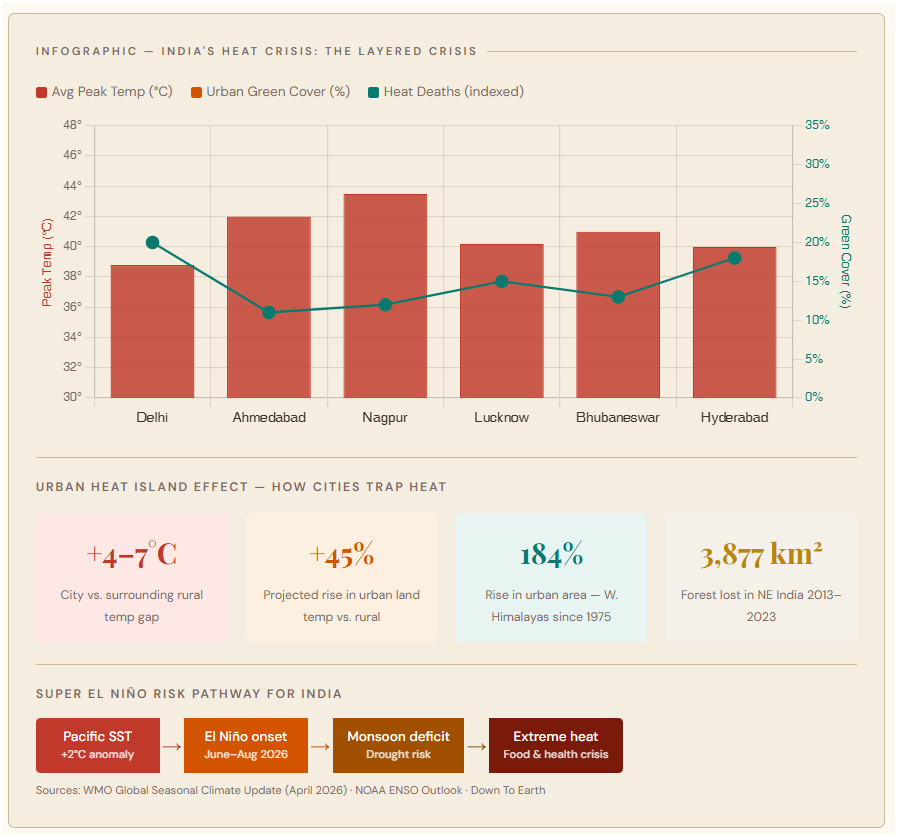
Research on Indian cities projects that mean urban land temperatures could rise by an additional 45% compared to surrounding rural areas. That gap – currently 4 to 7°C in many cities – will widen further as construction intensifies and green spaces disappear.
“You might work in a covered space, but if you return to a house made of heat-trapping materials with no ventilation, you don’t recover at night.”
– Researcher, Indian Institute for Human Settlements
Deforestation Debt: Paying for Development in Degrees
India’s cities are getting hotter partly because of what is being removed to build them: trees. According to the Food and Agriculture Organisation, India recorded one of the world’s highest deforestation rates between 2015 and 2020, losing an estimated 668,000 hectares of forest annually. Between 2013 and 2023, six northeastern states alone lost 3,877 square kilometres of forest cover – roughly the size of Goa.
Research by the Indian Institute of Remote Sensing (IIRS) found that urban expansion in the Western Himalayas increased by a staggering 184% between 1975 and 2015. In the same period, forest cover fell 11%, water bodies shrank 8%, and barren land surged by 30%. The researchers projected that by 2055, forests in the region could shrink by a further 9% as cities expand by another 63%.
In Hyderabad, Bengaluru, and Chennai, researchers have directly linked tree loss to hotter average summers. When urban forests at city outskirts are cleared for IT parks, highways, and ring roads, the shade, evapotranspiration, and micro-climate regulation they provided disappear overnight. What replaces them – asphalt, glass, steel – absorbs and radiates heat far more aggressively. In April 2025, students at the University of Hyderabad famously protested the Telangana government’s move to clear trees on a 400-acre tract for an IT park auction, a case that ended with a Supreme Court stay – a rare judicial precedent for urban forest protection.
Super El Niño Cloud on the Horizon
As if India’s structural heat vulnerabilities were not enough, climate scientists are now tracking the formation of what could become the most powerful El Niño event in over a century. The World Meteorological Organisation confirmed in its latest April 2026 update that sea-surface temperatures in the equatorial Pacific are rising rapidly, with El Niño conditions likely to emerge as early as May–July 2026 – and potentially intensifying through the year.
NOAA now places a 62% probability on El Niño development during June–August 2026. Multiple forecasting models suggest the sea-surface temperature anomaly in the equatorial Pacific could exceed 2°C above the long-term average – the threshold that climatologists use to classify events as “Super El Niño.” The last three such events occurred in 2015-16, 1997-98, and 1982-83; the 2015-16 event triggered widespread droughts, mass coral bleaching, and pushed global annual temperatures to what were then-record highs.
For India, the consequences would be acute. El Niño is historically associated with deficient southwest monsoon rainfall – the lifeblood of Indian agriculture – leading to drought, food inflation, and devastation for the 600+ million Indians whose livelihoods depend on rain-fed farming. Compounded by already scorching pre-monsoon temperatures, a strong El Niño could make the summer of 2026–27 a genuine humanitarian emergency.
Unplanned Growth: The Architecture of a Heat Trap
India’s urban population is growing at a pace that planning systems simply cannot match. The number of rural-to-urban migrants grew from 51.6 million in 2001 to 78.2 million in 2011 – and that number has only accelerated since. The urban slum population grew from 52.4 million to 65.5 million in the same decade. These millions overwhelmingly end up in what experts call “heat traps”: dense, poorly ventilated settlements built with heat-absorbing materials and lacking any green buffer.
City administrations, when they think about heat at all, tend to respond reactively – issuing water bells in schools, opening cooling shelters during peak hours, distributing oral rehydration salts. Delhi’s Heat Wave Action Plan 2026 is a step forward, mapping high-risk “heat island” zones, mandating construction halts during peak hours, and introducing a Cool Roof Policy to reduce heat retention in buildings. But urban climate experts point out that such emergency responses, however necessary, are a substitute for the structural change that India’s cities desperately need: more green space, better insulation standards, zoning laws that mandate shade and reflective materials, and a ban on clearing urban forests for commercial purposes.
Who Pays the Price?
It is not the air-conditioned office worker or the diplomat in a leafy cantonment area who bears the brunt of India’s heat crisis. It is the outdoor labourer – the construction worker, the delivery rider, the street vendor – who works through 44°C afternoons with no shelter. It is the domestic worker who commutes two hours through sun-baked streets. It is the family in a tin-roofed jhuggi in Delhi’s Yamuna floodplain or Mumbai’s Dharavi whose home becomes an oven by 11am.
Between 2000 and 2020, the India Meteorological Department recorded 10,545 heat-related deaths. Experts widely believe this to be a severe undercount, as most heat deaths are attributed to underlying conditions in death certificates rather than heat itself. The invisible disaster, as public health researchers call it, kills quietly and without headlines.
Is There a Way Out?
The answers exist. They are not technologically complex – they require political will. Urban foresters, climate scientists, and city planners are aligned on the broad prescription: mandatory tree-planting buffers in all new urban developments, cool roof and reflective pavement standards in building codes, a moratorium on clearing urban forests and peri-urban green belts, district-level cooling infrastructure for the poorest neighbourhoods, and – critically – long-term heat planning that does not wait for a heatwave to strike before swinging into action.
India’s scientific institutions and a growing network of civil society organisations are producing the data. The courts are, occasionally, enforcing protection. But the pace of urban expansion – fuelled by infrastructure ambition and real-estate pressures – continues to outrun the pace of adaptation. Until that changes, India’s cities will keep getting hotter, one summer at a time, until the heat stops being a news story and becomes simply the air everyone has to breathe.
(Sources: India Meteorological Department (IMD) · Council on Energy, Environment and Water (CEEW) Heat Risk Report 2025 · AQI.in City Temperature Data, April 2026 · World Meteorological Organisation Global Seasonal Climate Update, April 2026 · NOAA ENSO Outlook, April 6, 2026 · Down To Earth / CSE (Super El Niño analysis) · Indian Institute of Remote Sensing (IIRS), LULCC study · Dialogue Earth / Mumbai Climate Week reporting · Sustainable Futures Collaborative, HAP Implementation Analysis · National Disaster Management Authority 2025 Advisory · Global Forest Watch · Food and Agriculture Organisation · TERI (The Energy and Resources Institute) Urban Forest Report · Scientific Reports journal – “Heat waves characteristics intensification across Indian smart cities” (2023, Nature portfolio) · India State of Forest Report (ISFR) 2023/2024)
About the Author
