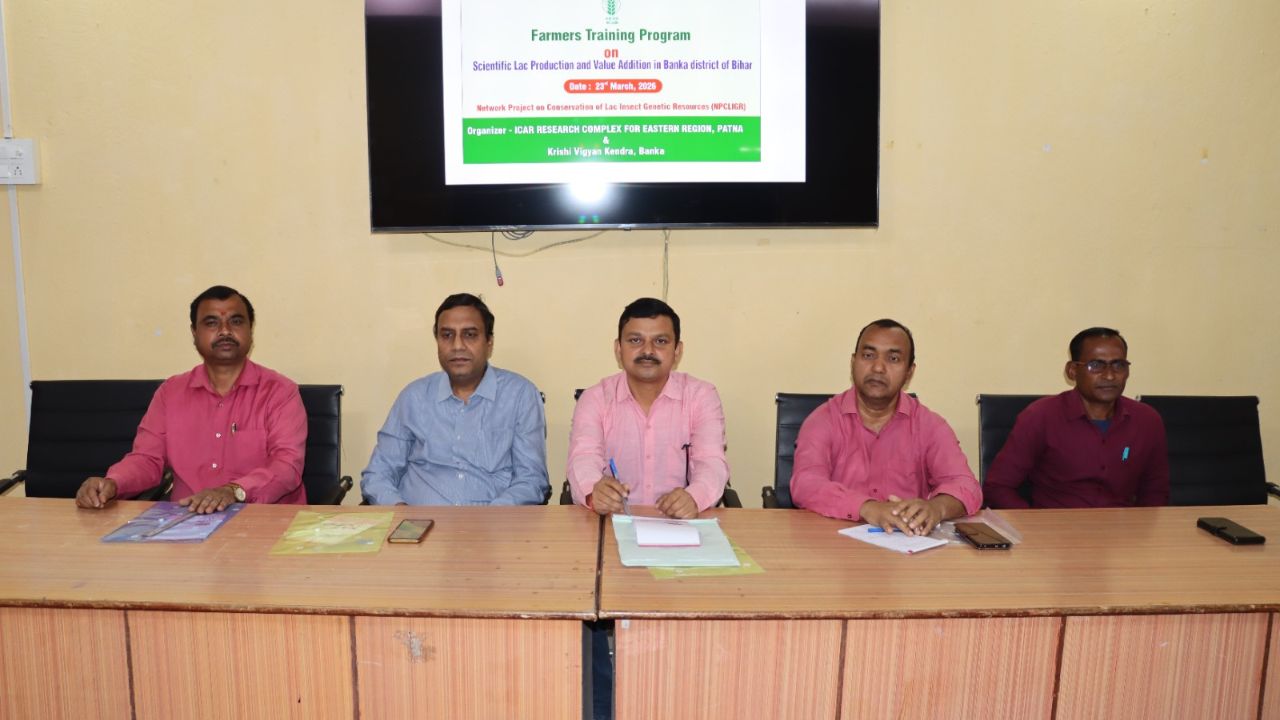
A farmers’ training programme on “Scientific Lac Production and Value Addition” was successfully organized on 23rd March 2026 in Banka district of Bihar under the Network Project on Conservation of Lac Insect Genetic Resources (NPCLIGR). The programme was jointly conducted by ICAR–Research Complex for Eastern Region, Patna and Krishi Vigyan Kendra, Banka.
The training focused on enhancing farmers’ skills in scientific lac cultivation, covering host management, brood lac selection, pest control, and post-harvest practices, with emphasis on value addition and market linkages to boost income.
Dr. Abhishek Kumar, PI, NPCLIGR highlighted that Banka has strong potential for lac cultivation due to favorable agro-climatic conditions. He emphasized that improved technologies and proper management can enhance productivity and quality, while conservation of lac genetic resources is essential for sustainability. He further stressed the need for regular capacity building, technical guidance, and stronger market linkages with value addition to boost farmers’ income. Highlighting its economic viability, he noted that with an input cost of less than ₹100 per tree, farmers can produce 4–5 kg lac worth over ₹1000 per tree, with abundant host plants like palas and semialata supporting production. He also emphasized the importance of scientific brood lac inoculation and timely harvesting for ensuring better yield and quality. He added that lac cultivation can emerge as a sustainable livelihood option, especially for small and marginal farmers in the region.
Adding to this, Dr. Brijendu Kumar, Head, KVK Banka stated that lac cultivation has immense potential to enhance farmers’ income in the district if scientific practices are adopted effectively. He emphasized that KVK will continue to provide field-level support, demonstrations, and regular guidance to ensure better adoption among farmers.
Dr. Anup Das, Director, ICAR–RCER, Patna, in his message, conveyed that lac cultivation is a promising livelihood option, particularly for small and marginal farmers. He underscored the need to integrate scientific approaches with traditional knowledge and highlighted the importance of continuous training, technical support, and market-oriented interventions for sustainable development.
Dr. Monobrullah, Co-PI, NPCLIGR; Dr. Sanjeev Kumar, Head, DCR, ICAR–RCER, Patna; Dr. Sanjay Kumar Mandal, SMS, KVK Banka, along with other team members, contributed significantly to the successful conduct of the programme.
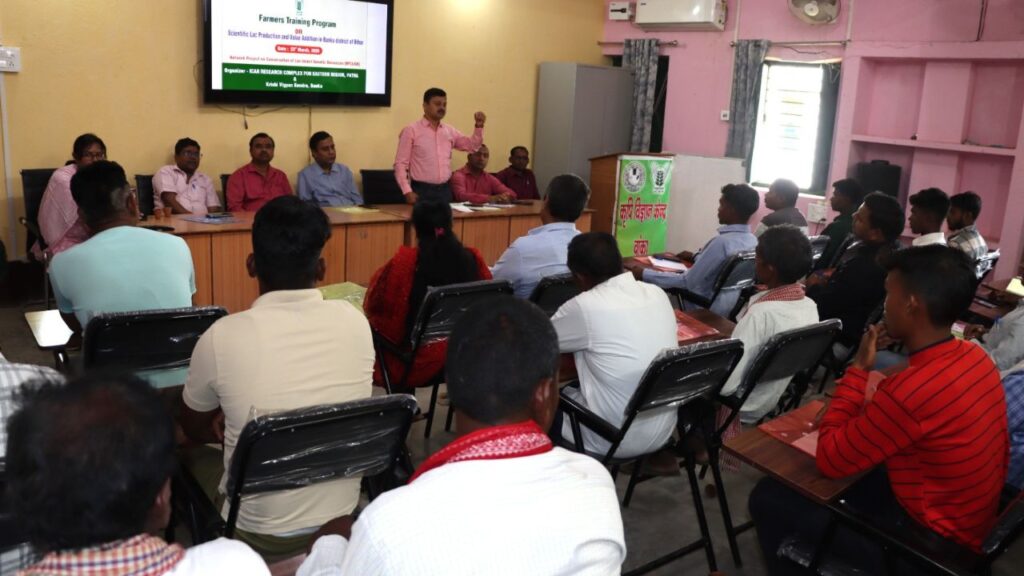
During the interaction, progressive farmer Munshi Marandi noted that lac can also be cultivated on sarifa (custard apple) and arhar (pigeon pea). Farmers expressed satisfaction, gaining practical knowledge on brood management, pest control, and value addition, boosting their confidence to adopt improved practices. “The programme witnessed the participation of around 50 farmers from Hirmoti village (Banka block), Bengalgarh (Chandan block), and Pakadwa and Medha villages (Katoriya block), including six women farmers, reflecting growing interest and inclusivity in lac-based livelihoods”, said Umesh Kumar Mishra, Member Secretary, Media, ICAR-RCER, Patna.
About the Author
