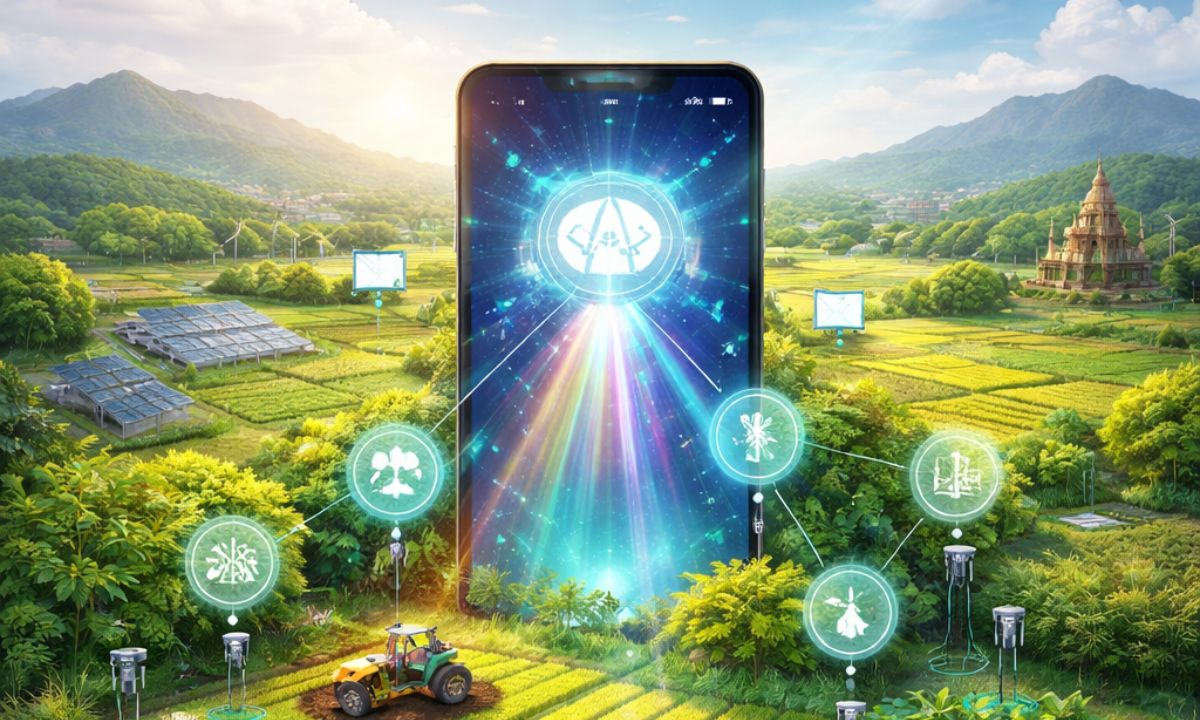
The Union Budget 2026–27 marks a bold shift toward technology-driven agriculture with the announcement of Bharat-VISTAAR – a multilingual, AI-powered advisory platform designed to transform how Indian farmers access knowledge, take field-level decisions, and manage environmental and market risks. Positioned at the intersection of AgriStack, Indian Council of Agricultural Research (ICAR) knowledge systems, and exponential artificial intelligence, Bharat-VISTAAR represents one of India’s most ambitious digital public infrastructure initiatives for agriculture.
At its core, Bharat-VISTAAR (Virtually Integrated System to Access Agricultural Resources) aims to democratize agricultural intelligence, ensure equitable access to quality advisories, and strengthen the link between scientific research and local farming realities. With India’s farm sector confronting climate uncertainty, shrinking landholdings, input inefficiencies, and growing market volatility, the platform is envisioned as a catalyst for precision agriculture, risk reduction, and productivity enhancement.
A Digital Leap: Integrating AgriStack Data With ICAR Expertise
A defining feature of Bharat-VISTAAR is its integration of two powerful national datasets:
1. AgriStack Portals
AgriStack consolidates farmer identities, land records, crop histories, soil profiles, weather data, and scheme-related information across ministries and states. By layering this information, the platform can:
- Understand each farmer’s socio-economic context
- Map landholding and cropping patterns
- Analyse historical trends and vulnerabilities
- Identify farmer entitlements and scheme eligibility
2. ICAR’s Package of Agricultural Practices (PoP)
ICAR’s validated practices – covering seeds, soil management, irrigation, crop protection, and harvesting – represent decades of agronomic research. Integrating them with digital records enables:
- Accurate, location-specific advisories
- Standardized, research-backed recommendations
- Alignment of traditional knowledge with scientific inputs
Finance Minister Nirmala Sitharaman emphasized that this convergence will strengthen data-driven farm decisions, optimize input usage, and significantly reduce errors in crop management.
Multilingual, Localized, and Inclusive Advisory System
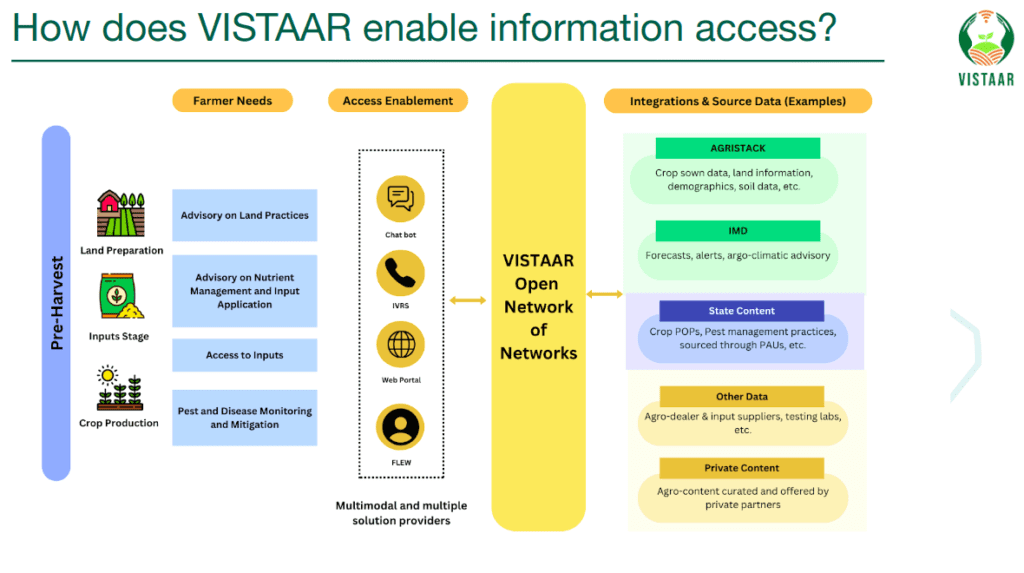
India’s agricultural workforce speaks over 120 languages and dialects, often limiting the reach of scientific advisories. Bharat-VISTAAR addresses this through multilingual AI models, capable of delivering guidance through:
- Local languages and dialects
- Voice-based IVR systems
- Chatbots and mobile apps
- Community centers and extension channels
This design ensures that small and marginal farmers, who constitute nearly 86% of India’s farming community, can access hyper-localized advisories without digital or linguistic barriers.
The platform provides:
- Region-specific crop advisories aligned with agro-climatic zones
- Alerts on weather anomalies, pest outbreaks, and disease risks
- Customized recommendations on seeds, fertilizers, irrigation, and market timing
- Guidance on government schemes, entitlements, and insurance
Supporting Precision Agriculture and Climate Resilience
Experts believe Bharat-VISTAAR will accelerate India’s shift toward precision agriculture, as it uses multiple data layers for calibrated decision-making. Precision farming requires understanding the interplay of:
- Soil health and moisture
- Weather forecasts and microclimate variations
- Plant nutrition demands
- Pest and disease life cycles
- Market conditions and input efficiency
By bringing these datasets under one AI-enabled advisory framework, Bharat-VISTAAR strengthens farmer resilience to:
- Erratic rainfall
- Soil degradation
- Temperature fluctuations
- Pest infestations
- Market unpredictability
CropLife India Chairman Ankur Aggarwal noted that integrating digital farmer records with validated practices can improve need-based field decisions, but emphasized that digital advisory must be strengthened by last-mile extension systems. Advisories are impactful only when delivered on time and adapted to local realities, he said.
Similarly, Susheel Kumar, Country Head & Managing Director of Syngenta India, welcomed the AI-driven approach, noting that it strengthens productivity, resilience, and sustainability at the field level.
VISTAAR as an Open, Interoperable Public Network
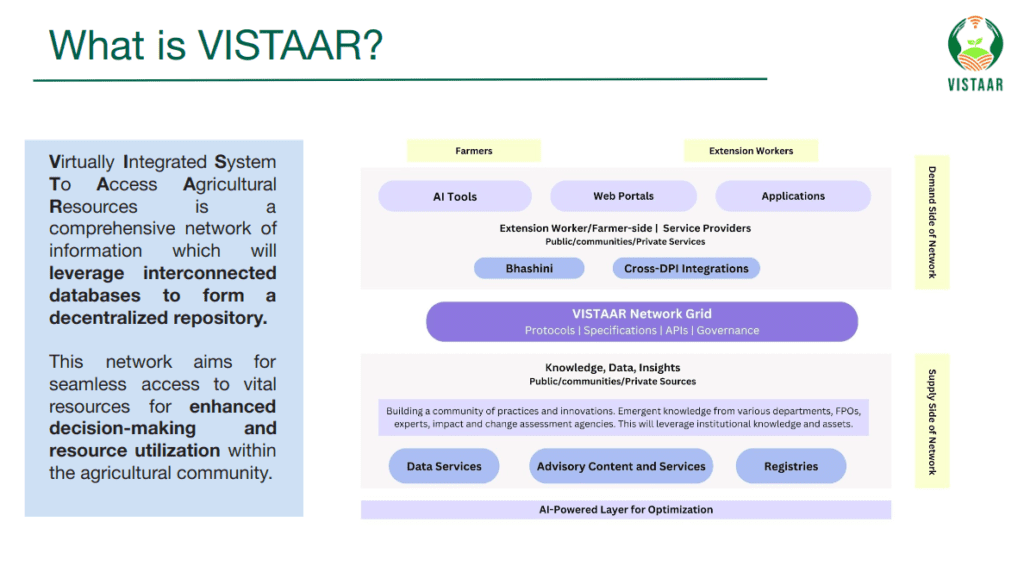
Unlike closed proprietary platforms, VISTAAR functions as an open, federated digital public infrastructure, enabling both private and public stakeholders to build upon its architecture. It is designed around the following service pillars:
1. Content Services
Discovery and dissemination of verified agriculture content, best practices, schemes, and skill-based learning modules.
2. Data Services
Secure access to datasets, farmer registries, crop and weather information, ensuring high-quality data flows across systems.
3. Registries
Decentralized, trusted records of farmers, service providers, agri-innovators, and experts.
4. Observation Services
Real-time monitoring of farms, inputs, climate patterns, and advisory outcomes.
Guiding Principles: Transparency, Trust, and Farmer Empowerment
Bharat-VISTAAR is built upon a strong value framework:
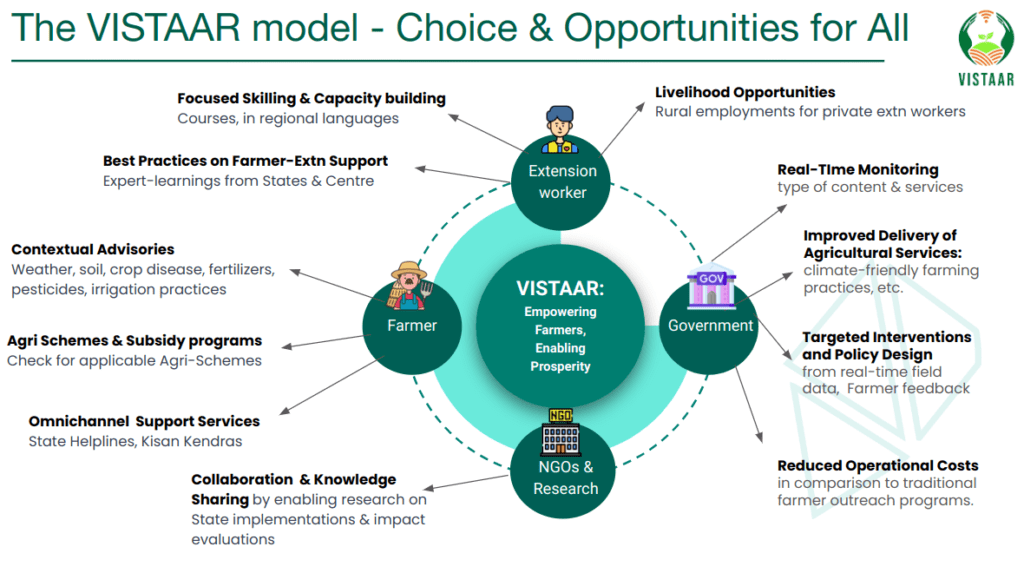
- Decentralized participation enabling states, FPOs, researchers, and innovators to contribute
- Autonomy for states to customise policies and contextualize advisories
- Open and transparent value flow across the ecosystem
- Interoperability allowing seamless discoverability across platforms
- Trusted, verifiable information, minimizing misinformation risks
- Community-driven empowerment, anchoring on farmer voices
- Explainable AI, ensuring transparency and farmer trust
- Inclusivity and diversity, allowing multi-stakeholder engagement
These principles ensure that advisories are not just data-driven, but also human-centered.
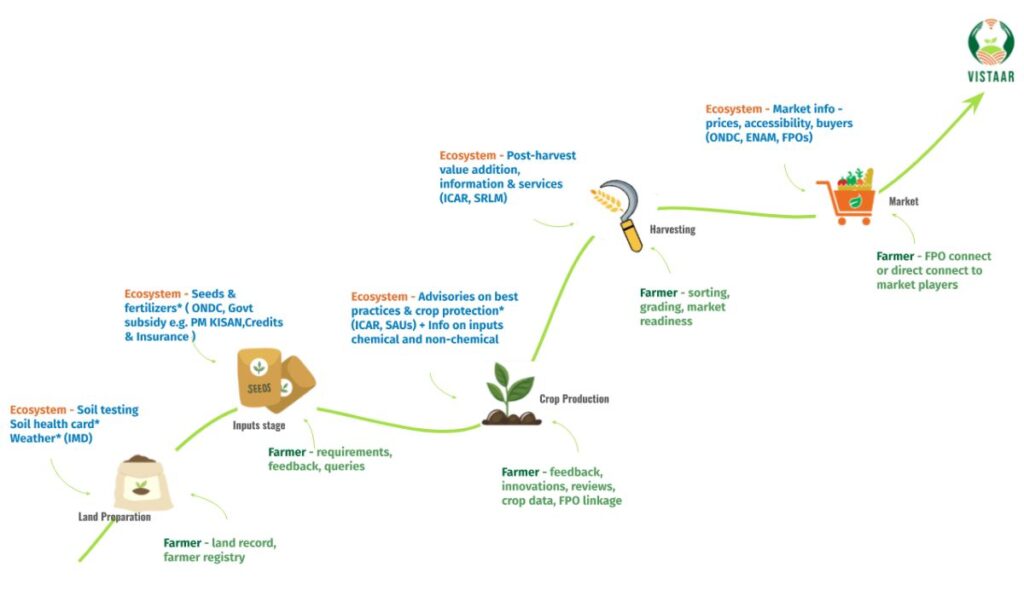
Bridging Research, Technology, and Field Realities
One of the long-standing gaps in Indian agriculture has been the disconnect between research institutions and field-level implementation. While ICAR and state universities produce valuable knowledge, its adoption at scale remains limited. Bharat-VISTAAR seeks to bridge this gap through:
- AI-powered translation of scientific research into simplified advisories
- Localization of recommendations according to soil and climate zones
- Strengthened digital extension systems
- Integration with Krishi Vigyan Kendras (KVKs), FPOs, and agri-startups
By federating access to validated data and advisories across platforms – IVR, chatbot, app channels – the system enhances discoverability, accuracy, and timeliness of information.
Impact Outlook: What Bharat-VISTAAR Means for India’s Farming Future
The platform is poised to influence India’s agricultural landscape in several transformative ways:
1. Higher Productivity
Personalized, data-backed recommendations optimize seeds, nutrients, irrigation, and crop protection.
2. Reduced Farming Risks
Predictive alerts on pests, diseases, market prices, and extreme weather strengthen preparedness.
3. Efficient Resource Management
Precision use of fertilizers, water, and inputs reduces costs and environmental impact.
4. Stronger Market and Scheme Linkages
Integrated data helps identify entitlements, scheme benefits, and opportunities.
5. Climate-Resilient Farming Systems
AI-driven modeling supports adaptation strategies aligned with India’s climate goals.
6. Democratized Access to Knowledge
Multilingual advisories empower even the most remote farmer communities.
Conclusion: A Future-Ready Agriculture Ecosystem
Bharat-VISTAAR is more than a digital advisory tool – it is a visionary attempt to create India’s most comprehensive, inclusive, and intelligent agricultural knowledge system. By combining multilingual AI, federated data networks, scientific practices, and field-level engagement, the initiative aims to usher in an era of precision, autonomy, and resilience in Indian agriculture.
As India prepares for a climate-challenged future, Bharat-VISTAAR stands as a cornerstone in its mission to empower farmers, elevate productivity, and build a sustainable farm economy grounded in technology and trust.
About the Author
