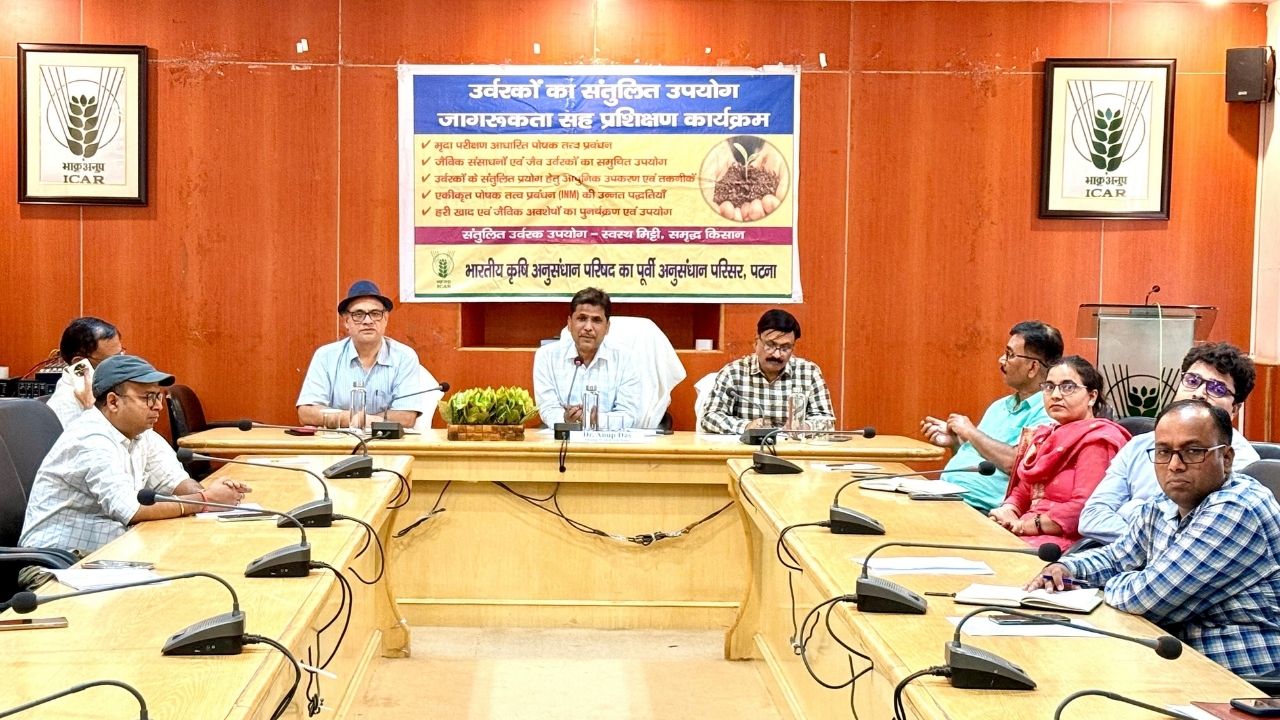
A joint coordination team meeting on the implementation of the balanced use of fertilizers campaign in Purnea district was organized at the ICAR–Research Complex for Eastern Region on April 22, 2026, in hybrid mode.
The meeting focused on addressing the excessive and imbalanced use of DAP fertilizer in Purnea, which has been identified among the top 100 DAP-consuming districts in the country. The session was chaired by Dr. Anup Das, Director, ICAR-RCER, Patna, and graced by Dr. Anjani Kumar, Director, ATARI, Patna. Participants included representatives from KVK Purnea, the district agriculture department, and Bhola Paswan Shastri Agricultural College, Purnea.
During the meeting, experts discussed strategies for promoting balanced fertilizer use, including integrated nutrient management, green manuring, cultivation of summer green gram, and the use of biofertilizers. Plans were made to conduct capacity-building programmes through training sessions and workshops to enhance farmers’ skills. A total of 100 demonstrations, each on green manuring/legume-based cropping systems and biofertilizer use, were proposed.
Experts also emphasized the need to move away from blanket fertilizer recommendations and adopt soil test-based and site-specific nutrient management approaches tailored to local agro-ecological conditions. The use of emerging alternatives such as nano fertilizers and liquid nutrient formulations was recommended to improve input efficiency and reduce dependence on bulk fertilizers like DAP.
In his remarks, Dr. Anup Das highlighted that rationalizing fertilizer use is essential not only for reducing input costs for farmers but also for maintaining soil health and ecological balance in the long term.
With Purnea witnessing a gradual shift from wheat to maize and makhana cultivation, scientists recommended revisiting crop-specific nutrient schedules to ensure efficient fertilizer use. The expanding cultivation of makhana in aquatic environments was also discussed, with a focus on developing scientific nutrient management practices to prevent indiscriminate fertilizer application and protect water quality.
The meeting further stressed the importance of strengthening field-level interventions through frontline demonstrations, farmer training programmes, and awareness campaigns to promote the economic and environmental benefits of balanced fertilization. Deliberations highlighted that the disproportionately high consumption of DAP in Purnea has led to skewed nutrient application, adversely affecting soil health, reducing fertilizer-use efficiency, and posing risks to long-term agricultural sustainability.
Participants agreed on a coordinated action plan involving research institutions, extension agencies, and line departments to ensure the effective implementation of the national campaign on balanced fertilizer use in Purnea district.
About the Author
