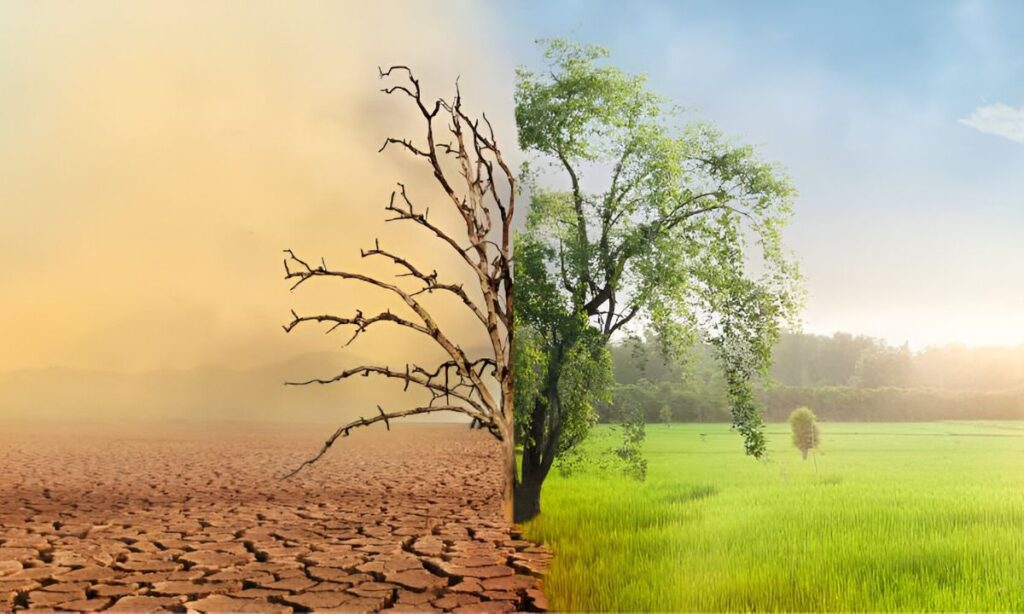
Three decades after the world began meeting annually under the UN climate convention, the numbers tell a brutal truth.
Global greenhouse gas emissions have risen, not fallen. Global GHG emissions grew by about 51% between 1990 and 2021. New estimates show that total global emissions reached roughly 53.2 gigatonnes of CO₂-equivalent in 2024, an increase of 1.3% over 2023. Energy-related CO₂ alone hit a record 37.8 GtCO₂ in 2024, up 0.8% in a single year, pushing atmospheric CO₂ concentrations to around 422.5 ppm, about 50% above pre-industrial levels.
The climate system is responding exactly as scientists warned – only faster.
- 2024 was the warmest year ever recorded, beating 2023’s record. Multiple datasets show global temperatures now roughly 1.46–1.55°C above pre-industrial levels, making 2015–2024 the ten hottest years in the entire instrumental record.
- The World Meteorological Organization reports that CO₂ levels are now the highest in at least 800,000 years, around 420 ppm in 2023, with 2024 likely higher.
- 2024 brought an avalanche of extreme events: lethal heat in Mexico and India, record marine heatwaves, Amazon drought, devastating floods in Europe and Africa – so many that NOAA and other agencies struggled to even maintain a complete tally.
If climate diplomacy was a new drug, this is the moment regulators would start asking whether it actually works.
So the uncomfortable question arises: if global talks and COPs have not yet bent the emissions curve in any visible way, are we over-investing political attention in them – and under-investing in preparing communities for the impacts that are now unavoidable?
This is not an argument to abandon climate negotiations. It is an argument to radically rebalance our priorities: from chasing ever-more ambitious statements on paper to putting money, technology, and local power into the hands of people on the frontlines.
Mitigation Mirage: When ‘Progress’ Doesn’t Show Up in the Atmosphere
On paper, the world has never looked so committed:
- Almost every country has a net-zero pledge of some sort.
- The Paris Agreement legally binds countries to submit and periodically strengthen national climate plans (NDCs).
- Hundreds of corporations have “science-based targets”.
Yet the UNEP Emissions Gap Report 2024 shows how wide the gap remains between climate talk and atmospheric reality:
- Under current policies, the world is on track for about 3.1°C of warming by 2100.
- Even if all current national pledges (NDCs) are fully implemented, the world would still heat by around 2.6°C.
- To have a cost-effective chance of limiting warming to 1.5°C, global emissions must fall by about 42% by 2030 compared to today’s levels – a transformation nowhere in sight.
In other words, the climate diplomacy machine is running at full speed, but it is mostly rearranging trajectories on slides, not in the sky.
And while we argue about wording – “phase-out” vs “phase-down” of fossil fuels – people living in informal settlements, smallholder farmers, fishers, women, children, and outdoor workers are already navigating a new climate reality with almost no protection.
Adaptation: Neglected Half of Climate Action
Climate action rests on two legs:
- Mitigation – cutting emissions so future warming is limited.
- Adaptation – preparing societies, economies and ecosystems to cope with the warming we can no longer avoid.
Mitigation still gets most of the attention, political capital, and finance. But the impacts of under-investing in adaptation are stark.
The UNEP Adaptation Gap assessments show:
- Developing countries will require around US$310–365 billion per year for adaptation by 2035 (in 2023 values).
- Actual international public adaptation finance is roughly US$26 billion per year.
- That’s a 12–14-fold gap between what vulnerable countries need and what the world is providing.
Even the proposed new global climate finance goal of US$300 billion per year by 2035 would barely cover current estimated adaptation needs, let alone future ones as impacts intensify.
This mismatch is not just a technocratic issue. It is a moral one.
injustice in numbers
- The poorest countries have contributed the least to cumulative emissions, yet face the worst climate impacts.
- Many are already spending scarce domestic resources on rebuilding after floods, cyclones, and droughts – money that could have gone to schools, health, or jobs.
Every year we delay serious adaptation, we lock in higher future losses: more children pulled out of school after disasters, more farmers falling into debt, more health systems overwhelmed by heatwaves and vector-borne disease.
Where Adaptation Works: Evidence from the Frontlines
The good news is that when we do invest in communities, it works. We have hard evidence that properly designed, locally-rooted adaptation measures save lives and livelihoods.
1. Bangladesh: Cyclones that no longer kill hundreds of thousands
Bangladesh is often described as “ground zero” for climate vulnerability. Yet over the past decades it has become a global leader in adaptation.
A landmark study found that cyclone-related deaths in Bangladesh have declined more than 100-fold in 40 years: from about 500,000 deaths in 1970 (Cyclone Bhola) to 4,234 in 2007 (Cyclone Sidr), despite similar or stronger storm intensities.
The difference? A combination of:
- Dense networks of cyclone shelters
- Massive expansion of early warning systems and community volunteers
- Better embankments and coastal afforestation
- Public awareness and evacuation drills
Climate change is worsening cyclone risk, but preparedness has dramatically reduced mortality. This is adaptation in action.
2. Ahmedabad, India: Heat Action Plans that save lives
In 2010, Ahmedabad suffered a deadly heatwave, with nearly 1,300 excess deaths in a few weeks. Scientists and city officials responded with South Asia’s first Heat Action Plan (HAP) in 2013.
Evaluations show that after the HAP was implemented:
- More than 1,100 deaths per year were avoided on hot days, on average.
- Mortality on the hottest days (≥45°C) dropped by roughly 27% compared to pre-plan years.
The plan combined:
- Early seasonal heat forecasts and graded heat alerts
- Public messaging campaigns (hydration, avoiding peak afternoon exposure)
- Mapping and protecting vulnerable groups (slums, outdoor workers, elderly)
- Training health workers to recognise and treat heat stress
Today, Ahmedabad’s model has inspired heat action plans across India, and even experiments with “cool roofs” – reflective coatings on low-income housing roofs that cut indoor temperatures by 1–2°C and lower health risks.
3. Everyday, low-cost resilience
Around the world, similar community-level adaptation efforts are quietly reshaping risk:
- Cool roofs, shade structures and green corridors in cities to counter urban heat islands.
- Climate-resilient crops and water harvesting systems that help farmers survive erratic monsoons.
- Social protection and insurance that help households rebuild after floods instead of sliding permanently into poverty.
These interventions don’t make headlines like COP battles over commas and clauses. But they show what happens when we invest in people first, politics second.
What “Preparing Communities” Really Means
Shifting focus from high diplomacy to grounded resilience is not about giving up on emissions cuts. It is about recognizing that 1.5°C is already brushing past us, and even 2°C will bring massive disruption.
A serious pivot to community protection would prioritise at least five pillars:
1. Risk-informed local planning
- Integrate climate risk data (flood maps, heat index, landslide risk) into city masterplans, village development plans, and zoning.
- Restrict construction in high-risk zones; enforce building codes for heat, storm, and flood resilience.
- Use participatory planning so communities map their own risks and priorities.
2. Health systems ready for a hotter, wetter world
- Scale heat action plans nationwide in heat-prone countries, with clear roles for health departments, municipalities, and disaster agencies.
- Invest in surveillance and early warning for heat-related illness, vector-borne disease, and water-borne outbreaks.
- Design hospitals and clinics to remain operational during floods and storms.
3. Climate-resilient livelihoods
- Support diversification of incomes so farmers, fishers, and informal workers are not wiped out by a single failed season or storm.
- Invest in climate-smart agriculture: drought-resistant varieties, better soil moisture management, agroforestry.
- Create safety nets – cash transfers, employment guarantees, micro-insurance – explicitly linked to climate shocks.
4. Nature as infrastructure
- Restore mangroves, wetlands, and floodplains as natural buffers against storm surges and floods.
- Expand urban green infrastructure to reduce heat and absorb stormwater.
- Protect and rehabilitate degraded commons – forests, pastures, coastal ecosystems – that support rural resilience.
5. Locally-led adaptation and governance
- Shift adaptation finance directly to local governments, community groups, and grassroots organisations, instead of only large, top-down projects.
- Recognise and integrate indigenous and traditional knowledge on water management, cropping patterns, and ecosystem stewardship.
- Build accountability and transparency so communities can see how climate funds are used.
These are not theoretical bullet points. They are already working in pockets across Bangladesh, India, Africa, Latin America, and small island states. The problem is scale and speed, not proof of concept.
So, Do Climate Talks Still Matter?
Yes – but not in the way we often pretend.
Global climate negotiations are indispensable for:
- Setting long-term temperature and finance goals
- Defining rules for carbon markets, transparency, and accounting
- Creating political pressure on big emitters and financial institutions
However, if success continues to be measured mainly by how many countries sign up to “net zero by 2050” or agree to another vaguely worded “phase-down”, we will continue to win battles in conference halls while losing the war in villages, towns, and cities.
A more honest paradigm would:
- Treat adaptation and resilience as equal to mitigation, not an afterthought or consolation prize.
- Judge COP outcomes not only by gigatonnes “promised” but by lives and livelihoods actually protected.
- Channel a much larger share of climate finance into community-scale, locally-led adaptation, not just large infrastructure or corporate decarbonisation deals.
In practice, that means asking hard questions after every summit:
- How much new money is going into early warning systems, resilient housing, local health systems, and social protection?
- How many local governments can now access climate finance directly?
- How many frontline communities had a meaningful say in how funds are allocated?
From Climate Diplomacy to Climate Dignity
It is tempting to dismiss climate talks and COPs as a failure. The atmosphere certainly isn’t seeing the benefits yet.
But abandoning the only universal forum we have would be self-defeating. Instead, we need to drastically change what we expect from it.
The age of assuming that ambitious mitigation commitments alone will “solve” climate change is over. We have entered the age of consequences, where the central political question is:
How do we protect people’s lives, dignity, culture, and rights in a world that is already 1.5°C – and likely more – warmer than the one our institutions were built for?
That won’t be answered by another cleverly worded communiqué. It will be answered by whether a farmer has access to climate-resilient seed, whether a slum-dweller can sleep through a heatwave without risking their life, whether a coastal child has somewhere safe to run when the siren sounds.
Climate action that does not show up in the lives of communities is simply not climate action.
The sooner climate diplomacy centres that truth, the less brutal the coming decades will be.