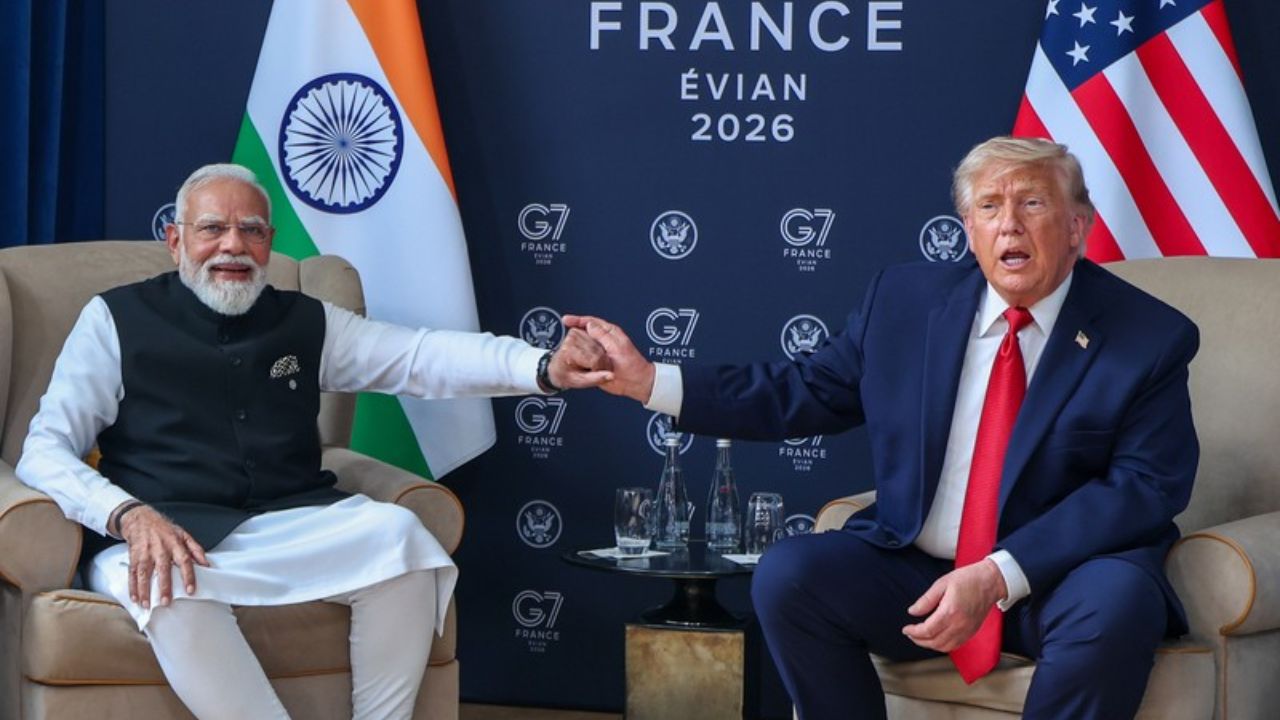
Prime Minister Narendra Modi participated in a high-level working session at the G7 Summit in Evian, France, on Wednesday, joining leaders from major economies and partner nations to discuss global cooperation, sustainable development, and international solidarity.
The session, titled “Forging New Partnerships and Rebuilding International Solidarity,” brought together heads of state and government from G7 member countries, invited partner nations, and senior representatives of key multilateral institutions, including the World Bank and the African Development Bank. The discussions focused on strengthening global partnerships, addressing emerging challenges, and enhancing cooperation to promote inclusive growth and stability.
French President Emmanuel Macron formally welcomed Prime Minister Modi and other participating leaders at the summit venue. Following the official welcome ceremony, leaders gathered for a group photograph before commencing deliberations. Sharing the photograph on social media, Prime Minister Modi emphasized the importance of collaboration among India and G7 nations in advancing global prosperity, sustainability, and human well-being.
Earlier in the day, the Prime Minister arrived in Evian on a two-day visit to attend the summit. In a message posted after his arrival, he expressed optimism about engaging with world leaders on pressing international issues. He reiterated India’s commitment to working with the global community to build a more sustainable, resilient, and prosperous future.
The G7 Summit holds significant importance for India as the country continues to play an increasingly influential role in global affairs. Over the years, India has emerged as a key voice representing the interests and concerns of developing nations, often referred to collectively as the Global South. Prime Minister Modi is expected to use the summit platform to advocate for issues such as equitable economic growth, climate action, energy security, food security, and reforms in global governance institutions.
India’s regular participation in the G7 outreach process reflects growing international recognition of its economic strength, diplomatic influence, and contribution to addressing global challenges. The country has consistently emphasized the need for inclusive development and stronger international cooperation in tackling issues ranging from geopolitical tensions to sustainable development goals.
Apart from attending the multilateral sessions, Prime Minister Modi’s visit includes a series of bilateral engagements with world leaders. On the sidelines of the summit, he is scheduled to hold separate meetings with Canadian Prime Minister Mark Carney, United Kingdom Prime Minister Keir Starmer, and President of the United Arab Emirates Sheikh Mohamed bin Zayed Al Nahyan. These discussions are expected to focus on strengthening strategic partnerships, enhancing trade and investment ties, and expanding cooperation in areas such as technology, energy, and security.
Later in the evening, Prime Minister Modi will attend a gala dinner hosted by President Macron for summit participants. The event is expected to provide an informal setting for leaders to exchange views on global developments and explore opportunities for deeper collaboration.
One of the most closely watched engagements during the summit will be Prime Minister Modi’s scheduled meeting with United States President Donald Trump. The meeting, expected to take place tomorrow, is likely to cover a broad range of issues, including trade, defense cooperation, technology partnerships, and regional security developments. The two leaders are also expected to exchange perspectives on key international challenges and explore avenues for further strengthening the India-US strategic partnership.
As global uncertainties continue to shape international politics and economics, India’s participation in the G7 Summit underscores its growing role as a bridge between developed and developing nations. Through its engagements in Evian, New Delhi aims to reinforce its commitment to multilateral cooperation while ensuring that the aspirations and concerns of the Global South remain central to global decision-making processes.
About the Author
