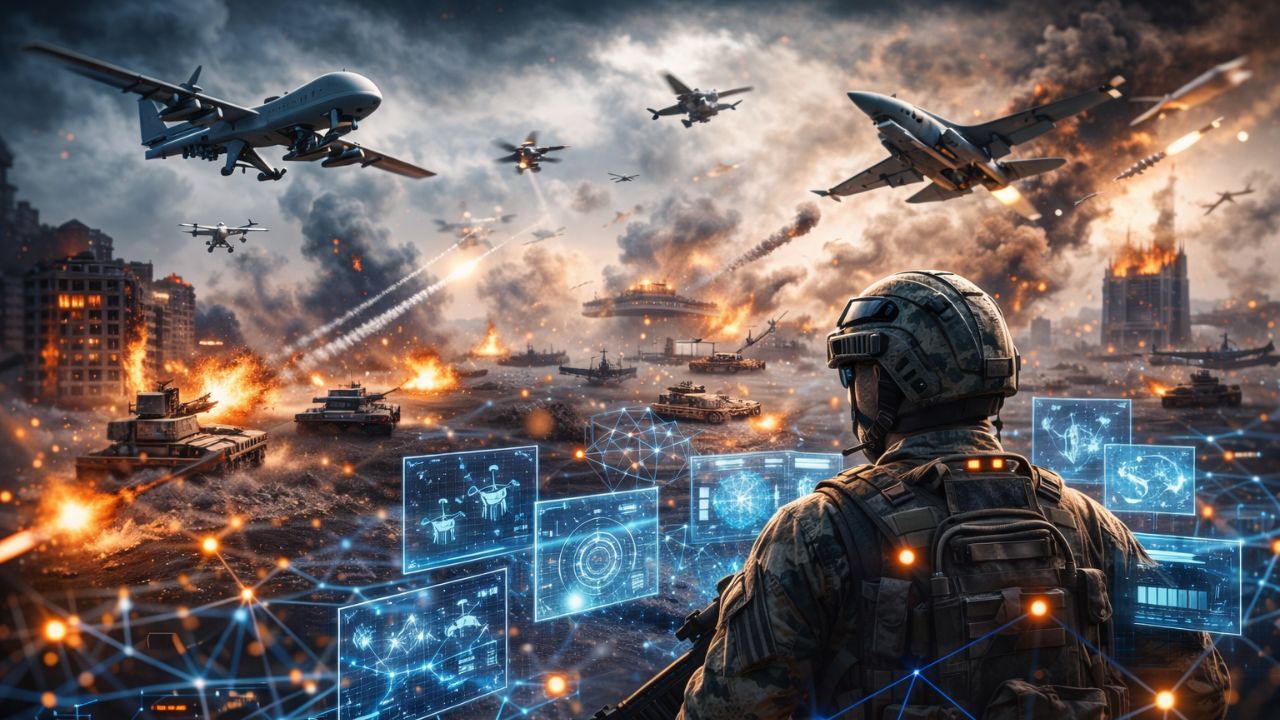
The character of warfare is undergoing a profound transformation in the twenty-first century. Traditional military doctrines that relied on centralized command structures, large platforms, and hierarchical decision-making are increasingly being challenged by a new strategic concept- Decentralised Mosaic Defence (DMD). This emerging doctrine reflects the realities of modern battlefields shaped by digital networks, autonomous systems, cyber capabilities, and multi-domain operations.
The idea behind mosaic defence is simple yet revolutionary: instead of relying on a few large and expensive platforms or centralized command structures, modern militaries can deploy many smaller, modular, and networked units that function collectively as a flexible combat system. Each unit acts as a “tile” in a mosaic, contributing to a larger operational picture while retaining the ability to function independently.
In an era defined by rapid technological change, hybrid warfare, and great-power competition, decentralised mosaic defence is emerging as a powerful framework to enhance resilience, adaptability, and deterrence.
Understanding the Concept of Mosaic Defence
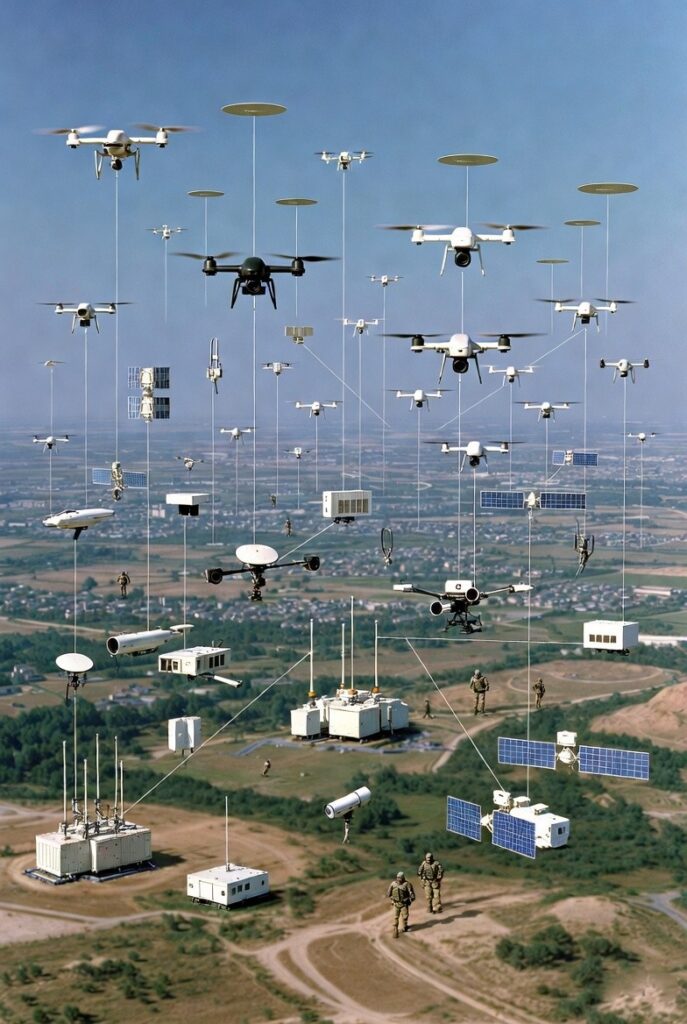
The concept of mosaic warfare was originally developed by the United States Defense Advanced Research Projects Agency (DARPA) as a strategy to address the limitations of traditional monolithic military systems. Instead of relying on rigid, high-value platforms such as aircraft carriers or advanced fighter jets, the mosaic approach uses a distributed network of diverse systems—drones, sensors, satellites, cyber assets, and ground forces—that can be combined dynamically for specific missions.
At its core, mosaic defence emphasises three principles:
- Decentralisation – Authority and operational capability are distributed across many nodes rather than concentrated in a central command.
- Modularity – Systems and units can be assembled or reconfigured rapidly depending on operational requirements.
- Networked coordination – Advanced digital networks allow dispersed elements to operate as a coherent force.
This approach enables military forces to adapt quickly to evolving battlefield conditions while creating uncertainty and complexity for adversaries.
Unlike conventional warfare models, where destroying a few key assets could cripple an entire force, a mosaic structure ensures that the system remains functional even if several components are neutralised.
Shift from Platform-Centric to System-of-Systems Warfare
For decades, military power has been defined by large, technologically sophisticated platforms- fighter aircraft, tanks, aircraft carriers, and missile systems. While these platforms remain important, they are also extremely expensive and vulnerable to advanced precision weapons.
Mosaic defence addresses this vulnerability by adopting a “system-of-systems” approach. Instead of a single platform performing multiple functions, capabilities are distributed among multiple smaller units. Sensors, communication systems, strike assets, and intelligence platforms are integrated through digital networks to create a flexible operational architecture.
For example:
- A satellite may detect an enemy target.
- A drone swarm may track the target.
- Ground-based missile systems may execute the strike.
- Cyber units may disrupt enemy communications simultaneously.
Each component contributes a specific capability, but the combined effect creates a powerful, integrated military response.
Decentralisation as a Strategic Advantage
A defining characteristic of mosaic defence is decentralisation. Traditional military structures rely heavily on centralized command and control, where operational decisions are made at higher headquarters and transmitted down the chain of command.
However, modern battlefields—characterised by electronic warfare, cyberattacks, and disrupted communications—make such centralized systems vulnerable.
In contrast, mosaic defence empowers local units with greater autonomy and decision-making authority, allowing them to respond rapidly to emerging threats without waiting for central approval.
This decentralised model offers several strategic advantages:
- Resilience: The destruction of one command node does not collapse the entire system.
- Speed: Local commanders can act immediately based on real-time intelligence.
- Flexibility: Units can reorganise dynamically to address new operational challenges.
In essence, decentralisation transforms military forces into adaptive networks rather than rigid hierarchies.
Integration with Multi-Domain Operations
Another critical dimension of mosaic defence is its integration with multi-domain operations (MDO). Modern conflicts are no longer confined to traditional land, sea, and air battlefields. They now extend into space, cyberspace, and the electromagnetic spectrum.
Mosaic warfare provides the technological and operational framework necessary to coordinate actions across these domains. Networked systems enable information from satellites, drones, cyber sensors, and ground forces to be shared instantly, creating a unified operational picture.
For instance:
- Space-based sensors provide surveillance.
- Cyber units disrupt enemy command networks.
- Air and naval platforms deliver precision strikes.
- Ground forces exploit the resulting tactical advantage.
By integrating capabilities across domains, mosaic defence enables militaries to achieve decision superiority and operational dominance.
Role of Emerging Technologies
The effectiveness of decentralised mosaic defence depends heavily on emerging technologies. Several technological developments are enabling this transformation.
Artificial Intelligence and Data Analytics
Artificial intelligence (AI) plays a critical role in processing vast amounts of battlefield data. AI systems can analyse information from sensors, satellites, and reconnaissance drones to identify threats and recommend tactical responses.
Autonomous Systems
Unmanned aerial vehicles (UAVs), autonomous underwater vehicles, and robotic ground platforms are essential components of mosaic warfare. These systems can perform surveillance, logistics, and strike missions without exposing human soldiers to risk.
Internet of Military Things (IoMT)
The concept of the Internet of Military Things connects various sensors, weapons systems, and platforms through secure networks, enabling real-time coordination and information sharing across the battlefield.
Advanced Communications Networks
Secure, resilient communication networks—including satellite communications and 5G-enabled battlefield networks—ensure that distributed units remain connected even in contested environments.
Together, these technologies create a digitally interconnected combat ecosystem capable of rapid adaptation and coordination.
Real-World Applications and Strategic Adoption
Several countries and military organisations are exploring or implementing elements of mosaic defence.
United States
The United States has been at the forefront of developing mosaic warfare concepts. DARPA and the U.S. Department of Defense have invested heavily in programmes that integrate sensors, platforms, and command systems into networked battle architectures.
Initiatives such as Joint All-Domain Command and Control (JADC2) aim to link sensors and weapons systems across all branches of the military, enabling seamless coordination between land, air, sea, space, and cyber forces.
Iran
Iran has adopted a version of decentralised mosaic defence within the structure of the Islamic Revolutionary Guard Corps (IRGC). The strategy involves dividing the country’s defence forces into multiple autonomous units capable of operating independently in the event of an invasion.
By dispersing command structures and empowering local commanders, the system is designed to create a resilient defence network that can sustain prolonged conflict and complicate enemy operations.
Other Countries
NATO members and Indo-Pacific nations are also studying mosaic warfare as a framework for future military transformation. The concept is increasingly viewed as essential for maintaining deterrence in an era of great-power competition and rapid technological change.
Implications for India’s Defence Strategy
For India, the concept of decentralised mosaic defence holds significant strategic relevance. The country faces complex security challenges across multiple domains, including contested borders, maritime security concerns, cyber threats, and space competition.
Adopting mosaic defence principles could enhance India’s ability to address these challenges through:
- Networked battlefield systems integrating Army, Navy, and Air Force capabilities
- Greater use of unmanned systems and drone swarms
- Integration of space-based surveillance with ground operations
- Enhanced cyber and electronic warfare capabilities
India’s ongoing defence modernisation programmes—combined with indigenous technological initiatives led by organisations such as DRDO and private-sector innovators—could provide the foundation for a mosaic-style defence architecture.
Challenges and Risks
Despite its advantages, decentralised mosaic defence also presents several challenges.
1. Cyber Vulnerabilities
Networked systems are inherently vulnerable to cyberattacks. If communication networks are compromised, coordination between units may be disrupted.
2. Complexity of Integration
Integrating diverse platforms, technologies, and military branches into a unified network requires advanced interoperability standards and extensive testing.
3. Ethical and Operational Concerns
The increasing use of autonomous systems and AI-driven decision-making raises ethical questions regarding accountability and control in combat operations.
Addressing these challenges will require robust cybersecurity frameworks, clear operational doctrines, and international dialogue on the responsible use of emerging military technologies.
Future of Warfare
Decentralised mosaic defence represents a fundamental shift in military thinking- from rigid, platform-centric forces to flexible, networked combat ecosystems.
As emerging technologies continue to reshape the battlefield, the success of future militaries will depend not only on the power of individual platforms but also on their ability to connect, coordinate, and adapt across complex operational environments.
In this evolving landscape, mosaic defence offers a compelling model for achieving resilience, agility, and strategic advantage. By leveraging distributed capabilities, advanced technologies, and multi-domain integration, it may well define the next generation of warfare in an increasingly interconnected world.
About the Author
