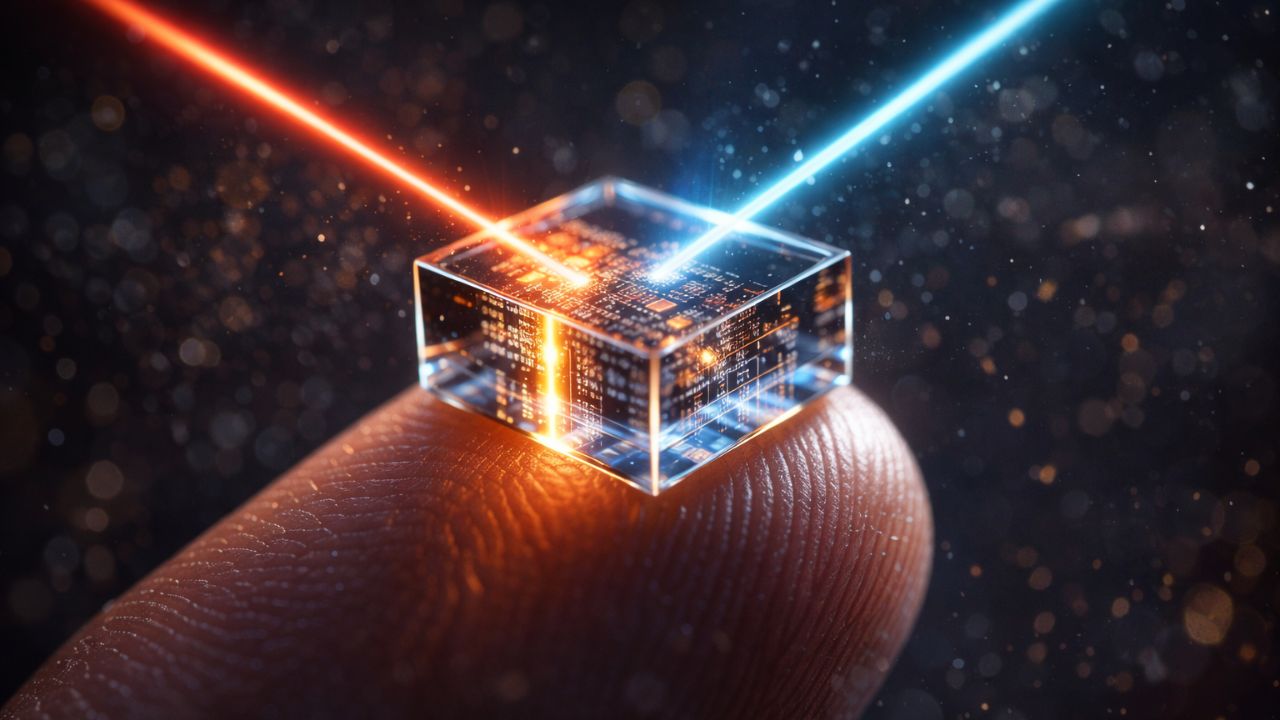
Microsoft Research has demonstrated a glass-based archival storage system that can preserve 4.8 terabytes of data, roughly equal to two million printed books, in a palm-sized glass square for over 10,000 years. The research, called Project Silica, was published in the peer-reviewed journal Nature on 18 February 2026.
The findings mark a significant step toward long-term digital storage that far outlasts conventional hard drives and magnetic tapes, which degrade within decades.
How the Technology Works
The system uses femtosecond laser pulses, each lasting just a few quadrillionths of a second, to create tiny three-dimensional structures called voxels inside a piece of glass. These voxels change how light travels through the material and can be read back later using an automated microscope. Because the data is embedded deep inside the glass itself, rather than on a surface coating, it is highly resistant to damage.
The glass square used in the study measures 12 centimeters across and is just 2 millimeters thick. At its highest density, the system stores 1.59 gigabits of data per cubic millimetre.
From Costly Glass to Common Cookware
A major achievement in this iteration of Project Silica is the shift from expensive, hard-to-manufacture fused silica glass to ordinary borosilicate glass, the same material used in kitchen cookware and laboratory glassware.
According to Microsoft Research, this change directly addresses two key barriers to commercialisation: cost and availability of materials. The new approach, utilizing what the team calls “phase voxels,” requires only a single laser pulse per data point, significantly simplifying the hardware stack. The reading system now requires just one camera instead of the three or four used previously.
Richard Black, a partner research manager at Microsoft Research who led the project, stated in a blog post accompanying the paper that glass is “incredibly protected from temperature, moisture, and dust”, and that keeping a piece of glass on a shelf does not cost very much.
Durability and Lifespan
To test how long the data would last, the researchers conducted accelerated ageing experiments, repeatedly heating inscribed glass samples to temperatures of up to 500 degrees Celsius. Their results suggest that data encoded using phase voxels would remain readable for more than 10,000 years at a temperature of 290 degrees Celsius, and likely far longer at normal room temperature.
This durability far exceeds that of current archival storage media. Standard magnetic tapes and hard drives typically degrade within 30 to 50 years.
Writing and Reading Speed
The system currently achieves a write speed of 65.9 megabits per second using four laser beams in borosilicate glass. The researchers note that using 16 or more beams simultaneously could increase this speed further. Machine learning models are used during the reading process to correct errors and accurately recover stored data.
The write speed, however, remains well below that of current commercial tape systems such as LTO-10, which write at 400 megabytes per second uncompressed. Experts say glass storage is more likely to emerge as a specialised, ultra-long retention tier rather than a full replacement for existing cold storage systems.
Project Silica
Microsoft began developing Project Silica in 2017, building on foundational research by scientists at the University of Southampton in the United Kingdom and Harvard University in the United States. The University of Southampton’s Peter Kazansky, a professor of optoelectronics, was among the first to demonstrate data storage in fused quartz glass with a long-term lifespan, in a 2014 paper.
According to market research firm International Data Corporation, the volume of data generated globally could reach 394 zettabytes by 2028, nearly three times the 2023 figure, making sustainable long-term archival storage an increasingly urgent challenge.
What Happens Next
Microsoft Research has said the research phase of Project Silica is now complete. In a statement accompanying the Nature paper, the company said it is “exploring options for how to apply the research learnings”. No commercialisation timeline has been announced. The research has been made publicly available for other scientists and organisations to build upon.
About the Author
