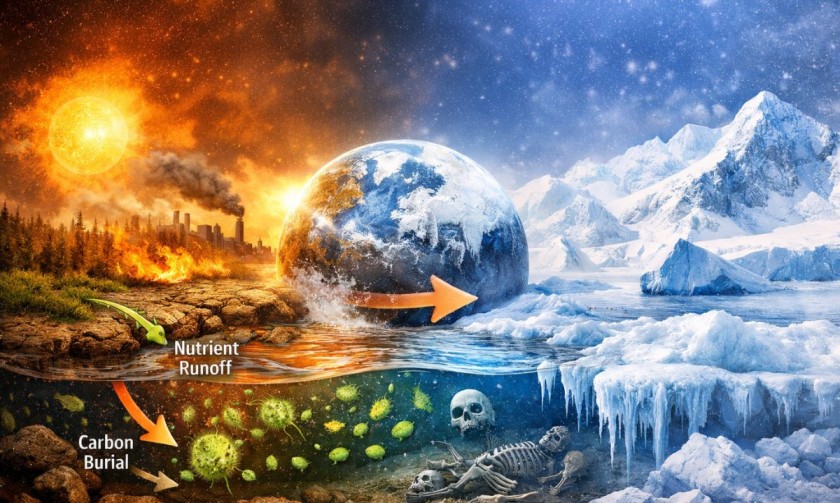
Global warming is usually discussed as a one-way problem. Rising temperatures, melting ice, stronger storms, and heat stress dominate climate conversations. But new research suggests Earth’s climate system may not always stop neatly at balance. Under certain conditions, warming could push the planet so far that it eventually flips into extreme cooling, even an ice age.
Scientists from University of California, Riverside have identified a missing feedback in Earth’s long-term carbon cycle. Their findings, published in Science, help explain why some ancient ice ages were far more severe than scientists previously understood.
This research does not suggest global warming will save us from climate change. Instead, it shows that Earth’s natural systems can overshoot, creating climate extremes over geological timescales.
How Earth Normally Regulates Its Climate
For decades, scientists believed Earth had a slow but reliable thermostat based on rock weathering.
The process works like this. Carbon dioxide in the air dissolves into rainwater. That rain falls on land and reacts with rocks, especially silicate rocks such as granite. Over time, these rocks break down and the carbon is carried by rivers into the ocean.
In the ocean, the carbon combines with calcium to form shells and limestone. These materials sink to the seafloor and lock carbon away for millions of years. As temperatures rise, weathering speeds up and removes more carbon dioxide, cooling the planet again.
This mechanism was thought to prevent Earth from drifting too far toward extreme heat or extreme cold.
Why Ancient Ice Ages Were So Extreme
Geological evidence tells a different story. Some of Earth’s earliest ice ages were so intense that ice covered almost the entire planet. These “snowball Earth” events cannot be explained by a gently self-correcting climate system.
This puzzle led researchers to search for an additional feedback that could push Earth beyond balance.
The Missing Link: Oceans, Nutrients, and Plankton
The newly identified feedback involves the ocean’s biological carbon pump.
As global temperatures rise, rainfall increases. This rain washes more nutrients such as phosphorus from land into the ocean. These nutrients feed plankton, tiny organisms that absorb carbon dioxide through photosynthesis.
When plankton die, they sink, carrying carbon to the ocean floor. This process removes carbon from the atmosphere and helps cool the planet.
But warming changes how this system behaves.
More plankton growth can reduce oxygen levels in the ocean. In low-oxygen conditions, phosphorus that would normally be buried in sediments leaks back into seawater. This recycled phosphorus fuels even more plankton growth, which further lowers oxygen levels.
This creates a runaway loop. More nutrients lead to more plankton. More plankton leads to more carbon burial. More carbon burial leads to cooling that can go far beyond the original state.
A Climate System That Can Overshoot
Instead of smoothly stabilizing temperature, this feedback can overcorrect.
In computer simulations, researchers found that this nutrient driven carbon burial could cool the planet enough to trigger an ice age. The system behaves like an air conditioner that keeps running even after the room is already cold.
The climate control is not broken, but it is uneven. Small shifts in conditions can lead to very large outcomes over long periods of time.
Why Today’s Earth is Different
Earth’s atmosphere today contains much higher oxygen levels than it did during ancient ice ages. According to the study, this makes the ocean nutrient feedback less powerful now than it was billions of years ago.
Human activity is still adding carbon dioxide faster than natural systems can remove it. The planet will continue warming in the near future. While the new model suggests cooling could eventually follow, this process would take tens to hundreds of thousands of years.
Any future cooling is also expected to be much weaker than ancient snowball events because oxygen-rich oceans limit how strongly nutrients can recycle.
Why Climate Action Still Matters
The idea that global warming could eventually contribute to an ice age does not reduce the urgency of climate action.
Natural climate corrections operate far too slowly to protect current societies, ecosystems, or economies. The warming happening today will affect sea levels, food systems, biodiversity, and human health long before any long-term cooling begins.
This research highlights an important truth. Earth’s climate system is powerful, complex, and sometimes unstable. It does not always respond gently or predictably.
Understanding these deep-time processes helps scientists explain Earth’s past and refine models of its future. But for people alive today, the priority remains clear. Limiting greenhouse gas emissions is essential to avoid dangerous warming in the decades ahead.
The planet may eventually cool on its own, but not in time to help us.
About the Author
