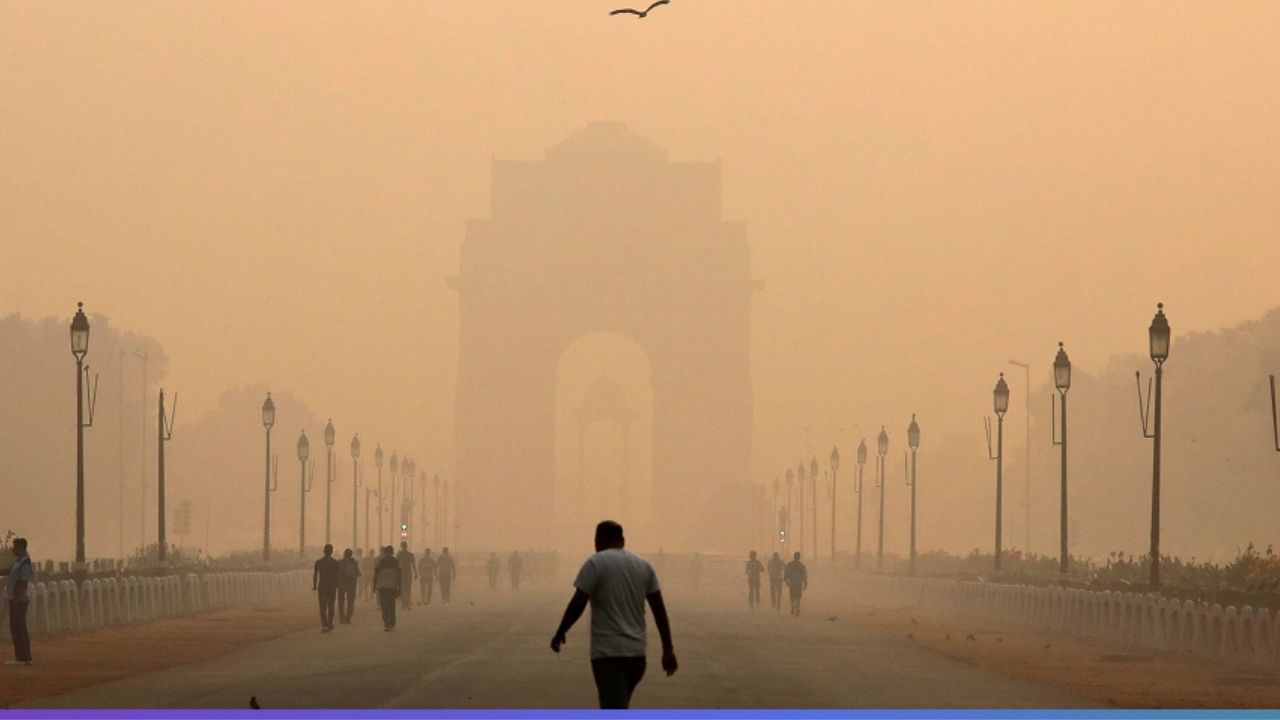
Large swathes of Delhi-NCR were enveloped in a dense blanket of toxic smog, sharply reducing visibility and causing widespread discomfort among residents. Several parts of the capital recorded air quality in the ‘very poor’ category, prompting authorities to intensify anti-pollution measures.
RK Puram emerged as one of the worst-affected areas, registering an Air Quality Index (AQI) of 374, according to data from the Central Pollution Control Board (CPCB). Areas around Jawaharlal Nehru Stadium were also shrouded in thick haze, with the AQI touching 349. Najafgarh reported a comparatively lower AQI of 284, but air quality there too remained firmly in the ‘poor’ range, with hazardous haze lingering throughout the morning.
With pollution levels deteriorating, the Commission for Air Quality Management (CAQM) invoked all Stage-IV measures under the Graded Response Action Plan (GRAP) across Delhi-NCR. These stringent steps are aimed at curbing emissions from multiple sources, including construction activity, vehicular movement and industrial operations.
The poor visibility was not limited to the national capital. A thick layer of fog also covered Ayodhya in Uttar Pradesh, significantly reducing visibility and affecting early-morning movement.
Under the AQI scale, values between 301 and 400 fall in the ‘very poor’ category, while readings above 400 are classified as ‘severe’. Prolonged exposure to such air quality can pose serious health risks, particularly for children, the elderly and people with respiratory ailments.
Flights operate under low-visibility protocols
Dense fog conditions also led the Indira Gandhi International (IGI) Airport to activate Low Visibility Procedures (LVP) on Thursday morning. In an advisory issued around 4.30 am, airport authorities informed passengers that while visibility levels had dropped, flight operations were continuing as scheduled.
“Low-visibility procedures are in progress at Delhi Airport. All flight operations are presently normal,” the advisory said, while urging travellers to stay in contact with their respective airlines for real-time updates on arrivals and departures.
CAQM flags road dust and waste lapses
Earlier this month, CAQM carried out an extensive road-inspection drive to assess dust pollution and waste management across the capital. As part of the exercise, 19 teams inspected 136 road stretches under the Delhi Development Authority (DDA) jurisdiction on December 12.
The findings revealed that 15 stretches had high levels of visible dust, while 38 showed moderate dust accumulation. Another 61 stretches recorded low dust intensity, and only 22 stretches were found free of visible dust. The inspection also flagged the presence of municipal solid waste on 55 stretches and construction and demolition waste on 53 stretches. Instances of municipal waste or biomass burning were detected at six locations.
“These observations point to recurring gaps and negligence in maintenance,” CAQM said, stressing the urgent need for improved operational efficiency and stricter enforcement by the DDA. The commission underlined that road dust, open waste burning and poor waste disposal significantly contribute to elevated particulate matter levels in Delhi.
To address the issue, CAQM has called for stronger on-ground action, including regular mechanical sweeping, timely removal of collected dust, better maintenance of road shoulders and central verges, increased use of water sprinklers and dust-suppression systems, and strict prevention of open burning.
As winter conditions persist, authorities have urged agencies to ensure full compliance with GRAP measures to prevent further deterioration of air quality and safeguard public health.