


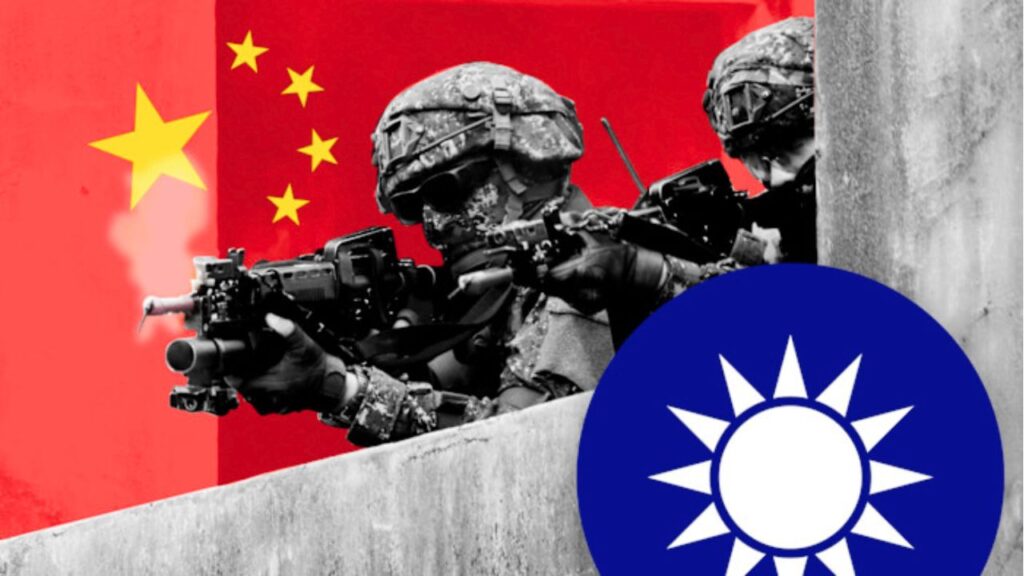
The Taiwan issue represents one of the most complex geopolitical challenges in modern international relations, with 23.4 million people living on an island that China claims as its own territory while maintaining a self-governing democratic system. The dispute centres on whether Taiwan is an independent country or part of China, a question that has intensified military tensions, disrupted global semiconductor supply chains, and drawn in major powers including the United States, Japan, and the European Union.
What Is the Taiwan Issue?
Taiwan, officially known as the Republic of China (ROC), is a self-governing democracy separated from mainland China by the 180-kilometre Taiwan Strait. The People’s Republic of China (PRC), established in 1949, has never governed the island but claims Taiwan as an integral part of its territory and has not ruled out using force to achieve unification, according to official Chinese government statements.
The island’s political status remains disputed. According to the US Congress research service, Taiwan governs the main island of Taiwan and outlying islands, including Penghu, Kinmen, and Mazu archipelagos. Since the 1950s, Taiwan has maintained a separate government, military, currency, and democratic system, yet only 11 United Nations member states and the Holy See maintain formal diplomatic relations with Taiwan as of January 2024.
In 1971, UN General Assembly Resolution 2758 recognized the PRC as the only legitimate representatives of China to the United Nations and expelled ROC representatives from the UN and related organizations. The resolution did not mention Taiwan or address its political status, though China and other parties interpret its implications differently.
Historical Background: From Civil War to Separation
The roots of the Taiwan issue trace back to China’s civil war between the Communist Party of China (CPC) and the Kuomintang (KMT) nationalist forces. According to official records, the CPC emerged victorious in 1949 and established the PRC on mainland China. The defeated ROC government, led by Chiang Kai-shek, retreated to Taiwan with approximately two million supporters.
The 1943 Cairo Declaration stated that Taiwan, then under Japanese colonial rule, would be restored to the Republic of China following World War II. In 1945, the ROC accepted the surrender of Japanese troops in Taiwan and assumed control of the island on behalf of the Allied powers.
Both sides have never signed any agreement to officially end the civil war, according to historical records. Until the 1970s, the ROC maintained international recognition from most countries as the legitimate government of China, while the PRC was recognised primarily by Soviet Bloc nations and some Western countries.
The One China Policy: Different Interpretations
The “One China” concept lies at the heart of the dispute, but different parties interpret it differently.
China’s Position: The PRC maintains that there is only one China Taiwan is part of China, and the PRC government is the sole legitimate government representing all of China. According to Chinese government statements, the PRC proposed the “one country, two systems” model for Taiwan in January 2019, similar to arrangements used in Hong Kong and Macau.
Taiwan’s Position: According to Taiwan’s official government portal, the government neither yields nor provokes, maintaining the cross-strait status quo based on the ROC Constitution. Taiwan’s current president, Lai Ching-te, who took office in May 2024, has rejected the “one China” framework. In March 2025, President Lai declared that the PRC meets the definition of a “hostile foreign force” under Taiwan’s 2019 Anti-Infiltration Act.
United States Position: According to the US State Department, the United States acknowledges, but does not endorse, the Chinese position that Taiwan is part of China. The 1979 Taiwan Relations Act mandates that the United States provide Taiwan with defence articles necessary to maintain sufficient self-defence capability, while maintaining “strategic ambiguity” by not specifying whether it would defend Taiwan from a PRC attack.
When asked in February 2025 whether China would “never take Taiwan by force” during his presidency, US President Donald Trump responded he would “never comment on that,” according to official statements. Secretary of State Marco Rubio stated in February 2025 that the United States opposes “any forced, compelled, coercive change in the status of Taiwan.”
Why the World Is Watching: Military Tensions Escalate
Military tensions across the Taiwan Strait have intensified dramatically, particularly since 2016 when Beijing cut off official communication with Taiwan’s government.
Recent Military Exercises: According to the US Department of Defence’s 2025 China Military Power Report released in December 2025, China conducted its largest Taiwan-focused military exercises to date in December 2025. The drills, codenamed “Justice Mission 2025,” included live-fire elements and simulated island encirclement operations involving 14 China Coast Guard vessels alongside People’s Liberation Army forces.
According to the Pentagon report, the exercises simulated blockade scenarios designed to isolate Taiwan economically and politically without triggering immediate global conflict. The drills practised cutting off Taiwan’s major ports, interdicting energy imports, and conducting counter-intervention operations against potential US involvement.
The 2027 Timeline: Multiple defence assessments indicate growing concern about China’s military preparations. According to the Pentagon’s 2025 report, General Secretary Xi Jinping has set a “Centennial Military Building Goal” for 2027, requiring the People’s Liberation Army to achieve capabilities for prevailing in a Taiwan conflict involving US intervention.
The so-called “Davidson Window,” named after former Indo-Pacific Command commander Phil Davidson, refers to assessments shared in U.S. congressional testimony that China’s leadership has instructed the People’s Liberation Army to be ready to seize Taiwan by 2027.
Grey-Zone Tactics: According to the Pentagon report, China employs sustained pressure through cyber operations, economic coercion, legal warfare, and military intimidation rather than immediate invasion. Defence analysts note that Beijing has strong incentives to apply pressure through these “grey-zone tactics” without crossing into open warfare.
The Semiconductor Factor: Taiwan’s Global Economic Importance
Taiwan’s dominance in semiconductor manufacturing has become central to why the world closely monitors cross-strait tensions.
Production Dominance: According to industry data, Taiwan produces over 60 percent of the world’s semiconductors and approximately 92 percent of the most advanced chip manufacturing capacity. Taiwan Semiconductor Manufacturing Company (TSMC) alone produces over 50 percent of the world’s advanced semiconductors, supplying critical components to technology companies including Apple, Nvidia, and AMD.
According to Taiwan’s official statistics, the semiconductor industry contributes approximately 15 percent to Taiwan’s GDP and accounted for $115 billion in 2023, representing around 20 percent of the global semiconductor market.
Global Dependency: Semiconductors are essential to virtually all modern industries, from automobiles (which contain 1,000-3,500 semiconductors each) to telecommunications, healthcare, and artificial intelligence. According to a US International Trade Commission analysis, approximately 92 percent of the world’s most advanced chip manufacturing capacity is located in Taiwan.
According to the Institute for Economics and Peace, a full-scale conflict over Taiwan could result in a $10 trillion loss to the global economy. The organisation notes that advanced industries dependent on Taiwan’s chips, from aerospace to healthcare, would experience immediate disruption.
The Silicon Shield Debate: Taiwan’s semiconductor dominance has been described as a “silicon shield”, the concept that China would be deterred from military action because disrupting Taiwan’s chip production would devastate the global economy, including China’s own technology sector. According to trade data, China receives over half of Taiwan’s chip exports.
However, some analysts, including former US national security official Matthew Pottinger, have challenged the silicon shield theory, arguing that China may not behave according to economic rationality when pursuing strategic objectives.
International Response and Regional Implications
- Japanese Position: According to official statements, Japanese Prime Minister Sanae Takaichi made unusually direct remarks in November 2025, suggesting that an attack on Taiwan could trigger collective self-defence considerations under Japanese law. This prompted diplomatic tensions with Beijing, which demanded a retraction of the statement.
- European Union Stance: According to a December 2025 statement from the European External Action Service, the EU opposes any unilateral actions that change the status quo in the Taiwan Strait, particularly by force or coercion. The statement emphasised that peace and stability in the Taiwan Strait are of strategic importance for regional and global security and prosperity.
- Regional Allies: According to defence analyses, any conflict over Taiwan would likely involve multiple regional actors. Japan hosts US military bases critical to potential Taiwan operations, while the Philippines has strategic locations that could support US forces. South Korea, hosting 28,500 US troops, would face pressure to provide rear-area support.
Arms Sales and Defence Cooperation
According to US government data, the United States has continued substantial arms sales to Taiwan despite Chinese objections. In 2025, the United States approved multiple weapons packages totalling billions of dollars, focused on asymmetric defence capabilities including missiles, drones, and systems designed to complicate a Chinese assault.
In September 2025, Taiwan revealed its first missile to be jointly manufactured with an American company, the Barracuda-500 autonomous cruise missile, co-produced between Taiwan’s National Chung-Shan Institute of Science and Technology and Anduril Industries, according to official announcements.
Taiwan adopted a new military spending target in 2025 of 3.5 percent of GDP for core defence spending and 1.5 percent for national security infrastructure, according to government statements.
Diplomatic Isolation
China has systematically reduced Taiwan’s diplomatic recognition. According to official records, in March 2023, Honduras severed ties with Taiwan and established relations with China. In January 2024, just days after Taiwan’s presidential election, the Pacific island nation of Nauru switched recognition to Beijing.
Taiwan maintains quasi-diplomatic offices in most nations under various names, most commonly as Taipei Economic and Cultural Offices. According to the Lowy Institute, approximately 74 percent (142) of UN member states explicitly endorse the PRC’s position that Taiwan is part of China, though 23 of those states do not endorse the one-China principle but merely acknowledge or respect rather than recognise it.
What Happens Next: Key Factors to Watch
- Near-Term Outlook: According to US and regional officials’ assessments, while the risk of conflict is rising, an invasion is not the most likely near-term outcome. Instead, the danger lies in sustained pressure, miscalculation, and crisis escalation, particularly as more actors become implicated in the Taiwan equation.
- Economic Pressures: According to China’s National People’s Congress in March 2025, Premier Li Qiang described the international environment as “exceptionally complex” with growing external pressure and “adverse impact” on China’s development.
- Military Readiness: According to defence assessments, China’s military continues advancing toward Xi Jinping’s 2027 capabilities goal despite leadership purges and ongoing disciplinary investigations across China’s military and defence industry.
- Supply Chain Diversification: Multiple countries are attempting to reduce dependence on Taiwan’s semiconductor production. TSMC has committed over $100 billion to establish fabrication plants in Arizona, with production expected to begin in 2025 (delayed from 2024 due to specialist worker shortages). TSMC is also investing in facilities in Germany and Japan, though these will focus on less advanced chip technologies while Taiwan retains the most sophisticated manufacturing capabilities.
- Cross-Strait Dialogue: According to Taiwan’s official position, the government calls on Beijing authorities to face the reality of the ROC’s existence and respect the choices of Taiwan’s people by engaging with their legitimately elected government. However, official cross-strait communications have been suspended since 2016, with interactions limited to semi-official bodies.
Global Stakes
The Taiwan issue represents a convergence of historical grievances, territorial disputes, economic interdependence, military calculations, and great power competition. According to multiple defence and economic analyses, the stakes extend far beyond the Taiwan Strait itself.
A conflict would likely draw in the United States through security commitments, involve Japan and potentially other regional allies, devastate global semiconductor supply chains affecting industries worldwide, and could escalate into a broader regional or even global conflict.
According to the Council on Foreign Relations, Taiwan remains “the likeliest potential flashpoint in US-China relations.” As military tensions persist, diplomatic channels remain limited, and economic dependencies deepen, the international community continues to watch Taiwan closely, recognising that events in this small island could reshape the global order.