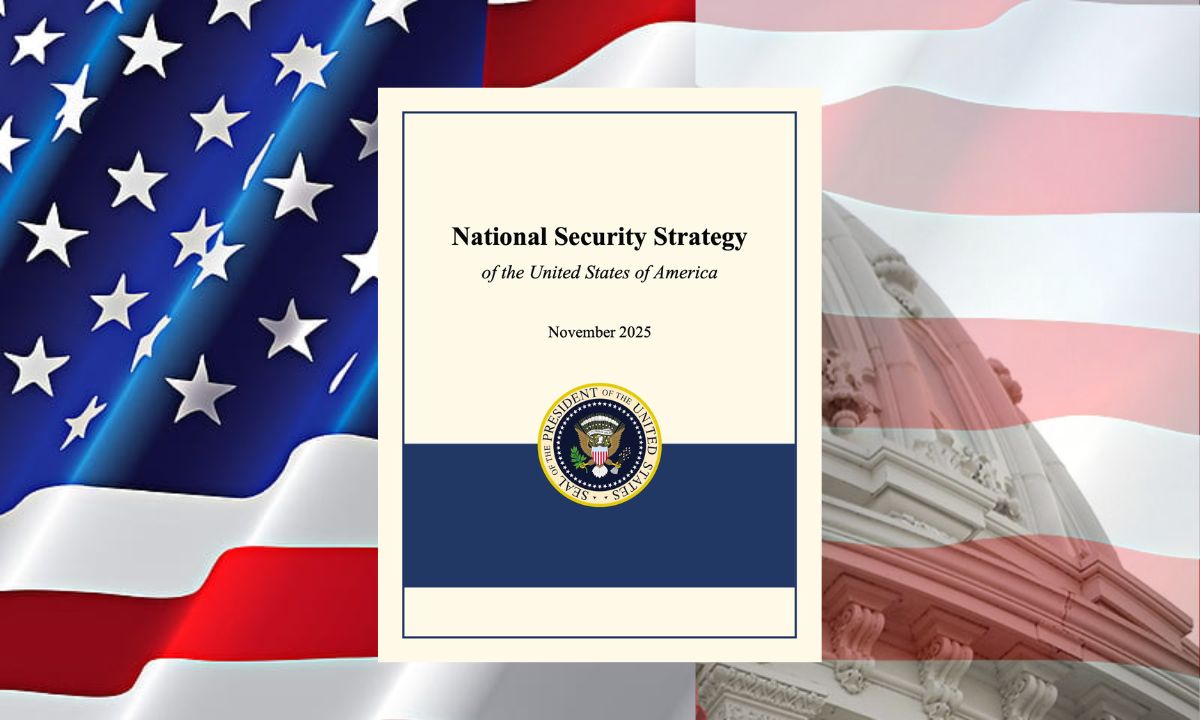
U.S. National Security Strategy 2025: The White House’s release of the 2025 National Security Strategy (NSS) offers one of the clearest windows yet into how Washington now sees the world -and its place in it. Gone is the familiar language of a “rules-based international order.” In its place is a blunt, unapologetic articulation of power, competition, and national interest.
This is not a rhetorical document. It is a declaration of intent.
What follows is how the strategy reshapes America’s worldview -and what it means for Asia, Europe, China, and the global balance of power.
1. China Is Explicitly Acknowledged as a Near-Peer Rival
For the first time, the United States openly acknowledges China as a “near-peer” competitor, abandoning years of semantic caution. The NSS admits that Washington’s long-standing engagement strategy failed -China did not liberalise politically, nor did it integrate into the global system on U.S. terms.
The response outlined is unmistakable:
- intensified military deterrence
- expanded force posture across the First Island Chain
- tighter coordination with allies
- and a sustained effort to deny China technological and strategic leverage
Economically, the strategy rejects full decoupling but embraces selective disengagement. Cooperation is permitted only where it does not dilute American power. In all other domains -semiconductors, AI, supply chains, energy technologies -competition is the default.
In practical terms, this amounts to long-term containment, even if the word itself is carefully avoided.
2. Monroe Doctrine Returns -Updated for the 21st Century
One of the most striking elements of the NSS is the revival of hemispheric dominance under what the document describes as a “Trump Corollary” to the Monroe Doctrine.
The message is clear:
The Western Hemisphere is once again a red line.
Latin America is no longer viewed as a neutral geopolitical space. Chinese infrastructure investment, port access, telecommunications networks, and mineral acquisitions are framed as direct security threats. The U.S. signals a readiness to counter these moves through:
- increased naval and security presence
- economic pressure
- migration enforcement
- and political influence operations
This is not subtle diplomacy. It is a reassertion of sphere-of-influence politics -openly stated.
3. Europe Is No Longer Treated as a Strategic Equal
Perhaps the most unexpected tone shift appears in the NSS’s assessment of Europe.
The document describes the continent as facing economic stagnation, demographic decline, regulatory overreach, and political fragmentation, even warning of potential “civilizational erosion.” It places blame squarely on European leadership for prolonging the Ukraine conflict and becoming increasingly dependent on China and Russia.
Most strikingly, the U.S. states its intention to “cultivate resistance” within European societies -an unusually direct admission of ideological and political intervention aimed at reshaping allied states from within.
This represents the most confrontational language toward Europe ever used in a U.S. national strategy document, signalling frustration with allies seen as burdens rather than force multipliers.
4. Middle East Is Downgraded -From Battlefield to Balance Sheet
The Middle East no longer occupies a central strategic role in U.S. foreign policy. The NSS treats the region less as a security theatre and more as an investment and transactional zone.
With America now a major energy exporter, the region’s strategic value has diminished. Washington seeks:
- security cooperation
- counterterrorism coordination
- technology and defence partnerships
-but explicitly avoids open-ended military commitments.
The era of transformational wars and democracy promotion is decisively over. What replaces it is pragmatic management, not stabilization.
5. Africa: Strategic Access Over Development
Africa receives limited attention, but the intent is unmistakable. The National Security Strategy shifts away from humanitarian framing toward resource security and strategic competition, particularly with China.
Critical minerals, energy access, and influence over logistics corridors dominate Washington’s priorities. Aid is no longer an end in itself; it is a tool for geopolitical positioning.
This reflects a broader global trend: Africa is increasingly treated as a resource battleground, not a development partner.
6. Doctrine, Finally Stated Without Euphemism
One line in the NSS encapsulates the entire strategy:
“The United States cannot allow any nation to become so dominant that it could threaten our interests.”
This is American hegemony stated plainly -without moral language or ideological framing. It is classic great-power realism, stripped of post-Cold War idealism.
Spheres of influence, power balancing, burden-shifting, and coercive leverage are no longer implied. They are openly embraced.
7. Climate Leadership Is Quietly Abandoned
The NSS decisively steps back from climate leadership. Net-zero commitments are rejected, and climate policy is framed through the lens of energy security rather than global responsibility.
Implicitly, the U.S. appears willing to cede climate leadership to China -an extraordinary admission given Beijing’s dominance in solar manufacturing, EVs, batteries, and green supply chains.
This suggests a calculation that the U.S. cannot compete effectively in this domain without undermining its industrial revival.
What This Means for U.S.–China Relations
The strategy locks in a structural rivalry that transcends electoral cycles. Washington signals that it will:
- intensify military pressure around China
- coordinate allies to constrain China economically
- contest Chinese influence globally -from Africa to Latin America
- protect technological dominance at all costs
Cooperation will exist, but only selectively and on U.S. terms.
This is the most adversarial U.S. posture toward China ever formalised in an official strategy.

What Makes This NSS Different
The defining feature of the 2025 National Security Strategy is its tone.
Previous strategies cloaked American ambition in the language of multilateralism and shared values. This one does not. It embraces competition over coexistence, dominance over consensus, and interest over ideology.
It is a worldview shaped by perceived decline -and a determination to reverse it through power consolidation.
Also Read: Impact Journalism: Where Public Trust and Real Impact Take Shape
Final Assessment:
The 2025 National Security Strategy sketches a world order defined by hard choices and sharper hierarchies. China is firmly positioned as the central rival, while Europe is portrayed as drifting and in need of political and strategic correction. Latin America is pulled back into Washington’s sphere of influence, Africa is increasingly viewed through the lens of strategic resources, and the Middle East is treated less as a region to be transformed than one to be monetised and managed.
Climate responsibility is notably deprioritised, while U.S. primacy emerges as the organising principle shaping every major policy choice. Rather than offering a vision of global stability, the strategy signals an era of managed rivalry, hardened spheres of influence, and a more openly competitive international order.
For Asia- and particularly for countries like India that seek to preserve strategic autonomy-this document reads less as a roadmap for cooperation and more as a cautionary signal of the pressures and trade-offs that lie ahead.
2025 U.S. National Security Strategy
About the Author
