Agriculture Innovation: Under the relentless Rajasthan sun, nineteen-year-old Ramdhan Lodha wasn’t just another teenager dreaming of city life or corporate careers. Instead, he was hunched over spare bicycle parts, batteries, and solar panels in his village workshop in Jhalawar, piecing together what would become a revolution for India’s struggling small-scale farmers. His hands, though young, moved with the confidence of someone who had witnessed pain and chosen to do something about it.
The sight that haunted him most? Watching his father, Rajaram Lodha, return home each evening with shoulders hunched in pain, his body bearing the weight of heavy spray pumps and his lungs bearing the effects of chemical exposure. “I grew up seeing my father and neighbouring farmers battle weeds that could wipe out months of backbreaking work in just weeks,” Ramdhan recalls, his voice carrying both the softness of youth and the determination of a seasoned innovator.
When Classroom Science Meets Real-World Problems
For most students, science remains confined to textbooks and laboratory experiments. For Ramdhan, every chapter was a potential solution to his village’s agricultural challenges. While his classmates memorised formulas, he envisioned applications. While others saw machinery as fixed technology, he saw opportunities for innovation.
Growing up in a farming household, Ramdhan understood a harsh reality that many urban Indians never witness: small-scale farmers don’t just compete with market forces, they battle nature itself. Uncontrolled weeds can reduce crop yields dramatically, turning what should be a harvest celebration into a season of losses. Chemical spraying requires expensive equipment, physical stamina, and often comes at the cost of the farmer’s health.
“Every science competition at school became my platform to create something meaningful,” Ramdhan shares. These weren’t just academic exercises for grades. They were his lifeline to funding, his pathway to making a real difference. At just fifteen years old, he designed his first prototype and entered a government competition, winning Rs 10,000 seed money that would eventually grow into a full-fledged agricultural innovation.
Building Dreams from Bicycle Parts and Determination
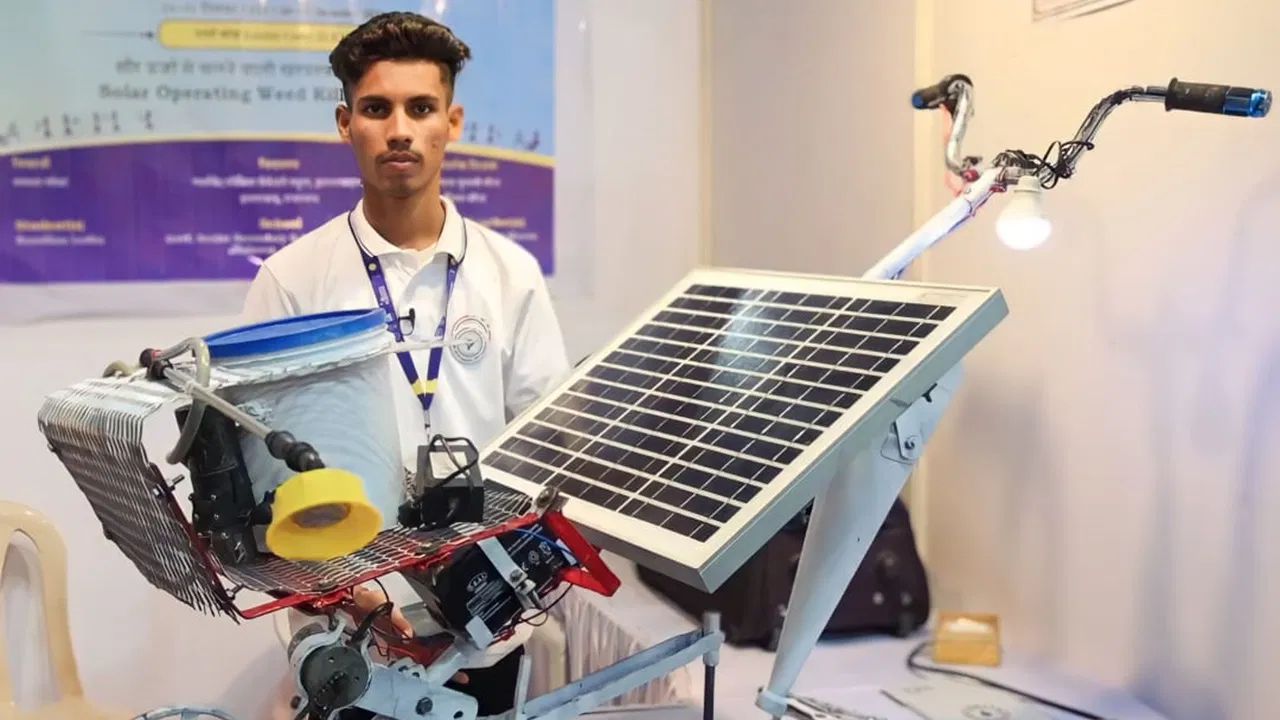
The journey from concept to creation is where most dreams falter. Not for this determined teenager. Ramdhan refused to let financial constraints or lack of sophisticated equipment dim his vision. With the prize money from that first competition and help from a local welder, he began assembling his machine using repurposed bicycle parts, batteries, and whatever materials he could source affordably.
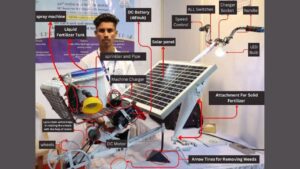
His creation was anything but ordinary. The multipurpose agricultural machine could simultaneously remove weeds, spray fertilisers, sow seeds, and apply manure, four labour-intensive tasks that traditionally required separate tools, multiple workers, and exhausting physical effort. The genius lay not just in the multifunctionality, but in the power source: solar energy, supplemented by a battery for cloudy days.
The machine’s design reflected an intimate understanding of small-farm realities. Adjustable components meant it could adapt to different crop types and field conditions. The lightweight bicycle frame made it manoeuvrable in compact farming spaces. The solar panel eliminated ongoing fuel costs, a game-changing feature for farmers operating on razor-thin margins.
First Trial: When Father Became the First Believer
The true test of any innovation comes not in the workshop but in the field. Rajaram Lodha became the first farmer to use his son’s invention, and the results spoke louder than any technical specifications could. The machine that once seemed like a teenager’s ambitious project suddenly became the talk of the village.
Other farmers watched in amazement as the device glided through fields, uprooting weeds while simultaneously preparing soil and applying nutrients. What previously took hours of backbreaking labour now happens in a fraction of the time. The physical toll on farmers? Reduced by half. The efficiency of operations? Boosted by sixty per cent.
Word spread quickly through rural Jhalawar. Neighbours who had initially been sceptical, after all, what could a teenage boy know about farming machinery?, now waited their turn to test the device. The praise wasn’t just about the technology; it was about the understanding behind it. Ramdhan had designed the machine with empathy, having lived the farmer’s struggles rather than merely studying them.
 Recognition Beyond Borders: From Village Workshop to National Stage
Success in rural Rajasthan is one thing. National recognition is another entirely. Ramdhan’s breakthrough came at the Indian Silicon Valley Challenge organised by Scaler School of Technology, where his innovation won Rs 1 lakh in prize money. More valuable than the cash was the validation; his solution wasn’t just locally useful; it had national and potentially international relevance.
“Following this achievement, interest in my machine extended beyond India’s borders,” Ramdhan reveals with barely contained excitement. Inquiries started arriving from overseas, from regions where small-scale farmers faced similar challenges. His invention had transcended its origins, becoming a beacon for sustainable, affordable agricultural technology worldwide.
But Ramdhan’s feet remain firmly planted in Rajasthan’s soil. His mission isn’t to build an empire in Silicon Valley; it’s to ensure that farmers like his father can afford the technology that transforms their lives.
Economics of Empowerment: Making Innovation Accessible
Here’s where Ramdhan’s story diverges from typical entrepreneurial narratives. Most innovators focus on maximising profits. Ramdhan focuses on maximising impact. While commercial agricultural machinery costs lakhs of rupees, completely out of reach for small landholders, he’s determined to price his “Kishan Rover” between Rs 20,000 and Rs 25,000.
“My goal is to reach all small farmers. Other machines cost much higher. With additional features, this machine will become a good investment for farmers,” he explains. It’s a price point that transforms the machine from a luxury to a realistic investment that can pay for itself within a single growing season through reduced labour costs and increased productivity.
The economics are compelling: traditional farming methods require hiring labourers for weeding, separate equipment for fertiliser application, and significant time investment. Ramdhan’s machine consolidates these costs while eliminating ongoing fuel expenses through solar power. For farmers operating on tight budgets, these savings represent the difference between profit and loss.

Challenges and the Road Ahead: Scaling Impact
Creating a working prototype is one thing. Bringing it to market at scale is an entirely different challenge. Ramdhan understands this reality and is tackling it head-on. He has applied to prestigious incubation programs at IIT Kashipur and IIT Madras, seeking the mentorship and resources needed to refine his design for mass production.
His application to Shark Tank India Season 4 and participation in Startup Mahakumbh 2024 represent strategic moves to secure the funding necessary for scaling. But more than money, he seeks partnerships with people who share his vision that agricultural innovation should serve farmers, not just investors.
“I want innovations like this to come in large numbers to help small farmers. Indian farmers need more innovation to grow and profit,” Ramdhan emphasises. His vision extends beyond personal success to catalysing a broader movement of farmer-centric technology development.
By 2025, if funding materialises as planned, the Kishan Rover will begin reaching farmers across India. Each machine deployed represents not just a sale but a family’s burden reduced, a farmer’s health protected, and a community’s agricultural future brightened.
Bigger Picture: Youth, Innovation, and Agricultural Transformation
Ramdhan’s story illuminates a crucial truth about India’s agricultural sector: solutions don’t always come from agricultural universities or corporate R&D departments. Sometimes they emerge from the fields themselves, created by young people who understand farming’s challenges intimately because they’ve lived them.
His success offers a blueprint for addressing India’s agricultural challenges through grassroots innovation. It demonstrates that with support systems, science competitions providing seed funding, incubation programs offering mentorship, and platforms like Shark Tank connecting innovators with investors, rural youth can become powerful agents of agricultural transformation.
A Message for Every Young Innovator
“Farmers should also go digital and keep up with other industries,” Ramdhan concludes, but his message extends beyond agriculture. To every teenager tinkering in workshops, every student seeing problems others ignore, every young person told their dreams are too ambitious, Ramdhan’s journey says: build it anyway.
His path from village workshops to national recognition proves that transformative change doesn’t require Silicon Valley resources or elite institution credentials. It requires observation, empathy, persistence, and the courage to believe that your solution matters, even when you’re building it from bicycle parts.
As Ramdhan continues refining his invention and planning the Kishan Rover’s market launch, he carries more than a business plan. He carries the hopes of millions of small-scale farmers across India who need affordable, practical innovations that respect both their financial constraints and their dignity as producers feeding the nation.
In rural Jhalawar, a nineteen-year-old boy with solar panels and spare parts has lit a path forward, not just for his family’s farm, but for India’s agricultural future.