


Amid shifting global supply chains, geopolitical realignments and continuous economic uncertainty, India is quietly but decisively strengthening itself in the global trade arena. India’s export story in the last year is not only that of recovery-but it is a larger story of deeper structural change that has been enabled by diversification and policy reforms and has created a new generation of trade agreements that transcend tariff red cuts by far. This momentum can be seen by the year-on-year export performance from November 2024 to November 2025. India is not only becoming a reliable supplier, but also a strategic partner in an increasingly fragmented global trading system.
Export Performance: Growth with Stability
Between November 2024 and November 2025, India’s total exports rose from USD 64.05 billion to USD 73.99 billion, registering a robust 15.52% growth. Imports, by contrast, remained largely stable at USD 80.63 billion, leading to a sharp 61.07% reduction in the trade deficit-from USD 17.06 billion to USD 6.64 billion.
This narrowing of the trade gap is significant. It reflects not only export growth but also better alignment between imports, domestic production, and global demand. At a time when many economies are grappling with widening trade imbalances, India’s trajectory points to a more sustainable external sector.
Merchandise and Services: A Balanced Export Engine
India’s export growth in November 2025 was supported by both merchandise and services, reinforcing the country’s shift toward a more balanced export structure.
- Merchandise exports reached USD 38.13 billion, up 19.38% year-on-year.
- Services exports rose to USD 35.86 billion, registering 11.67% growth.
Merchandise accounted for 51.53% of total exports, while services contributed 48.47%, underscoring India’s emergence as a hybrid export economy-where manufacturing strength and services competitiveness complement each other.
Sectoral Drivers
Several sectors recorded notable gains:
- Readymade garments and textiles, a labour-intensive segment, grew 11.27%, supporting employment and MSMEs.
- Organic and inorganic chemicals expanded 18.49%, reflecting India’s growing footprint in higher-value manufacturing.
- Pharmaceuticals, with India widely recognised as the “Pharmacy of the World”, grew 20.19%, supplying over 200 countries, including highly regulated markets such as the US, Europe, Japan, and Australia.
- Gems and jewellery surged 27.8%, driven by demand for Indian craftsmanship across the US, UAE, Hong Kong, and Europe.
- Petroleum products recorded 11.65% growth, supported by India’s refining capacity and strategic location.
- Engineering goods continued steady expansion, with the US, UAE, Germany, the UK, and Saudi Arabia among the top destinations.
- Electronics exports, led by mobile phones, have seen a structural transformation-from Rs 1,500 crore in 2014-15 to nearly Rs 2 lakh crore in 2024-25-placing India firmly on track to build a USD 500-billion electronics ecosystem by 2030-31.
Export Diversification: Reducing Risk, Building Resilience
Export diversification has become a central pillar of India’s trade strategy. In an era marked by demand volatility, geopolitical shocks, and supply-chain disruptions, over-reliance on a narrow basket of products or markets can expose economies to sharp external risks.
By expanding across products and destinations, India is:
- Reducing exposure to commodity price swings
- Enhancing resilience against global demand shocks
- Encouraging innovation and technology spillovers across sectors
- Strengthening macroeconomic stability, especially as exports accounted for 21.2% of India’s GDP in 2024
Trade Agreements as Strategic Growth Tools
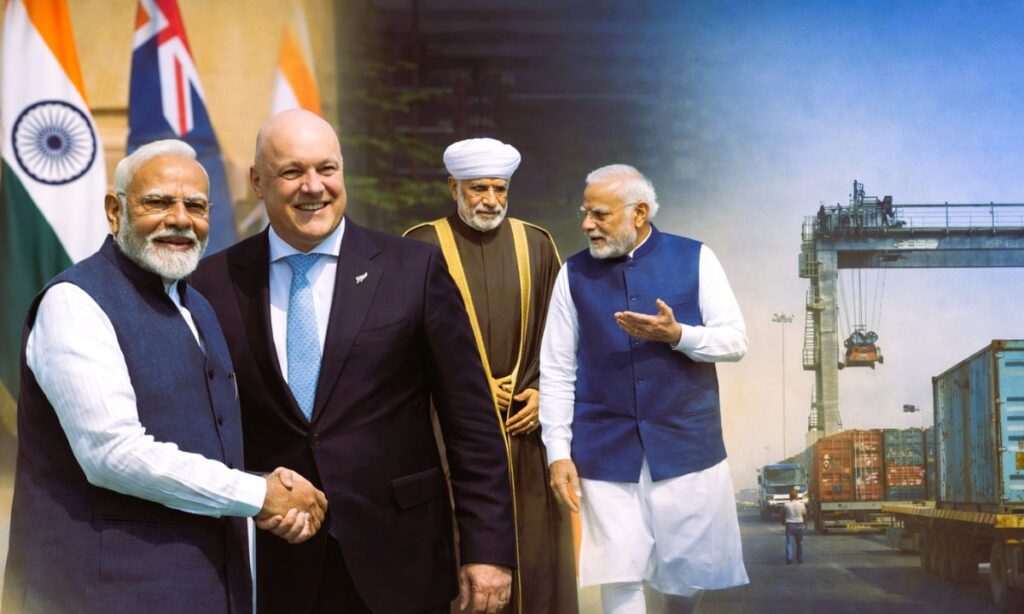
India’s recent trade diplomacy reflects a clear shift-from tariff-centric FTAs to new-generation trade pacts that integrate goods, services, investment, mobility, and regulatory cooperation. Two agreements concluded in December 2025 illustrate this evolution: the India–New Zealand Free Trade Agreement and the India–Oman Comprehensive Economic Partnership Agreement (CEPA).
India-New Zealand FTA: Expanding India’s Pacific Footprint
The India–New Zealand FTA marks one of India’s most comprehensive trade agreements with a developed economy in the Pacific region.
Key highlights include:
- Zero-duty access on 100% of Indian exports to New Zealand, eliminating the average tariff of 2.2%
- A USD 20-billion FDI commitment into India over 15 years, backed by a rebalancing mechanism that allows India to suspend FTA benefits if investments do not materialise
- A target to double bilateral trade from USD 2.4 billion to nearly USD 5 billion within five years
Managed Liberalisation with Safeguards
India has liberalised 70% of tariff lines, covering 95% of New Zealand exports by value, while ensuring gradual adjustment:
- Immediate duty elimination on 30% of tariff lines, including wood, wool, and sheep meat
- Phased tariff reduction over 10 years, lowering the average tariff from 16.2% to 9.06%
Crucially, nearly 30% of tariff lines are excluded, including dairy, select animal products, vegetables, almonds, and sugar-safeguarding India’s sensitive agricultural and dairy sectors.
Services, Mobility, and IPR
The agreement includes India’s most ambitious services offer, covering 118 services sectors, alongside progressive mobility provisions:
- No numerical cap on Indian students
- Extended post-study work visas (up to 4 years for PhD holders)
- A new temporary employment pathway for 5,000 Indian professionals at any time
- 1,000 working holiday visas annually
New Zealand has also committed to amending its Geographical Indication (GI) law, extending protection to Indian agricultural and artisanal products on par with European Union standards.
India–Oman CEPA: Deepening Integration in West Asia
Signed in December 2025, the India–Oman CEPA builds on 70 years of diplomatic relations and positions Oman as a key pillar of India’s West Asia trade strategy.
Key outcomes include:
- Zero-duty access on 98.08% of Oman’s tariff lines, covering 99.38% of India’s exports by value
- Major gains for labour-intensive sectors such as agriculture, textiles, leather, gems and jewellery, engineering goods, pharmaceuticals, and automobiles
- Enhanced opportunities for MSMEs, artisans, and women-led enterprises
India already holds a 10.24% share in Oman’s agricultural imports, exporting rice, fruits, processed foods, marine products, meat, and condiments. The CEPA significantly strengthens India’s competitiveness through duty-free access across key product categories.
Notably, the agreement includes:
- The first-ever commitment by any country on traditional medicine across all modes, opening new avenues for India’s AYUSH and wellness sectors
- Liberalised Mode-4 mobility for professionals in accountancy, architecture, medical, and allied services
With over 6,000 India–Oman joint ventures operating in Oman, the CEPA provides a structured framework for scaling trade, investment, and services-led cooperation.
Domestic Reforms Supporting Export Competitiveness
India’s external trade gains are reinforced by sustained domestic reforms:
- The Export Promotion Mission (Rs 25,060 crore) supporting MSMEs through finance, quality, and branding
- Next-Gen GST 2.0, enabling faster refunds and lower logistics costs
- Labour Code reforms, simplifying compliance while strengthening worker protection
- Infrastructure and logistics upgrades through PM GatiShakti, the National Logistics Policy, PLI schemes, and digital platforms such as ICEGATE and the National Single Window System
Conclusion
India’s export trajectory reflects a decisive shift-from volume-driven trade to value-led, diversified, and robust global integration. Strong sectoral performance, deliberate export diversification, and new-generation trade agreements such as the India–New Zealand FTA and India–Oman CEPA are reshaping India’s role in global commerce.
With the evolution of the global trade structures, India is emerging not merely as a participant, but as a shaper of supply chains, standards and strategic alliances, which are anchored on competitiveness, trust and long-term economic resilience.