
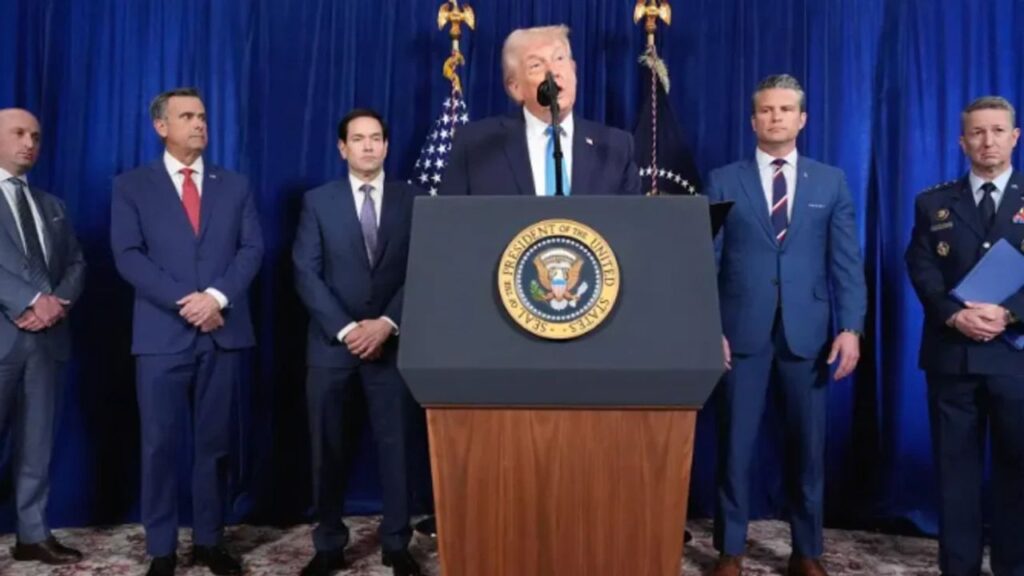


The United States has ignited an international storm after President Donald Trump announced that American forces carried out a pre-dawn operation in Venezuela that resulted in the capture of President Nicolás Maduro and First Lady Cilia Flores. The operation, which Trump said was a “large-scale strike,” reportedly followed explosions and low-flying aircraft over Caracas, leaving at least 40 people dead and plunging the capital into panic.
According to the US administration, the mission—codenamed Operation Absolute Resolve—led to the detention of Maduro and Flores, who now face charges in New York linked to terrorism and drug trafficking. Trump accused the Venezuelan leader of heading a “narco-terrorist organisation” and shared an image on his Truth Social platform purportedly showing Maduro in handcuffs and a blacked-out mask.
US Attorney General Pam Bondi confirmed that an unsealed indictment accuses Maduro of narco-terrorism, cocaine importation conspiracies, and weapons offences, charges that could carry lengthy prison sentences if proven. Meanwhile, Venezuelan authorities declared a nationwide state of emergency as security forces were deployed across the country.
Domestic legal questions in the US
The operation has drawn sharp criticism at home and abroad. Secretary of State Marco Rubio described the action as primarily a law enforcement measure, arguing it fell outside the scope of military action requiring congressional approval. However, several lawmakers disagreed.
Representative Jim Himes, the senior Democrat on the House Intelligence Committee, demanded an immediate briefing, urging the administration to explain both its legal basis and its strategy for maintaining regional stability. President Trump dismissed constitutional concerns in media interviews, saying critics should praise the outcome rather than question its legality.
International law under scrutiny
Legal experts have raised serious concerns that the strike may violate international law. Scholars cited provisions of the UN Charter that prohibit the use of force against the sovereignty or political independence of another state, except in cases of self-defence or with authorisation from the UN Security Council.
Geoffrey Robertson KC, a former president of the UN war crimes court in Sierra Leone, described the raid as contrary to Article 2(4) of the charter, calling it a potential “crime of aggression.” Other experts echoed that view, arguing there was no clear evidence that Venezuela posed an imminent threat to the United States that would justify self-defence.
Elvira Domínguez-Redondo, a professor of international law at Kingston University, said the operation appeared to be an unlawful use of force, while Susan Breau of the Institute of Advanced Legal Studies noted that neither UN authorisation nor a credible self-defence claim had been established.
Uncertain fallout
As diplomatic tensions escalate, questions remain about the broader consequences for regional stability and international norms. While the US administration frames the operation as a decisive blow against alleged criminal activity, critics warn it could set a dangerous precedent for unilateral military action.
With Venezuela under emergency rule and global institutions closely watching, the legality—and long-term impact—of the operation is likely to be debated for months to come.