
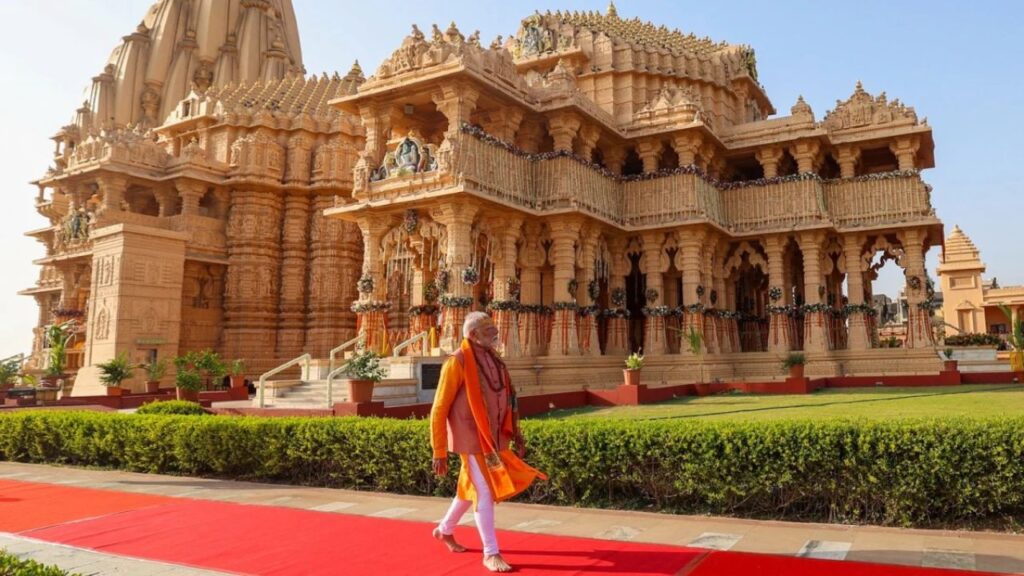


The four-day ‘Somnath Swabhiman Parv’ commenced on Thursday, January 8, 2026, at the historic Somnath Temple near Veraval in Gujarat’s Gir Somnath district, drawing attention to the shrine’s enduring legacy of faith, resilience, and cultural pride. The event holds special significance as it marks 1,000 years since the first attack on the revered temple by Mahmud of Ghazni in 1026, an episode often cited as a defining moment in India’s civilisational history.
The grand celebrations are aimed at commemorating not just the temple’s past, but also its repeated reconstruction and the unwavering spiritual resolve of the Indian people over centuries. Somnath, regarded as one of the twelve Jyotirlingas of Lord Shiva, has been destroyed and rebuilt multiple times, becoming a powerful symbol of cultural continuity and national self-respect.
Prime Minister Narendra Modi is scheduled to visit Gujarat for three days beginning January 10 and will play a central role in the ongoing celebrations. On January 11, he will offer prayers at the Somnath Temple and lead the ‘Shaurya Yatra’, a ceremonial roadshow highlighting courage and heritage. According to officials, the yatra will cover a distance of one kilometre and feature 108 horses, a number symbolically associated with spirituality and completeness in Indian tradition.
In a message shared on social media platform X on Thursday, the Prime Minister reflected on his earlier visits to Somnath and underscored the temple’s significance as a beacon of resilience. Recalling the attack of 1026 and subsequent invasions, Mr. Modi stated that such assaults failed to weaken India’s spiritual foundations. Instead, he noted, they strengthened cultural unity and inspired generations to rebuild the shrine, reinforcing the nation’s civilisational ethos.
“The repeated reconstruction of Somnath reflects the unbreakable spirit of faith and the collective resolve of the people,” he said, adding that the temple stands today as a testament to India’s ability to rise stronger after adversity.
The inauguration ceremony of Somnath Swabhiman Parv was attended by several senior leaders, including Union Tourism Minister Gajendra Singh Shekhawat, Gujarat Ministers Jitu Vaghani and Pradyuman Vaja, along with local representatives and temple authorities. Cultural programmes, exhibitions, and discussions focusing on India’s heritage, temple architecture, and historical narratives are scheduled throughout the four-day event.
Gujarat Chief Minister Bhupendra Patel described the parv as a moment of national pride, stating that it has provided people across the country with an opportunity to reconnect with India’s rich heritage and cultural identity. He emphasised that Somnath is not merely a religious site but a symbol of India’s enduring values and civilisational strength.
“The Somnath Temple embodies the spirit of unity, faith, and self-respect. This celebration allows citizens to reflect on our shared history and draw inspiration from it,” Mr. Patel said.
Local authorities expect a large turnout of devotees, tourists, and cultural enthusiasts during the celebrations. Security arrangements have been strengthened, and infrastructure around the temple town has been upgraded to accommodate visitors.
As Somnath Swabhiman Parv unfolds, the focus remains on honouring a thousand years of perseverance and spiritual continuity. Through rituals, cultural displays, and symbolic events like the Shaurya Yatra, the celebrations aim to reaffirm the temple’s place not only in religious tradition but also in India’s broader historical and cultural narrative.