
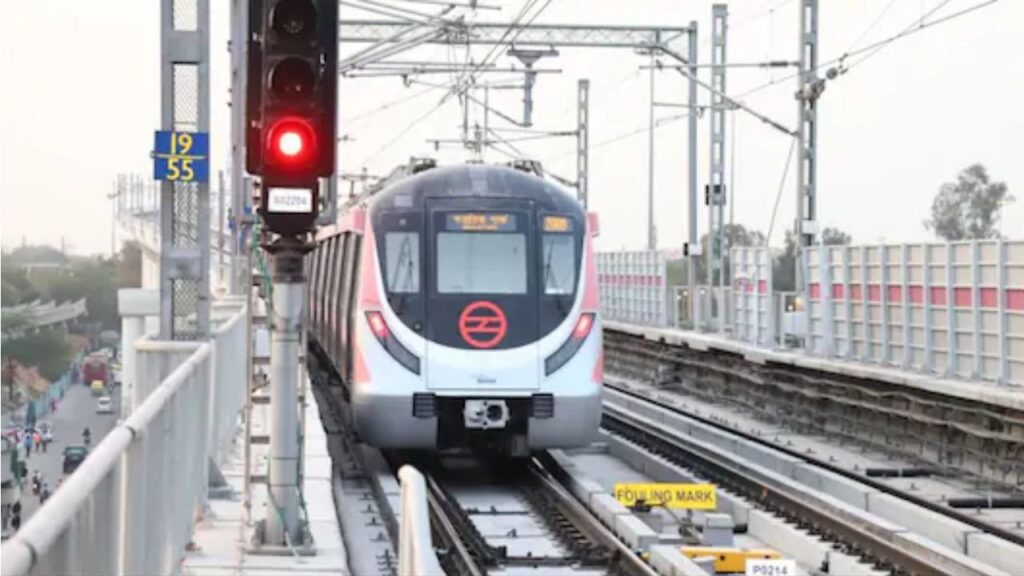


Prime Minister Narendra Modi inaugurated India’s first Ring Metro in the national capital, marking a major milestone in the expansion of the Delhi Metro network. The launch of the Majlis Park–Maujpur-Babarpur corridor completes the circular connectivity of the Delhi Metro Pink Line, transforming it into a fully operational ring route around the city.
During the event, the Prime Minister also inaugurated the Deepali Chowk–Majlis Park extension of the Delhi Metro Magenta Line and laid the foundation stone for new corridors under Delhi Metro Phase-V, signalling the government’s continued focus on strengthening urban transportation infrastructure.
Delhi Gets Its First Ring Metro
The completion of the Pink Line as a circular corridor represents a significant advancement in India’s urban mobility network. With the addition of the Majlis Park–Maujpur-Babarpur stretch, the Pink Line now forms a complete loop across large sections of Delhi.
The newly operational corridor is approximately 12.3 kilometres long and includes several elevated stations aimed at improving connectivity across north and northeast parts of the city. With this addition, the total length of the Pink Line has increased to about 71.56 kilometres, making it India’s first fully operational ring metro corridor.
The Ring Metro system allows commuters to travel across different parts of the capital without passing through heavily crowded central interchange stations. Transport planners believe this circular network will significantly reduce travel time and congestion on other busy metro lines.
Majlis Park–Maujpur Corridor to Boost Connectivity
The Majlis Park–Maujpur-Babarpur corridor is considered a key component of the Pink Line Ring Metro project. It connects several densely populated neighbourhoods in north and northeast Delhi, offering improved last-mile connectivity to residents.
The corridor incorporates modern engineering features designed to support efficient urban transport. One of the highlights is a newly constructed bridge across the Yamuna River, which strengthens connectivity between different parts of the capital. The project also includes a double-decker viaduct that carries both the metro line and a road flyover, showcasing advanced urban infrastructure planning.
Major stations along the corridor include Majlis Park, Burari, Jharoda Majra, Jagatpur-Wazirabad, Soorghat, Nanaksar-Sonia Vihar, Khajuri Khas, Bhajanpura, Yamuna Vihar, and Maujpur-Babarpur. These stations are expected to serve thousands of commuters daily and support mobility in rapidly developing residential areas.
Magenta Line Extension Adds New Connectivity
Alongside the Ring Metro inauguration, the Prime Minister also launched the Deepali Chowk–Majlis Park extension of the Magenta Line. This new stretch measures approximately 9.9 kilometres and introduces seven additional stations to the existing route.
With this expansion, the Magenta Line now extends to nearly 49 kilometres, further strengthening connectivity between northern Delhi and other parts of the metro network. The extension is expected to reduce travel time for daily commuters and improve access to key commercial and residential areas.
A notable engineering aspect of the new corridor is its elevated structure. Some sections reach a height of around 28.36 metres, making it one of the tallest elevated metro segments within the Delhi Metro system.
New Corridors Announced Under Delhi Metro Phase-V
During the ceremony, Narendra Modi also laid the foundation stone for three upcoming metro corridors under Delhi Metro Phase-V (A). These projects aim to further expand the city’s metro network and improve accessibility across key areas.
The proposed corridors include the Central Vista corridor from Ramakrishna Ashram Marg to Indraprastha, which will run underground for about 9.9 kilometres. This route will connect major national landmarks such as Central Secretariat, India Gate, the National War Memorial-High Court area, Bharat Mandapam and Indraprastha.
In addition, the Golden Line will be extended from Aerocity to Indira Gandhi International Airport Terminal-1, improving connectivity to the airport region. Another extension will link Tughlakabad to Kalindi Kunj through an elevated corridor.
Officials say these projects will enhance connectivity to key administrative, commercial and residential zones in the national capital.
With the inauguration of the Ring Metro and new expansions, the Delhi Metro continues to strengthen its position as one of the largest and most advanced urban transport systems in the world, offering faster, more efficient and environmentally sustainable travel for millions of commuters.