
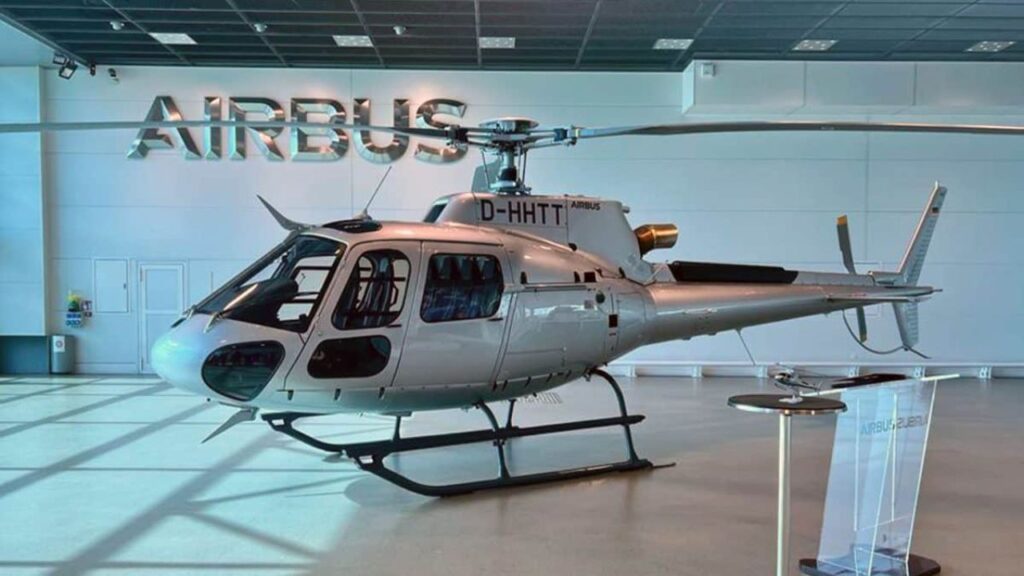


Prime Minister Narendra Modi and French President Emmanuel Macron jointly inaugurated the Tata Advanced Systems Limited (TASL) Final Assembly Line for the Airbus H125 light utility helicopter on February 17, 2026. The inauguration was conducted virtually from Mumbai, while senior Indian and French leaders attended the event at the Vemagal facility in Karnataka.
Present at the assembly line site were Defence Minister Rajnath Singh, French Minister of the Armed Forces and Veterans Affairs Catherine Vautrin, Union Civil Aviation Minister K. R. Naidu, and Karnataka’s Minister for Large and Medium Industries M. B. Patil. The event marks a significant milestone in India–France defence cooperation and strengthens India’s push towards indigenous manufacturing in the aerospace sector.
Addressing the gathering, Rajnath Singh described the new facility as a major step forward in the deepening strategic partnership between the two countries. He said the collaboration demonstrates the strength and limitless potential of India–France ties, especially in high-technology and defence manufacturing sectors. The project follows the earlier Tata-Airbus collaboration for the production of C-295 military transport aircraft in India, further reinforcing the growing aerospace ecosystem in the country.
The Defence Minister emphasised that initiatives such as the H125 assembly line reflect the government’s long-standing commitment to the Make in India and Aatmanirbhar Bharat missions. Since 2014, these policies have aimed at reducing import dependency in critical technologies while encouraging domestic capability development through global partnerships. He noted that the helicopter program is a clear example of how international Original Equipment Manufacturers can collaborate with Indian industry to create advanced manufacturing capabilities within the country.
The investment in the H125 program is expected to exceed Rs 1,000 crore. According to officials, the project is projected to generate substantial direct and indirect employment opportunities for skilled professionals and workers. Singh said the initiative would help nurture India’s industrial base, strengthen ancillary industries, and contribute to the development of advanced technical expertise.
Highlighting the capabilities of the H125 helicopter, the Defence Minister described it as a globally trusted single-engine platform known for its reliability and versatility. The aircraft is designed to perform efficiently in diverse and challenging operational conditions. Its military variant, the H125M, is particularly suited for high-altitude missions, reconnaissance, surveillance, logistics support, and emergency response operations.
The helicopter’s performance record is notable. The H125 is the only helicopter to have successfully landed on the summit of Mount Everest, underscoring its exceptional high-altitude capabilities. This feature is especially relevant for India’s armed forces, which frequently operate in high-altitude and extreme weather conditions along mountainous borders. The platform’s ability to function effectively in “high-and-hot” environments offers a strategic advantage in such terrains.
Rajnath Singh also pointed to broader reforms undertaken by the Ministry of Defence to increase private sector participation in the defence production ecosystem. These include corporatisation of Ordnance Factories, policy liberalisation to attract investment, and the establishment of dedicated defence industrial corridors. As a result of these measures, the private sector’s contribution to defence production has risen significantly, now accounting for nearly a quarter of the total output.
He added that India’s defence exports have grown substantially in recent years, positioning the country among leading global exporters in the sector. The expansion has provided momentum to thousands of micro, small and medium enterprises (MSMEs), which now form a crucial part of the supply chain. Currently, more than 16,000 MSMEs are engaged in defence-related production, with many international firms sourcing components from Indian manufacturers.
Inviting deeper collaboration, Singh encouraged foreign partners to pursue meaningful technology transfers and advanced manufacturing solutions that would not only serve India’s security requirements but also cater to global markets.
The Vemagal assembly line represents the second major industrial partnership between Tata Advanced Systems and Airbus after the C-295 transport aircraft project. Together, these ventures signal the emergence of a comprehensive military aerospace manufacturing ecosystem in India, reinforcing the country’s ambition to become a global hub for defence production and high-end aerospace technology.