
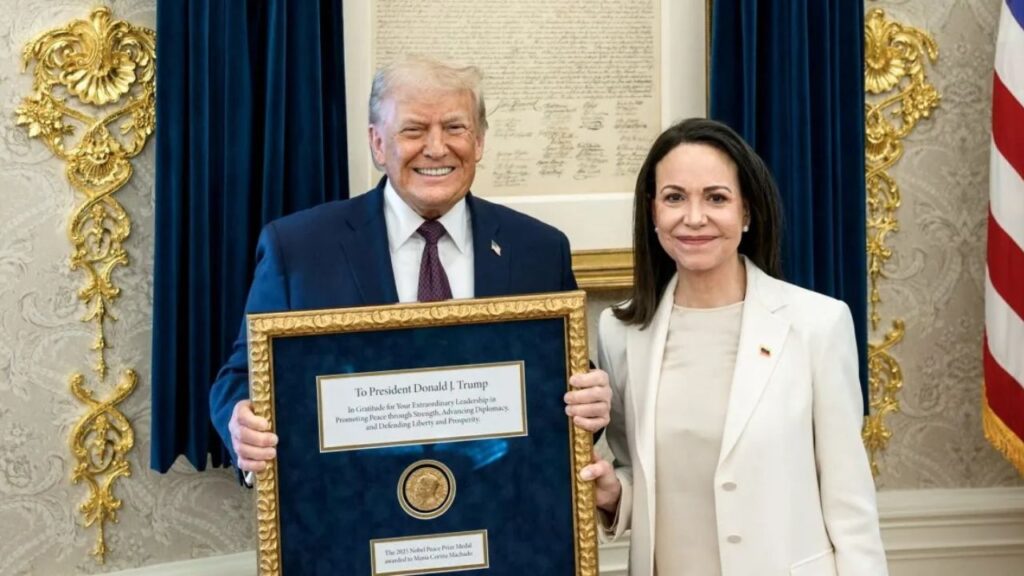


Venezuelan opposition leader María Corina Machado created global headlines after handing her 2025 Nobel Peace Prize medal to U.S. President Donald Trump during a meeting at the White House, an unprecedented gesture that sparked intense debate over symbolism, legality, and the integrity of the world’s most prestigious peace award.
Standing beside Machado and smiling broadly for photographers, Trump described the act as a “wonderful gesture of mutual respect.” The moment carried special significance for Trump, who has long expressed admiration for the Nobel Peace Prize and has openly voiced his desire to receive the honour himself.
Machado not only presented the medal to Trump but left it behind at the White House, further fueling speculation over whether the award itself had effectively been transferred. While the visual impact was powerful, Nobel authorities quickly clarified that such a transfer is not possible under the rules governing the prize.
The Norwegian Nobel Institute reiterated that the Nobel Peace Prize cannot be transferred, shared, revoked, or reassigned once awarded. According to the statutes of the Nobel Foundation, decisions are final and permanent, with no mechanism for appeal or alteration. Nobel committees also do not comment on the actions of laureates after the award is announced, underscoring that the honour remains exclusively tied to the original recipient.
“This decision stands for all time,” the institute said, stressing that while a physical medal can change hands, the title of Nobel Peace Prize laureate cannot.
Machado received the Nobel Peace Prize earlier this year for her role in Venezuela’s democratic movement. However, following dramatic political developments in the country — including the capture of long-time President Nicolás Maduro — Machado announced her intention to present the medal to Trump as an expression of gratitude.
Speaking to reporters after leaving the White House, Machado said she had given Trump the medal in recognition of what she described as his commitment to the freedom of the Venezuelan people. “I presented the president of the United States the Nobel Peace Prize medal as a recognition of his unique commitment to our freedom,” she said.
Trump later echoed her remarks in a social media post, writing that Machado had presented him with her Nobel Peace Prize for the work he had done, calling the act a meaningful and respectful gesture.
Despite the attention surrounding the handover, Nobel officials have emphasized an important distinction: while laureates may give away or donate the physical medal, the honour itself remains non-transferable. Trump does not become a Nobel Peace Prize winner by possessing the medal, nor does Machado relinquish her status as the official laureate.
The episode has divided public opinion. Supporters view Machado’s move as a powerful political statement aimed at strengthening U.S. support for democratic reform in Venezuela at a critical moment. They argue that the gesture highlights international cooperation and gratitude during a period of historic political change.
Critics, however, have questioned whether the act undermines the neutrality and prestige of the Nobel Peace Prize. Some observers have warned that politicising the award through symbolic gestures risks blurring the line between personal diplomacy and institutional recognition.
For Trump, the moment adds a curious chapter to his presidency and post-presidency narrative, reinforcing his long-standing pursuit of global recognition. For the Nobel Prize, it serves as a reminder that while symbols can be powerful, institutional rules remain firm.
Ultimately, Machado’s gesture stands as a striking act of symbolism rather than a transfer of honour. The Nobel Peace Prize remains hers in official records, even as the image of the medal in the White House continues to resonate across political and diplomatic circles worldwide.