
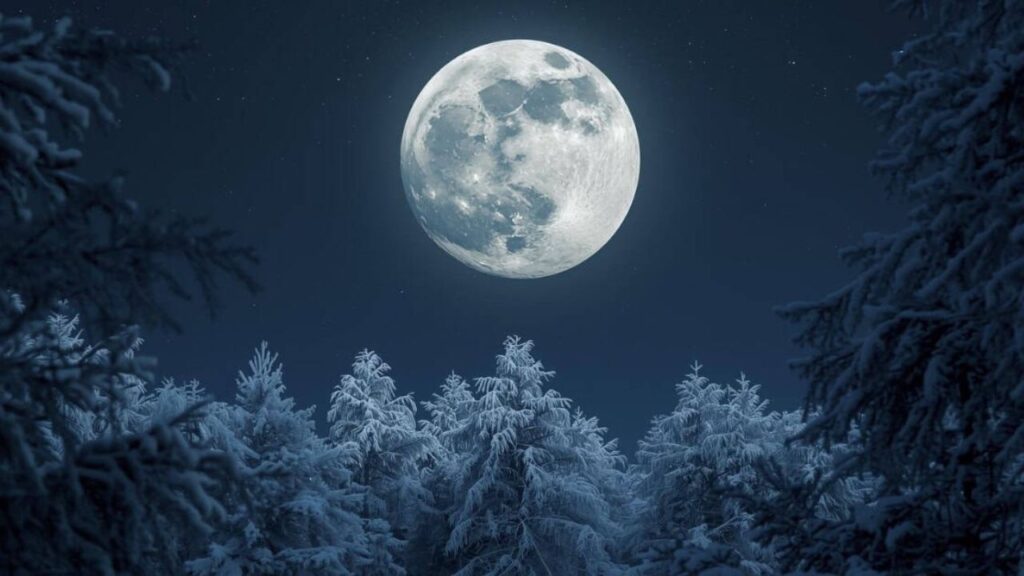


Skywatchers are in for a celestial treat this week as 2025’s final full moon — known as the “Cold Moon” — rises at sunset on December 5. If weather or city skylines obstruct your view, several observatories are offering free livestreams so you can enjoy the lunar spectacle from home.
Traditionally called the Cold Moon due to the onset of winter chill across the Northern Hemisphere, this month’s full moon is also known as the Moon Before Yule, marking the last full moon before Christmas. This year’s event will be particularly striking because the moon reaches full phase while coming within 90% of its closest distance to Earth, also called perigee. This alignment transforms it into a supermoon, appearing up to 14% larger and nearly 30% brighter than the faintest full moon of the year.
Adding to its brilliance, December’s full moon arrives as the moon’s orbit enters the final stage of a Major Lunar Standstill, a rare 18.6-year cycle. During this period, the moon rises from an unusually northerly point on the horizon and arcs higher through the sky than usual, creating dramatic viewing conditions for observers.
Where to Watch the Cold Moon Online
If clouds or poor visibility threaten your plans, two major observatories will broadcast the event live:
Virtual Telescope Project Livestream
- When: Dec. 4, 3 p.m. EST (2000 GMT)
- Where: Hosted from Manciano, Italy
The Virtual Telescope Project, led by astrophysicist Gianluca Masi, will stream telescopic views of the gleaming Cold Moon a day before its peak. The broadcast will also feature some of Masi’s most remarkable moon images captured above Rome’s historic monuments.
Griffith Observatory Livestream
- When: Dec. 5, 8:27 p.m. EST (0127 GMT on Dec. 6)
- Where: Live on YouTube from Los Angeles
Viewers can watch the moon rise dramatically over the eastern horizon as seen from the iconic Griffith Observatory on Mount Hollywood.
Gear Up for Moon Watching
Those inspired to explore the moon beyond livestreams can consider browsing guides featuring the best binoculars, telescopes, and astrophotography cameras and lenses available in 2025. With the right equipment, capturing the moon’s craters, shadows, and glowing surface becomes an unforgettable experience.