
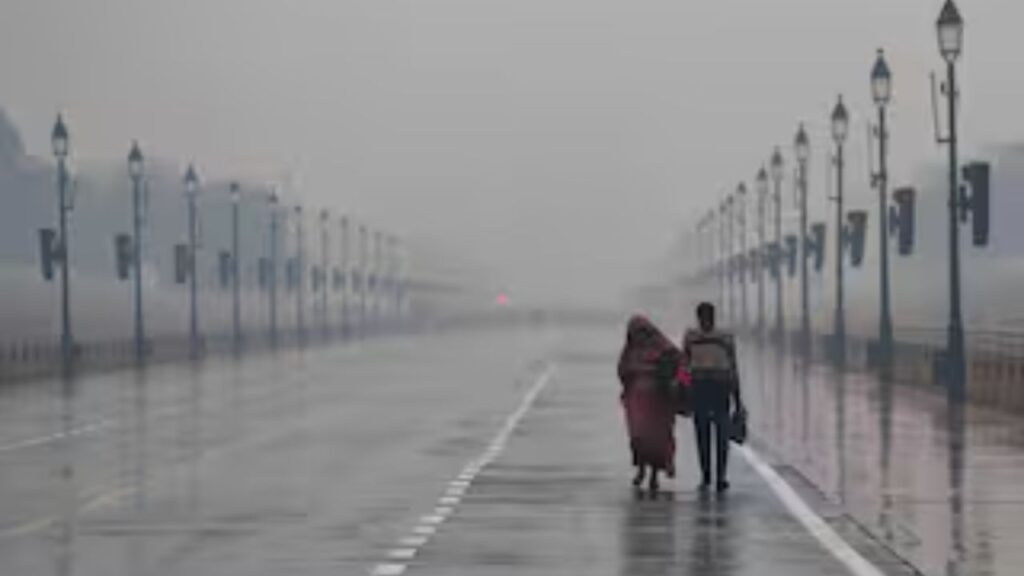


A thick blanket of fog covered Delhi-NCR on Monday morning, sharply reducing visibility on roads and at the airport, even as the region continued to battle hazardous air quality levels in the ‘severe-plus’ category. The combination of poor visibility and toxic smog disrupted daily movement and raised concerns for air and road travel across the capital.
Amid the worsening conditions, IndiGo Airlines issued a travel advisory, alerting passengers to possible delays due to low visibility at Delhi airport. The airline said flight operations were being adjusted as visibility levels had dropped, with some departures taking longer than usual. IndiGo assured travellers that its ground teams were available to assist passengers and stressed that safety remained its top priority.
The airline also warned that foggy conditions could slow down road traffic, advising passengers to leave early and factor in additional travel time to reach the airport. IndiGo said it is closely monitoring weather conditions and will keep passengers updated as operations gradually normalise with improving visibility.
On Sunday, Delhi witnessed one of its worst air pollution episodes in recent months, with a dense layer of toxic smog engulfing the city and drastically reducing sunlight. The city’s 24-hour average Air Quality Index (AQI) stood at 461, placing it firmly in the ‘severe-plus’ category. This marked the worst air quality recorded in December in nearly 13 months and the second-highest December AQI since systematic records began in 2015.
Meteorologists attributed the alarming pollution levels to unfavourable weather conditions, including high moisture, low temperatures and nearly calm winds, which trapped pollutants close to the ground. An atmospheric inversion — where cooler air near the surface remains trapped under warmer air above — further prevented the dispersion of pollutants.
Experts said that with wind speeds close to zero, Delhi’s pollution was largely driven by its own local emissions. “There is hardly any air movement, meaning pollutants remain confined over the city. Vertical mixing is limited, so whatever is emitted stays trapped,” explained Gufran Beig, founder of SAFAR and Chair Professor at the National Institute of Advanced Studies.
Air quality monitoring data showed that 38 out of 39 stations across the city recorded ‘severe’ pollution levels, with several areas — including Wazirpur, Rohini and Ashok Vihar — hitting the maximum AQI reading of 500. Shadipur was the only station to report ‘very poor’ air quality, with an AQI of 375.
This marks the second spell of severe pollution days in Delhi this winter season. Earlier, the city recorded three consecutive days of severe air quality between November 11 and 13. In total, Delhi has now experienced five days this season with AQI levels exceeding 400.
As pollution levels worsened over the weekend, authorities implemented the Graded Response Action Plan (GRAP). Stage III was enforced on Saturday morning, followed by Stage IV later in the evening as air quality showed no signs of improvement. Currently, all stages of GRAP remain in effect across the city.
Visibility also dropped sharply due to dense fog. On Sunday morning, Safdarjung recorded the lowest visibility at 200 metres, while Palam reported 350 metres. According to the India Meteorological Department (IMD), fog is classified as ‘dense’ when visibility falls below 200 metres. The IMD has forecast shallow to moderate fog during the early hours of Monday.
Despite a slight rise in wind speeds expected later in the day, experts warned that there would be no significant relief from pollution. The Centre’s Air Quality Early Warning System, however, indicated that AQI levels may improve marginally to the ‘very poor’ category in the coming days, though conditions are likely to remain unhealthy through mid-December.
With toxic air and dense fog continuing to grip the capital, authorities and airlines have urged residents and travellers to exercise caution, limit outdoor exposure, and plan journeys carefully amid challenging weather and pollution conditions.