
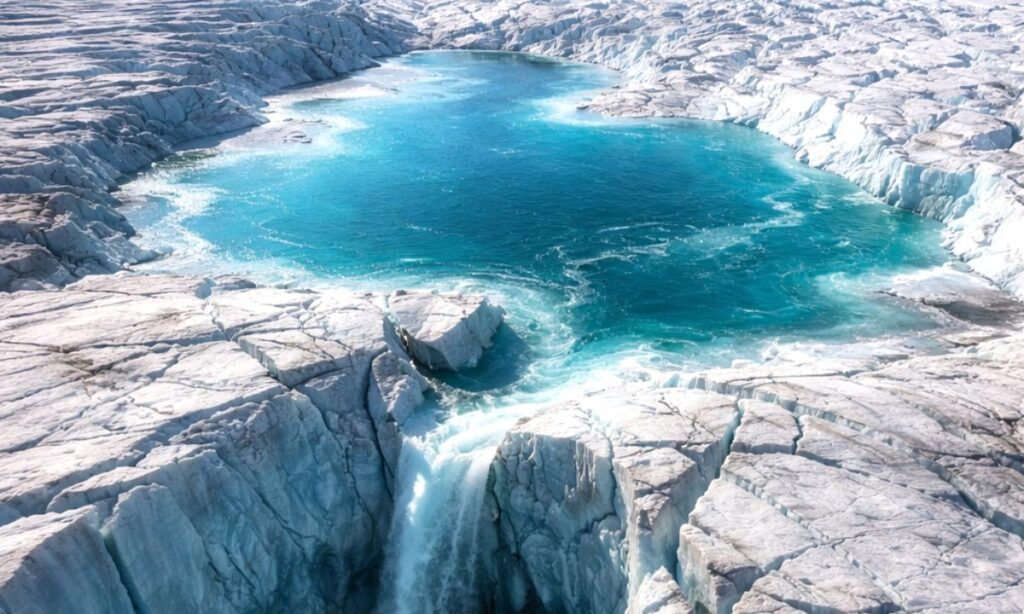


A large meltwater lake that first appeared in 1995 on Greenland’s 79°N Glacier is reshaping the ice in dramatic and unexpected ways. New research shows that repeated lake drainages are cracking the glacier, sending huge volumes of water deep inside the ice, and even lifting parts of the glacier from below.
The lake was first identified in satellite and aerial records from 1995. Before that, no surface lakes had ever been observed in this part of the glacier. According to Prof. Angelika Humbert, a glaciologist at the Alfred Wegener Institute Helmholtz Centre for Polar and Marine Research, the lake formed only after atmospheric temperatures began rising in the mid-1990s.
A lake that drains again and again
After forming, the lake did not remain stable. Between 1995 and 2023, its water repeatedly drained suddenly through cracks and channels in the ice. Each drainage released massive amounts of fresh water toward the ocean via the floating glacier tongue.
Researchers identified seven major drainage events in total. Four of them occurred within just the last five years. This shows that drainage is becoming more frequent as the climate warms.
Each sudden outflow puts extreme stress on the ice. Instead of draining smoothly, the water forces open fractures that cut deep into the glacier.
Strange cracks and giant vertical shafts
From 2019 onward, scientists began to observe unusual fracture patterns on the glacier surface. Large triangular fields of cracks formed during lake drainages. These shapes are different from anything researchers had seen at other meltwater lakes.
Some of these cracks developed into vertical shafts called moulins. These openings can be several dozen meters wide and act like funnels, guiding water rapidly from the surface to the base of the ice sheet.
Even after the main lake has drained, water continues to flow through these moulins. This allows enormous volumes of meltwater to reach the bottom of the glacier within just a few hours.
For the first time, researchers were able to measure these internal drainage channels directly and track how they change over several years.
Why cracks open and then close again
After the lake formed in 1995, its surface area slowly shrank as cracks appeared. In recent years, however, drainage events have become more frequent. Scientists suspect this is because the same triangular moulin systems have been reactivated again and again since 2019.
This behavior is linked to how glacier ice behaves. Ice flows slowly like a very thick liquid as it moves over bedrock. At the same time, it is elastic, meaning it can bend and partially return to its original shape.
This combination allows cracks and channels to open during sudden water pressure. Over time, the slow flow of ice can cause those channels to close again. Radar data shows that while the inside of the channels changes, the surface fracture patterns can remain visible for many years.
Meltwater is lifting the glacier
Aerial images revealed shadows along many of the surface cracks. In some cases, the ice on one side of a fracture was higher than on the other.
The most striking movement was observed beneath the lake itself. During drainage, huge volumes of water flowed into fractures below the glacier and pooled there. Radar data shows a blister-like feature under the ice, where water pushed the glacier upward from below, forming a temporary subglacial lake.
Remarkably, surface cracks from the earliest drainage events are still visible more than 15 years later. This shows that the glacier remembers these extreme events for a long time.
What this means for Greenland’s future
To reach their conclusions, researchers combined satellite data, airborne surveys, radar measurements, and computer models. The models help explain how drainage channels form, how long they stay open, and whether they can close again between events.
A key question now remains unanswered. Has repeated drainage pushed the 79°N Glacier into a new long-term state, or can it still return to normal winter conditions despite such extreme water input?
In just ten years, drainage has become more regular and more intense, with massive water pulses occurring over hours or days. Scientists do not yet know whether the glacier system can absorb this amount of water or if it will continue to weaken.
Why these findings matter
Cracks and fractures are often poorly represented in ice sheet models. This study provides rare real-world data on how fractures form, evolve, and interact with meltwater.
As warming continues, surface cracks are forming farther uphill, affecting larger parts of Greenland’s ice. Understanding these processes is critical for predicting how the Greenland ice sheet will respond to climate change and how fast it may contribute to future sea level rise.
For climate science and policy alike, what is happening on the 79°N Glacier is a warning from the ice itself.