


Introduction: State the Policy and the Narrative
Launched in 2014, the Swachh Bharat Mission (SBM) is one of India’s largest public sanitation initiatives aimed at eliminating open defecation, improving municipal solid waste management, and transforming sanitation behaviour across rural and urban areas. It is presented not merely as a cleanliness campaign, but as a civilisational shift toward hygiene, dignity, and modernity. From its outset, SBM was framed as a jan andolan, a people’s movement rather than a conventional government scheme. The political narrative attached to SBM emphasises national unity, citizen responsibility, and moral renewal. By linking cleanliness to patriotism and national pride, invoking Mahatma Gandhi’s vision SBM was positioned as a collective moral project rather than a technical sanitation programme. My core argument is that this political narrative significantly expanded public participation and bureaucratic urgency, but also introduced pressures for target-driven delivery, image management, and premature declarations of success.
SBM illustrates how political storytelling can accelerate policy action, but also how narrative oversimplification can overshadow on-ground complexities
Context: How the Narrative Was Built
A. Who shaped the narrative?
The narrative around SBM was primarily shaped by the Prime Minister, supported by the Ministry of Jal Shakti, state governments, cultural icons, and mass media. High-visibility events such public sweeping, celebrity ambassadors, and social media campaigns created a narrative frame that positioned cleanliness as a personal and patriotic duty.
B. What political goals or values does it signal?
SBM signals values of modernity, civic discipline, gender dignity, and national pride. It also communicates governance values aligned with the government’s political identity: efficiency, mass mobilisation, behavioural change, and a mission-driven approach.
C. How was it communicated?
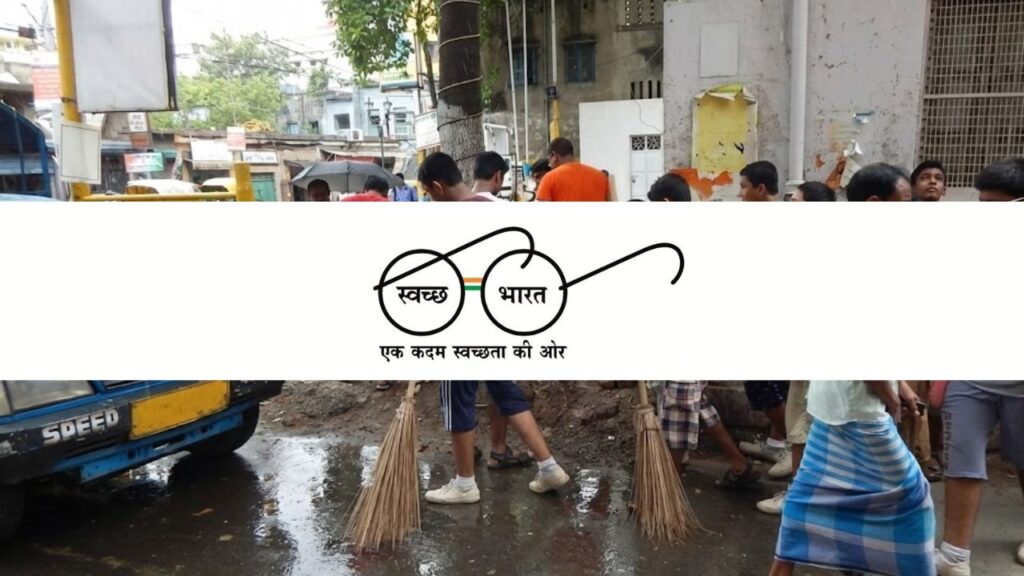
- Strong symbolism: Gandhi’s spectacles as SBM’s logo
- Multimedia campaigns, films, school competitions, and public pledges
- PM’s direct communication via radio (Mann Ki Baat), social media, and events
- Public participation through Swachhata Awards, cleanliness rankings, and “Swachhata hi Seva” weeks
This narrative strategy elevated sanitation from an administrative function to a social movement with emotional, moral, and political resonance.
Analysis: Narrative vs Policy Reality
A. Where the narrative aligns with outcomes
- Mass mobilisation: Citizens, celebrities, schools, and NGOs actively engaged.
- Rapid infrastructure expansion: Millions of toilets were constructed; ODF declarations surged.
- Behaviour change discourse: Sanitation entered mainstream conversations, breaking long-standing taboos around toilets and human waste.
- Administrative focus: Local governments received unprecedented attention and funding.
B. Where the narrative diverges
- Overemphasis on toilet construction: The narrative of “ODF India” led states to prioritise infrastructure numbers over sustainability, leading to underuse, broken toilets, or inadequate water supply in several regions.
- Underplayed challenges: Issues like manual scavenging, solid waste segregation, and faecal sludge treatment remained less visible.
- Pressure to meet political deadlines: District officials reported pressure to declare ODF status earlier than reality allowed, reflecting narrative-driven administrative behaviour.
C. How narrative influenced implementation
The narrative strengthened implementation by creating urgency and public engagement. However, it also simplified complex sanitation behaviour into a symbolic mission, sometimes sidelining systemic improvements (e.g., wastewater networks, urban SWM capacity).
D. Competing narratives
- Opposition parties questioned the authenticity of ODF claims.
- Civil society organisations highlighted gaps in post-construction sustainability and sanitation infrastructure inequity.
- The media alternated between celebrating SBM’s ambition and reporting ground-level inconsistencies.
The coexistence of celebratory political messaging and scrutiny-based narratives reveals the tension between symbolic politics and operational reality.
Impact: What the Narrative Has Achieved (or Undermined)
A. Positive impacts
- High public support: National pride framing helped normalise sanitation as a priority.
- Administrative momentum: Sanitation departments received budgetary and political priority not seen before.
- Rapid implementation: Deadlines created speed, particularly in rural toilet construction.
- Behavioural impact: Open discussion on sanitation helped shift norms in many regions.
B. Negative or unintended impacts
- Reduced focus on long-term operations and maintenance since visible construction had greater political value.
- Data inflation risks: Pressure to meet targets sometimes compromised reporting accuracy.
- Solid waste management lag: Complex elements like waste segregation and processing grew slower than toilet construction.
Overall, the narrative accelerated the mission’s rollout but sometimes at the cost of depth and institutional strengthening.
Forward View: Reframing or Rebalancing the Narrative
To sustain gains and correct distortions, SBM’s narrative for the next decade should evolve from “cleanliness as patriotism” to “sanitation as public health and environmental resilience.”
A. Shift narrative from infrastructure to outcomes
Emphasise:
- Toilet usage rates, not toilet counts
- Faecal sludge management
- Waste processing and circular economy
- Clean water and hygiene behaviour
B. Reintroduce the narrative of dignity and equity Focus on:
- Ending manual scavenging completely
- Safe sanitation for women, children, elderly, and persons with disabilities
- Addressing sanitation challenges in informal settlements
C. Build a narrative around scientific indicators
Use dashboards, public data, and local scorecards to communicate progress in:
- Segregation rates
- Waste processing
- Water quality
- Fecal sludge treatment coverage
D. Move toward shared responsibility, not just citizen voluntarism
Rebalance messaging toward:
- Municipal accountability
- Private sector waste responsibility
- Sustainable financing
This reframing can shift SBM from a symbolic campaign to a durable urban-rural sanitation transformation.
Conclusion
The Swachh Bharat Mission demonstrates the power of political narrative to mobilise a nation and catalyse administrative energy. Its success lies not only in infrastructure but in changing how India talks about sanitation as a matter of pride, dignity, and collective responsibility. Yet, the same narrative that accelerated the mission also created blind spots by prioritising visibility and symbolism over long-term system building. For SBM’s next phase, political storytelling must evolve to foreground sustainability, equity, and scientific accountability. Recognising the power of narrative allows policymakers to improve alignment between public messaging and ground realities. The central insight is clear: policy implementation is shaped as much by the stories we tell as by the rules we design. A refined, future-oriented narrative can ensure that SBM continues to deliver genuine, lasting improvements in sanitation and public health.
(Authored by Sahil Sawant, Project Associate, Civic Pride Organization)
References
- Ministry of Jal Shakti, Government of India “About Swachh Bharat Mission (Gramin / Urban)
- 10 years of Swachh Bharat Mission: Its aims and status on key targets” The Indian Express (2024)
- Toilet construction under the Swachh Bharat Mission and infant mortality in India” Scientific Reports (2024) (study showing SBM-linked health benefits, including mortality reduction)
- Frontiers journal “Effectiveness of the Swachh Bharat Mission and barriers to ending open defecation in India: a systematic review” (2023) documenting gaps between sanitation infrastructure and actual usage/sustainability.
- BMC Public Health “The process, outcomes and context of the sanitation change induced by SBM in rural Jharkhand” (2024), empirical data on toilet coverage and use under SBM