
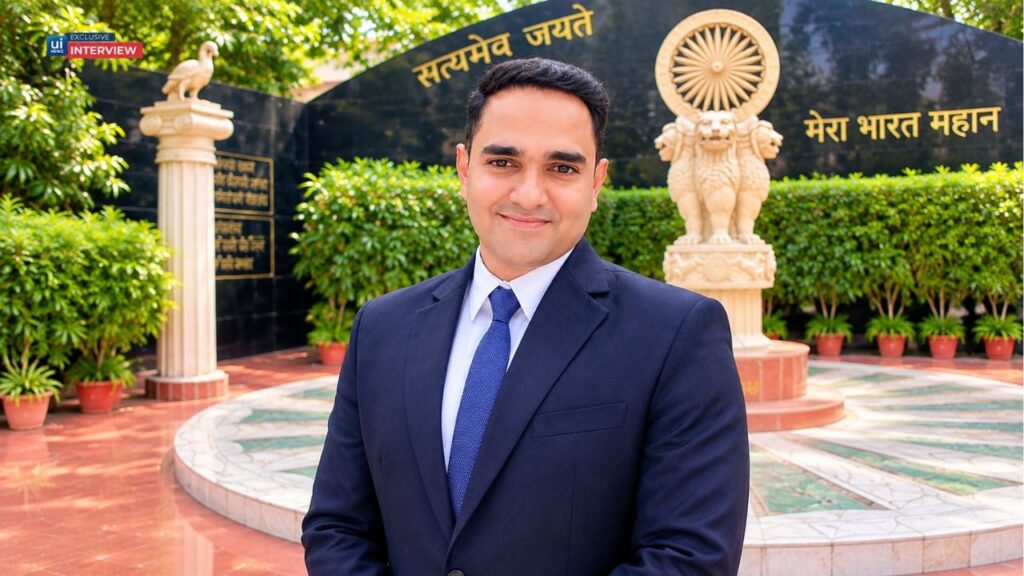


For years, Shiv Mishra’s world was beneath the sea, aboard Indian Navy submarines, where he served as Chief of the Weapons Department.
Today he works above ground, as an Executive Magistrate. The road between the two was not a straight one. It runs through a village in Basti district, a residential school that changed his course, one missed selection, and a stubborn belief that a task is not over until it is finished.
“It gave me an attitude of not going back before finishing your task. So I decided to finish my goal within the time limit.”
That is how Mishra describes what the military taught him. It is also a fair summary of his story.
A small village, a big exam
Mishra grew up in a small village in Basti district, Uttar Pradesh, where resources and infrastructure were hard to come by. What he did have, he says, was the guidance of his parents and teachers, and a great deal of determination.
It was enough to crack the entrance exam of Jawahar Navodaya Vidyalaya (JNV), the network of residential schools that gives talented children from rural areas a strong education. “It shaped and reinforced my destiny,” he says.
JNV gave him a good education and a firm foundation, and it paid off quickly. While still studying for his BSc in Mathematics (Honours) at the University of Lucknow, he cleared the entrance exam of the Indian Navy.
Life beneath the waves
In the Navy, Mishra became Chief of the Weapons Department aboard Shishumar-class and Kalvari-class submarines. He served in several countries, took part in multiple operations in national and international waters, and was associated with Project 75 in France.
The work, he says, built his leadership and gave him “the strength to perform tasks in difficult situations.” It also gave him a close view of the equipment itself. India’s current combat weapons, he says, still have limits when set against global standards such as those of the United States and Israel, though the DRDO is working to modernise the country’s arsenal.
Leading a team on a submarine means working with limited resources under high pressure. Mishra’s approach is what he calls “soft power”: open communication, used to deal with insubordination or low motivation among subordinates, rather than force.
The officer who stayed in his mind
Why leave a Navy career that had given him so much? Part of the answer is a wish for variety. After years in the defence sector, Mishra wanted something different.
The other part is a person. In his tehsil, there was an officer who was honest and served with dedication for the public good, and Mishra never forgot him. “I was inspired by an officer in my tehsil,” he says. “He was very honest and was serving with dedication for the public good.”
He set his sights on the Uttar Pradesh Public Service Commission (UPPSC) examination. He knew which jobs he wanted: Sub-Divisional Magistrate (SDM) or ARTO. He deliberately kept police services off the list because he did not want to step into another combat-style environment after the Navy.
A setback, and a second try
The first attempt did not go his way. In 2023, Mishra reached the Mains for the first time but was not selected in the end.
He did not stop. “Learning from the past, I decided to crack the exam in my second attempt,” he says. And he did.
He credits the military for that resolve. It gave him discipline, dedication, and a positive attitude towards difficult situations, he says, and a habit of seeing a task through to the end.
In May 2026, Mishra received his appointment letter from the Government of Uttar Pradesh at a ceremony where letters were handed to 932 selected candidates across 21 departments.
Eyes on the people he will serve
As an Executive Magistrate, Mishra says he wants to lead with compassion and reach as many people as he can, leaving no one behind. “I will try to deliver public service to the marginalised and the poor,” he says, “with proficiency, efficiency, competence and the highest level of professionalism.”
His thoughts go beyond the office. He worries about the rise of hatred in society, which he links to a decline in moral values, growing materialism, and the way social media spreads misinformation. He also points to historical and systemic causes behind the economic backwardness of Purvanchal, in eastern Uttar Pradesh, compared with the west of the state.
And there is poetry. Mishra loves Hindi verse, and during his conversation he recited a poem by Harivansh Rai Bachchan about disaster and human resilience. It is a fitting choice for a man whose story is about getting up and going on.
Himmat, hausla, hoshiyari
Asked what he would tell young aspirants, especially those from small towns and those in the armed forces who dream of the civil services, Mishra answers “in fauji style” with three words:
- Himmat (courage): the courage to face difficult situations.
- Hausla (morale): high morale and the confidence to pursue your goal.
- Hoshiyari (sharpness): a sharp mind and quick understanding.
“Be brave,” he says. “Be like a soldier.”
For a boy who once studied in a village with few resources and who missed his first big attempt, the advice comes with proof.
At UI NEWZ, we believe every story deserves to be heard. We bring you the voices, achievements and ideas that inform, inspire and make a difference, from local initiatives and emerging talent to enterprise, culture and community change. If you know someone whose journey deserves the spotlight, or have a story of your own to share, write to us at info.uinewz@gmail.com.