
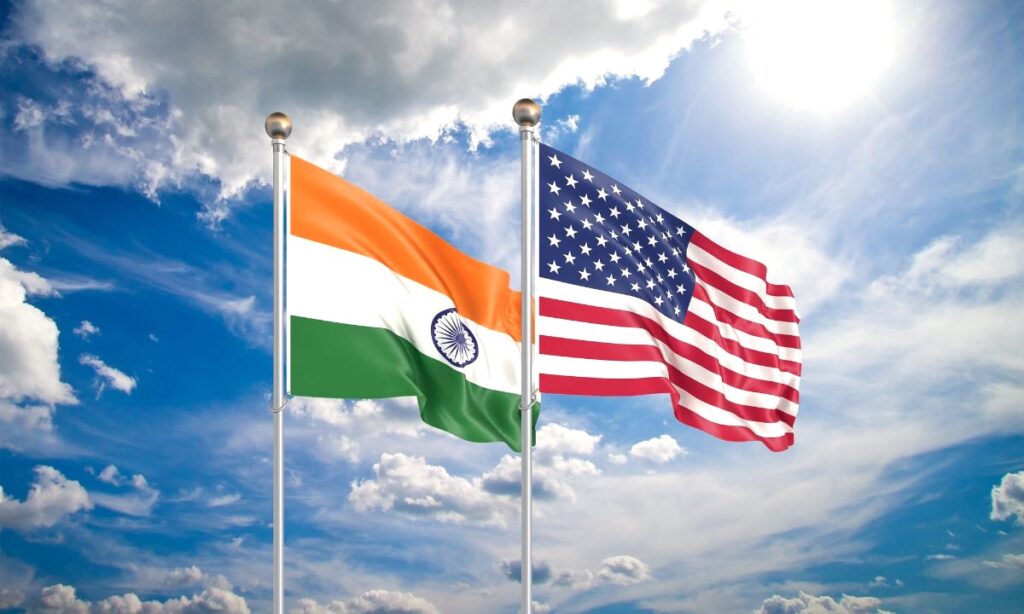


The United States of America and India have announced that they have reached a framework for an Interim Agreement on reciprocal and mutually beneficial trade, marking a significant step forward in deepening economic ties between the two strategic partners.
The framework reaffirms both countries’ commitment to the broader U.S.- India Bilateral Trade Agreement (BTA) negotiations, formally launched by Donald J. Trump and Narendra Modi on February 13, 2025. The Interim Agreement is expected to serve as a foundation for expanded market access, resilient supply chains, and balanced trade outcomes.
Key Highlights of the Interim Agreement Framework
Tariff Liberalisation by India
India has agreed to eliminate or reduce tariffs on all U.S. industrial goods and a wide range of U.S. agricultural and food products, including:
- Dried distillers’ grains (DDGs)
- Red sorghum for animal feed
- Tree nuts, fruits (fresh and processed)
- Soybean oil
- Wine and spirits
Reciprocal Tariff Measures by the United States
The United States will apply a reciprocal tariff rate of 18% on certain Indian-origin goods under existing executive orders, covering sectors such as textiles, apparel, leather, footwear, chemicals, home décor, artisanal products, and select machinery.
Subject to the successful conclusion of the Interim Agreement, the U.S. will remove reciprocal tariffs on a wide range of Indian exports, including:
- Generic pharmaceuticals
- Gems and diamonds
- Aircraft parts
Relief from Section 232 Tariffs & Sector-Specific Quotas
The U.S. will remove tariffs on certain Indian aircraft and aircraft parts imposed under national security provisions related to aluminum, steel, and copper imports.
India will also receive a preferential tariff-rate quota for automotive parts, subject to U.S. national security requirements. Outcomes related to pharmaceuticals will depend on the findings of the ongoing Section 232 investigation.
Market Access, Rules & Non-Tariff Barriers
- Both countries committed to preferential market access in sectors of mutual interest.
- Rules of origin will be established to ensure benefits primarily accrue to the U.S. and India.
- India agreed to address long-standing non-tariff barriers, including:
- Medical device trade restrictions
- Import licensing hurdles for ICT products
- Standards and testing requirements for U.S. exports
- Barriers affecting U.S. food and agricultural products
The two sides will also engage on standards cooperation and conformity assessment procedures to improve ease of compliance.
Economic Security & Supply Chain Cooperation
The agreement emphasizes stronger economic security alignment, including:
- Coordinated approaches to non-market policies of third countries
- Cooperation on investment screening and export controls
- Joint efforts to strengthen supply chain resilience and innovation
$500 Billion Trade & Technology Push
India has indicated its intent to purchase $500 billion worth of U.S. goods over the next five years, spanning:
- Energy products
- Aircraft and aircraft parts
- Precious metals
- Technology products
- Coking coal
Both nations also plan to significantly expand trade in advanced technology products, including GPUs and data-center-related goods, alongside deeper joint technology cooperation.
Digital Trade & Next Steps
The U.S. and India committed to addressing discriminatory or burdensome digital trade practices and establishing a clear pathway toward ambitious and mutually beneficial digital trade rules under the BTA framework.
Both sides agreed to promptly implement the framework and work toward finalizing the Interim Agreement, with the shared objective of concluding a comprehensive Bilateral Trade Agreement in line with the agreed roadmap.
Why it matters:
This Interim Agreement framework represents a historic milestone in U.S.- India relations- signaling a shift toward more balanced, predictable, and strategic trade cooperation at a time of global economic uncertainty and supply chain realignments.