
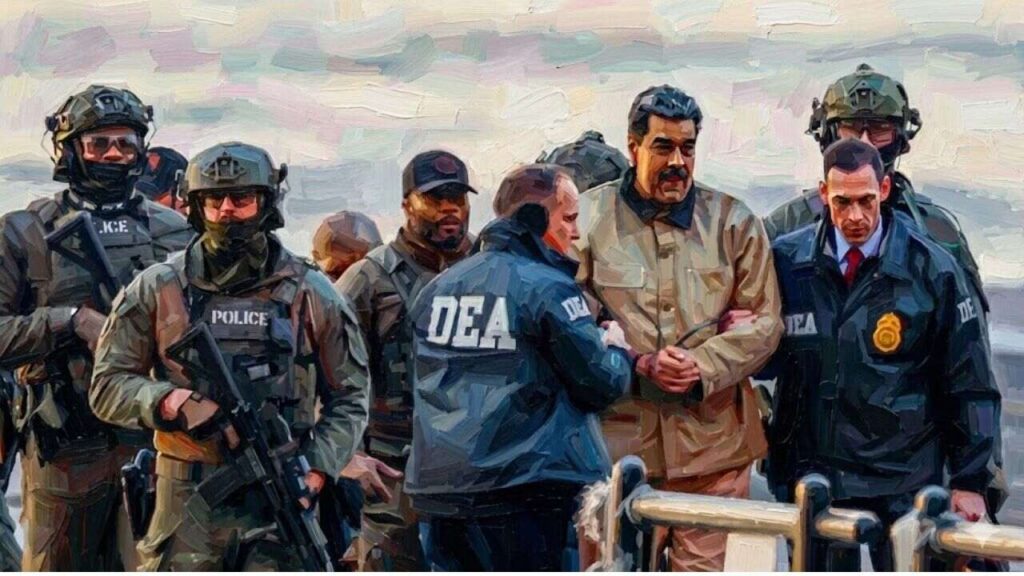


Venezuelan President Nicolás Maduro appeared in a Manhattan federal court on Monday, declaring himself a “prisoner of war” after US forces captured him in a military operation that killed dozens and sparked sharp criticism at the United Nations over violations of international law.
Maduro, 63, and his wife Cilia Flores, 69, pleaded not guilty to narco-terrorism and cocaine trafficking charges stemming from a 2020 indictment that accuses them of using Venezuela’s government to import tons of cocaine into the United States.
“I am the president of Venezuela, I consider myself a prisoner of war. I was captured at my home in Caracas,” Maduro told US District Judge Alvin Hellerstein through a translator on January 5, 2026. Flores also declared herself “first lady of the Republic of Venezuela” and pleaded “completely innocent” to the charges.
The operation has plunged Venezuela into uncertainty, drawn condemnation from US allies and adversaries alike, and raised fundamental questions about international law and American military power.
US Military Operation: What Happened
The US military launched “Operation Absolute Resolve” around 2 a.m. local time on January 3, 2026, with explosions reported across Caracas and surrounding areas. According to General Dan Caine, Chairman of the Joint Chiefs of Staff, American forces had spent months planning the operation, which involved large-scale aerial strikes to disable Venezuelan air defences before deploying ground forces.
Venezuelan officials report that at least 24 Venezuelan security personnel were killed during the attack. Cuba’s government stated that 32 Cuban military and intelligence agents died in the operation. Venezuelan officials have cited death tolls ranging from 40 to 80 people, including civilians.
President Donald Trump confirmed that some US service members were injured but stated there were no American fatalities. Two US personnel remain in medical treatment as of January 7, while five others have returned to duty, according to Department of Defence officials.
Maduro and Flores were transported aboard the USS Iwo Jima and later flown to New York’s Stewart Air National Guard Base. They were detained at the Metropolitan Detention Centre in Brooklyn before their court appearance.
The Charges: What Maduro Faces
The indictment, originally filed in March 2020 and unsealed on January 3, 2026, charges Maduro with four counts: narco-terrorism conspiracy, cocaine importation conspiracy, possession of machine guns and destructive devices, and conspiracy to possess machine guns and destructive devices.
US prosecutors allege that Maduro and his associates, including senior Venezuelan officials and members of the Revolutionary Armed Forces of Colombia (FARC), conspired to flood the United States with cocaine to undermine American communities while enriching themselves and supporting terrorism.
The indictment claims that Maduro and his co-conspirators used Venezuela’s military and intelligence apparatus to coordinate with FARC rebels to move massive quantities of cocaine through Venezuela to the United States and other countries. According to the charges, the conspiracy dates back to the late 1990s.
If convicted on all counts, Maduro faces a mandatory minimum sentence of 50 years in prison and a maximum sentence of life imprisonment. The narco-terrorism charge alone carries a mandatory minimum of 20 years.
‘Prisoner of War’ Declaration: What It Means
Maduro’s claim to be a “prisoner of war” rather than a criminal defendant carries significant legal and political implications. Under international law, prisoners of war are members of armed forces captured during armed conflict and are protected by the Geneva Conventions.
The declaration appears designed to frame his capture as an act of international aggression rather than legitimate law enforcement. By claiming POW status, Maduro positions himself as a head of state unlawfully seized through military force, not a criminal suspect lawfully arrested.
However, legal experts note that the US operation does not meet the threshold for armed conflict under international law, and Maduro’s status as a sitting head of state complicates his designation as a POW. The United States has not declared war on Venezuela and characterises the operation as law enforcement action against a criminal defendant.
The UN Charter generally prohibits the use of force against the territorial integrity or political independence of any state. The US action has drawn widespread international criticism for violating Venezuelan sovereignty.
International Reaction: Sharp Divisions
The operation has triggered one of the sharpest diplomatic crises in recent years. At an emergency UN Security Council session on January 4, Russia and China introduced a resolution condemning the US military action as a violation of international law and the UN Charter.
Russian Ambassador Vassily Nebenzia called the operation “an act of military aggression against a sovereign state” and demanded Maduro’s immediate release. Chinese Ambassador Fu Cong stated that the US had violated “the most fundamental principles of international law.”
However, the resolution failed to pass due to US and British vetoes. The United Kingdom abstained, with British officials expressing concerns about the operation’s legality while noting Maduro’s “appalling human rights record.”
Major US allies have issued cautious responses. France’s Foreign Ministry stated it was “concerned about the circumstances” of the operation and called for respect for international law. Germany’s government said it was “reviewing the legal basis” for the action.
Several Latin American countries have condemned the operation. Mexico’s President Claudia Sheinbaum called it a violation of Venezuela’s sovereignty. Brazil’s President Luiz Inácio Lula da Silva termed it a very serious affront to Venezuelan sovereignty and an extremely dangerous precedent. On January 4, Brazil, Spain, Chile, Colombia, Mexico and Uruguay issued a joint statement expressing their profound concern and firm rejection of the unilateral military action.
India’s Response: Cautious Diplomacy
India issued its first official statement on January 4, more than 24 hours after the operation, expressing deep concern but conspicuously avoiding naming the United States or condemning the military action directly.
The Ministry of External Affairs statement said that recent developments in Venezuela are a matter of deep concern and that India is closely monitoring the evolving situation. India reaffirmed its support for the well-being and safety of the people of Venezuela and called upon all concerned to address issues peacefully through dialogue, ensuring peace and stability of the region.
The carefully worded statement stands in marked contrast to the sharper responses from other major powers in the Global South. While countries like Brazil, Russia and China explicitly condemned the US action, India’s statement made no direct reference to Washington or the military strikes.
On January 3, immediately after the operation, the MEA had issued a travel advisory urging Indian nationals to avoid all non-essential travel to Venezuela and advising those already present to exercise extreme caution and remain in contact with the Indian Embassy in Caracas. The embassy has approximately 50 non-resident Indians and 30 persons of Indian origin under its purview.
India’s measured response reflects its delicate balancing act between its traditional principles of sovereignty and non-interference, its strategic partnership with the United States, and its economic interests in Venezuela. Indian public sector company ONGC Videsh Limited holds a 40 per cent stake in a joint venture with Venezuela’s state oil company for oil production in the San Cristobal field.
Former Indian diplomats have expressed concern about the precedent set by the operation. Rajiv Dogra, a former diplomat, called the development unbelievable and unprecedented in recent times, stating that Trump has broken all traditions and sanctities of sovereignty. Another former ambassador to Venezuela, Deepak Bhojwani, noted that Maduro had been in the crosshairs of the US administration for years.
Indian left parties took a stronger stance, with the CPI(M), CPI, CPI(ML)-Liberation, RSP and AIFB jointly denouncing what they termed US aggression and the kidnapping of Maduro. The parties called on the Indian government to join countries condemning the US action and stand firmly with Venezuela.
In contrast, the Venezuelan opposition and several Latin American conservative leaders have welcomed Maduro’s capture. Venezuelan opposition leader María Corina Machado called it “a moment of justice” and urged the formation of a transitional government.
Venezuela’s Response: Political Vacuum
Venezuela‘s government has declared a state of emergency and appointed Vice President Delcy Rodríguez as acting president. The National Assembly, controlled by Maduro loyalists, convened an emergency session to denounce the US operation as “an act of war.”
Venezuelan Defence Minister Vladimir Padrino López has mobilised the armed forces and called on regional allies for support. Cuba has deployed additional military advisers to Venezuela, according to Venezuelan government sources.
However, significant uncertainty surrounds the loyalty of Venezuela’s security forces. Some military commanders have reportedly gone into hiding, while others have pledged continued support for the government.
Venezuela has recalled its diplomatic staff from the United States and several allied countries. The government has also announced it will seek an emergency session of the Organisation of American States, though the US holds significant influence in that body.
How US-Venezuela Relations Reached This Point
Relations between Washington and Caracas have deteriorated dramatically over the past two decades. The US has maintained sanctions on Venezuela since the mid-2000s, escalating them significantly under both the Trump and Biden administrations.
In 2019, the US recognised opposition leader Juan Guaidó as Venezuela’s interim president after disputed elections, though Guaidó’s movement has since lost momentum. The US has maintained that Maduro’s 2018 re-election was fraudulent.
The 2020 indictment marked an unprecedented step, making Maduro one of the few sitting heads of state ever charged with crimes in US courts. At the time, the US State Department offered a $15 million reward for information leading to Maduro’s arrest or conviction.
Previous US administrations considered military options but ultimately rejected them as too risky and legally questionable. The Trump administration in 2019 publicly discussed military intervention but did not pursue it.
Venezuela sits atop the world’s largest proven oil reserves and has been wracked by economic collapse, hyperinflation, and mass emigration under Maduro’s government. More than seven million Venezuelans have fled the country since 2014, creating a refugee crisis throughout Latin America.
Legal Debate: Jurisdiction and Sovereignty
Legal scholars are sharply divided on whether the US had legal authority to capture Maduro. The US government argues that it has jurisdiction to prosecute individuals who conspire to import narcotics into American territory, regardless of their location or official position.
However, international law experts point out that head-of-state immunity generally protects sitting leaders from prosecution in foreign courts. While this immunity can be waived or removed under certain circumstances, the use of military force to seize a sitting head of state is unprecedented in modern international relations.
The International Court of Justice has previously ruled that immunity applies even when serious crimes are alleged. The case may force international courts to grapple with fundamental questions about sovereignty, immunity, and the enforcement of criminal law across borders.
What Happens Next
Maduro and Flores are scheduled to appear in court again on January 14 for a bail hearing. Given the nature of the charges and Maduro’s resources, federal prosecutors are expected to argue strongly against bail.
The trial itself could take months or years to conclude. Maduro’s legal team is expected to challenge US jurisdiction and argue that his capture violated international law.
In Venezuela, Acting President Rodríguez faces the challenge of maintaining government control amid potential military fractures and opposition mobilisation. Elections could be called, though the timeline and legitimacy of any such process remain uncertain.
Diplomatically, the US faces potential isolation on the issue. The UN General Assembly may vote on a non-binding resolution condemning the operation. Regional organisations, including the Community of Latin American and Caribbean States, have scheduled emergency meetings.
The operation may also reshape international norms around the use of force, head-of-state immunity, and extraterritorial law enforcement, with implications far beyond Venezuela.