
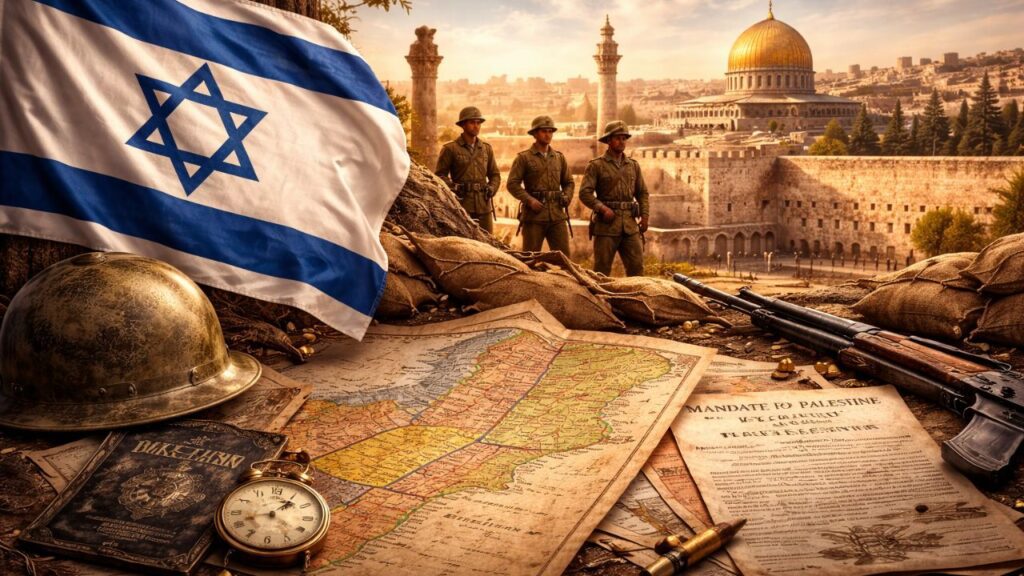


Israel Origin: It all happened in a rush, just before midnight. On May 14, 1948, as British rule in Palestine was about to end, David Ben-Gurion stood up in Tel Aviv’s Independence Hall and read out thirty-seven words that changed the Middle East forever: Israel was now a country. By midnight, the map had shifted. By morning, war had already broken out.
What followed was not simply a regional conflict. The creation of Israel set in motion a chain of events, mass displacement, multiple wars, and decades of unresolved diplomacy, whose consequences are still being negotiated in global forums today. To really get how Israel came to be, you have to rewind more than thirty years: back to a British promise made during wartime, a fading empire, and a pivotal vote at the United Nations.
British Mandate: How It Began
The origins of the Israel creation question lie in the aftermath of the First World War. Following the defeat of the Ottoman Empire, the League of Nations in 1922 appointed Britain to administer the territory of Palestine, an arrangement formalised as the Palestine Mandate.
The Mandate carried a critical political commitment: the 1917 Balfour Declaration, in which the British government expressed support for “the establishment in Palestine of a national home for the Jewish people,” while also stating that nothing should prejudice the civil and religious rights of “existing non-Jewish communities.”
At the time, Arabs comprised approximately 67 per cent of the population of Palestine, while Jews made up about 33 per cent, many of whom were recent immigrants from Europe.
The two communities held competing national aspirations over the same territory, and tensions mounted steadily through the 1930s and 1940s. In 1937, after a six-month Arab uprising, the British-established Peel Commission recommended dividing the land into two states, a Jewish one and an Arab one, marking the first official British proposal for partition.
Britain Refers the Question to the UN
Unable to reconcile the demands of Jewish and Arab communities, and facing growing unrest and armed attacks from both sides, Britain formally announced in February 1947 its intention to end the Mandate.
Britain formally requested on 2 April 1947 that the UN General Assembly set up the Special Committee on Palestine (UNSCOP). The eleven-nation committee, after examining the situation, recommended terminating the Mandate and partitioning Palestine into two independent states, one Jewish, one Arab, with Jerusalem placed under international administration.
The UN Partition Plan: Resolution 181 (1947)
Drafted by UNSCOP on 3 September 1947, the plan was adopted by the UN General Assembly on 29 November 1947 as Resolution 181 (II).
The partition plan allocated an Arab state 11,592 square kilometres, approximately 42.88 per cent of the Mandate’s territory, and a Jewish state 15,264 square kilometres, or about 56.47 per cent. The remaining 0.65 per cent, comprising Jerusalem and Bethlehem, was to become an international zone.
Although Jews were allocated more than half the area under the plan, they owned approximately 7 per cent of the land in 1947.
The Jewish Agency accepted the partition proposal. The Arab Higher Committee, the Arab League, and other Arab leaders rejected the plan, arguing it violated the principle of national self-determination enshrined in the UN Charter. They announced their intention to prevent its implementation.
Proclamation of Israel and the 1948 War
On 14 May 1948, Ben-Gurion proclaimed the establishment of the State of Israel. US President Harry S. Truman recognised the new nation on the same day.
On 15 May 1948, the first day of Israeli independence and exactly one year after UNSCOP was established, Arab armies from Egypt, Jordan, Syria, Iraq, and Lebanon invaded, and the Arab-Israeli War of 1948 began.
After tense early fighting, Israeli forces gained the offensive. Though the United Nations brokered two ceasefires, fighting continued into 1949. Formal armistice agreements were reached between Israel and Egypt, Lebanon, Transjordan, and Syria by early 1949.
In the 1948 war, Israel expanded to 77 per cent of the territory of Mandate Palestine, including the larger part of Jerusalem. Over half of the Palestinian Arab population fled or were expelled. This mass displacement is referred to by Palestinians as the Nakba, meaning “catastrophe.”
Jordan took control of the West Bank, and Egypt took control of the Gaza Strip. Jerusalem was divided, with West Jerusalem under Israeli control and East Jerusalem under Jordanian control.
International Recognition and US Role
The United States was the first country to recognise Israel. Although the US State Department had recommended against intervention, citing concerns over Soviet influence in the Arab world and the potential restriction of Arab oil supplies, President Truman ultimately decided to recognise the State of Israel.
The Soviet Union also extended early recognition. Britain, which had held the Mandate, did not immediately grant full recognition.
The Geopolitical Legacy
The creation of Israel in 1948 produced consequences that remain unresolved:
- Palestinian displacement: By 1949, approximately 750,000 Palestinians, roughly three-quarters of the Arab population of historic Palestine, had fled or been expelled.UN General Assembly Resolution 194 (1948) called for their right to return, a demand that remains central to Palestinian political negotiations today.
- The 1967 war and occupation: In the 1967 war, Israel occupied the remaining territories assigned by Resolution 181 to the Arab state, the Gaza Strip and the West Bank, including East Jerusalem, which Israel subsequently annexed. The war brought about a second exodus of Palestinians, estimated at half a million.
- Ongoing conflict: The status of Jerusalem, Palestinian statehood, Israeli settlements in the West Bank, and the rights of Palestinian refugees remain the principal unresolved issues in one of the world’s most protracted conflicts.
What Happens Next
The question of Palestinian statehood remains before the United Nations. As of 2024, the Palestinian Authority holds non-member observer state status at the UN, a position granted by the General Assembly in 2012. Multiple rounds of peace negotiations, including the Oslo Accords of 1993, Camp David talks of 2000, and subsequent frameworks, have not produced a final status agreement.
The UN Security Council continues to hold Israel’s compliance with international law under review, including the status of settlements in the occupied West Bank. Diplomatic efforts involving the United States, Arab states, and international mediators remain ongoing, though no binding resolution is in effect.