
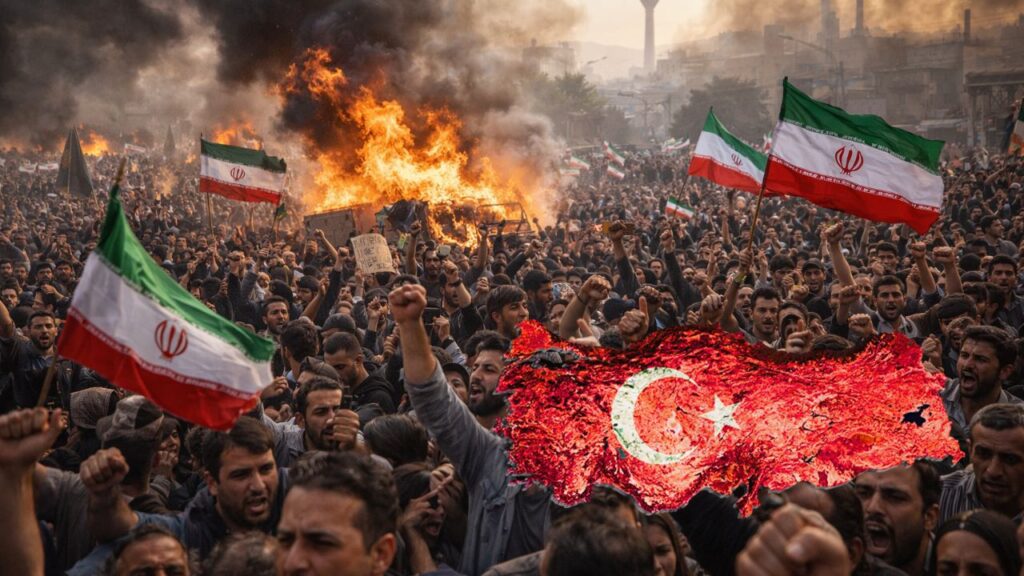


Iran’s Protest: Mass protests erupted across Iran beginning 28 December 2025, triggered by severe economic hardship and rapidly evolving into what observers have described as the largest uprising since the 1979 Islamic Revolution. The demonstrations have spread to all 31 provinces, prompting a violent security response that has drawn widespread international condemnation and raised fundamental questions about the survival of the Islamic Republic.
What Triggered the Protests
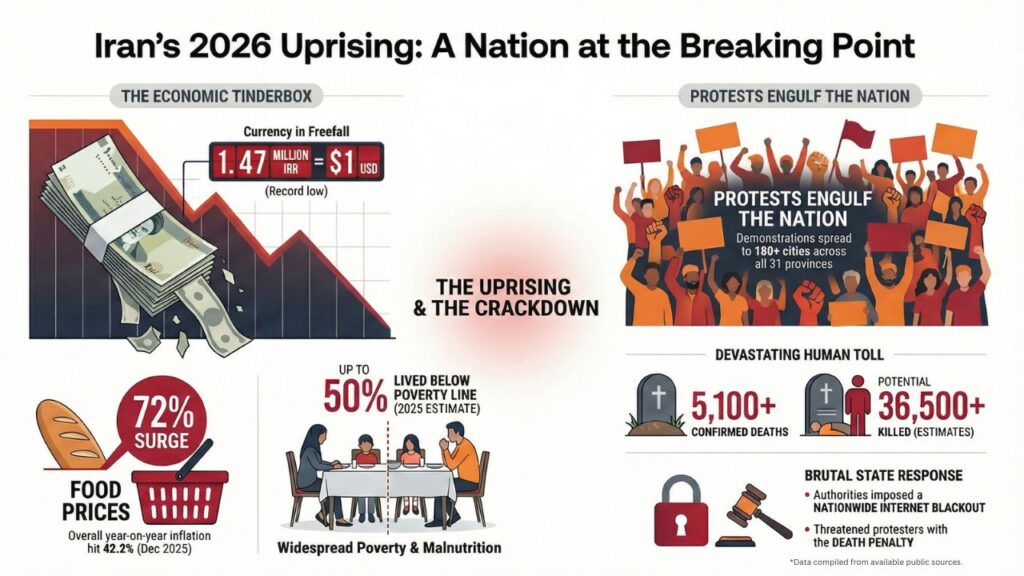
The unrest began when merchants and shopkeepers in Tehran’s Grand Bazaar closed their businesses to protest the collapse of Iran’s currency, the rial. According to trading data, the rial plunged to a record low of approximately 1.47 million against the US dollar in early January 2026, compared to 32,000 rials per dollar during the 2015 nuclear accord period.
Iran’s Statistical Centre reported inflation reached 42.2 percent year-on-year in December 2025, representing a 1.8 percent increase from November. In October 2025, inflation had peaked at 48.6 percent. Food prices surged by 72 percent and health items increased by 50 percent compared to December 2024, according to official government statistics.
The economic deterioration followed June 2025 military strikes by Israel and the United States on Iran’s nuclear facilities, which Iranian officials acknowledged caused extensive damage to the country’s infrastructure and defence capabilities.
Scale and Spread of Demonstrations
Human rights organizations report the protests quickly expanded beyond economic grievances. The US-based Human Rights Activists News Agency (HRANA) documented demonstrations in more than 180 cities and towns across Iran. Protesters chanted slogans including “Death to the Dictator” in reference to Supreme Leader Ayatollah Ali Khamenei, according to multiple reports.
The bazaar merchants, historically a conservative force supportive of the Islamic Republic and crucial to the success of the 1979 Islamic Revolution, played a central role in the initial demonstrations. Their participation marked a significant shift, as this traditionally regime-aligned group publicly expressed dissatisfaction with economic conditions.
University students also joined the protests. Students at Shahid Beheshti University released a statement declaring that “This criminal system has taken our future hostage for 47 years,” according to published reports.
Government Response and Casualties
Iranian authorities imposed a nationwide internet and telecommunications blackout beginning 8 January 2026, described by experts as unprecedented in scale. The shutdown has severely hampered verification of casualty figures and documentation of events.
Death toll estimates vary widely due to the communications blackout. HRANA reported it had confirmed at least 5,137 deaths as of 24 January 2026 and was investigating an additional 12,904 reported deaths. Time magazine and Iran International reported that between 30,000 and 36,500 protesters may have been killed during 8-9 January alone. The UN Special Rapporteur on Iran, Mai Sato, suggested the death toll could reach 20,000 or more based on reports from doctors inside Iran.
HRANA also documented over 18,400 arrests as of 14 January 2026. Reports indicate security forces used live ammunition against demonstrators, with hospitals in Tehran and other cities reportedly overwhelmed by casualties, including children.
Tehran’s prosecutor, Ali Salehi, announced, according to some reports, that protesters could face charges of “moharebeh” or “waging war against God,” which carries the death penalty under Iranian law. The judiciary stated that all “rioters” would be tried under this charge, according to official statements.
Official Statements from Iranian Leadership
Supreme Leader Ayatollah Ali Khamenei stated on 10 January that protesters’ demands were “completely fair” but added that “rioters” should “be put in their place,” according to state media reports.
President Masoud Pezeshkian, elected in 2024 on promises of economic reform and good governance, acknowledged the constitutional right to peaceful protest. He blamed the unrest on foreign-linked “terrorists” and said the June 2025 conflict with Israel had led the country “into chaos.” However, both Khamenei and Pezeshkian publicly acknowledged that economic problems could not be attributed solely to international sanctions, marking a rare admission of governance failures.
The government announced the replacement of Central Bank Governor Mohammad Reza Farzin and proposed a new subsidy system providing monthly electronic credits to households to offset rising prices. Government spokesperson Fatemeh Mohajerani warned that ending subsidized dollars for essential imports could raise prices of basic goods by 20 to 30 percent in the coming weeks.
Background: Iran’s Economic Crisis
Iran has been experiencing its deepest economic crisis in modern history, according to economic analysts. Several factors contributed to the deterioration:
The country’s gross domestic product contracted from approximately 600 billion US dollars in 2010 to an estimated 356 billion dollars in 2025, based on available data. International sanctions, particularly those reimposed by the United States, severely limited Iran’s oil exports and access to global financial markets.
Domestic issues compounded the crisis. Power outages affected the country for three to four hours daily since February 2025 due to energy infrastructure failures. The Ministry of Social Welfare reported in 2024 that 57 percent of Iranians experienced some level of malnutrition. Estimates suggested between 22 and 50 percent of Iranians lived below the poverty line as of March 2025.
Norway-based Iran Human Rights reported that Iran executed at least 1,500 people in 2025, representing a 50 percent increase compared to 2024 and marking the highest execution rate in nearly four decades.
Regional Context and Strategic Setbacks
Iran suffered significant strategic losses in 2024-2025 that weakened its regional position. The fall of Syrian President Bashar al-Assad’s regime in December 2024 eliminated a key Iranian ally. Israeli military operations severely degraded the Iranian-backed groups Hamas in Gaza and Hezbollah in Lebanon.
The June 2025 twelve-day conflict between Iran and Israel, which also involved US strikes, resulted in extensive damage to Iran’s nuclear programme, air defence systems, and missile production facilities. At least 1,190 people were killed in Iran during that conflict, according to reports, including nuclear scientists and senior military commanders.
These setbacks coincided with Iran’s budget proposal for the coming year, which increased security spending by nearly 150 percent while offering wage increases amounting to only about 40 percent of the inflation rate, according to budget documents.
International Response
United Nations Secretary-General António Guterres expressed being “deeply saddened by the reported loss of life and injuries” on 5 January 2026, according to UN spokesperson Stéphane Dujarric. Guterres called on Iranian authorities to uphold rights to freedom of expression, association and peaceful assembly, and urged all actors to refrain from actions that could heighten tensions.
UN High Commissioner for Human Rights Volker Türk stated on 7 January that he was “horrified by the mounting violence” and urged Iranian authorities to halt all forms of violence and repression against peaceful protesters. He called the labelling of protesters as “terrorists” unacceptable.
On 23 January 2026, the UN Human Rights Council adopted a resolution condemning the violent crackdown. Twenty-five member states, including France, Japan, South Korea, Spain, Italy and Mexico, voted in favour. Seven states, including China, India, Pakistan, Vietnam and Indonesia, voted against, while 14 states, including Brazil, Qatar, Egypt, South Africa and Thailand, abstained.
The resolution extended the mandate of the UN Special Rapporteur on Iran for one year and added two years to the mandate of the independent Fact-Finding Mission formed to investigate human rights violations during Iran’s 2022-2023 protests.
United States Position
US President Donald Trump stated on 2 January 2026 via social media that the United States would “come to the rescue” of protesters if Iran “shoots and violently kills peaceful protesters,” adding that America was “locked and loaded and ready to go.” The statement represented a departure from previous US responses to Iranian protests, which typically consisted of verbal support without explicit military intervention threats.
The US Department of State urged the Iranian government to respect citizens’ rights. US Ambassador to the UN Michael Waltz posted that “The people of Iran want freedom. They have suffered at the hands of the ayatollahs for too long.”
The United States moved the USS Abraham Lincoln aircraft carrier strike group toward the Middle East and deployed additional fighter jets to the region, raising concerns about potential military escalation. Italy and Poland issued advisories urging their citizens to leave Iran immediately.
European Response
On 9 January 2026, German Chancellor Friedrich Merz, French President Emmanuel Macron and British Prime Minister Keir Starmer issued a joint statement expressing deep concern over violence by Iran’s security forces and condemning the killing of protesters. On 13 January, Chancellor Merz stated, “We are now witnessing the final days and weeks of this regime,” arguing that a regime maintaining power only through violence was “effectively finished.”
The European External Action Service on 3 January called on Iranian authorities to uphold fundamental rights and refrain from violence against protesters.
Comparison to Previous Protests
The current unrest represents the largest uprising Iran has experienced since the 1979 Islamic Revolution that brought the clerical regime to power, according to multiple analysts and observers. The scale and intensity surpass even the 2022-2023 “Woman, Life, Freedom” protests triggered by the death of 22-year-old Mahsa Amini in custody after her arrest for allegedly not wearing her hijab correctly. Those demonstrations led to a 2024 UN investigation concluding that Iranian government actions amounted to “crimes against humanity,” a finding Tehran rejected.
Unlike the 2022 protests, which were primarily driven by women and girls demanding social freedoms, the 2025-2026 demonstrations have involved broader segments of society, including men, merchants, students and workers, with economic grievances initially at the forefront before expanding to demands for political change. The participation of bazaar merchants, historically supportive of the Islamic Republic and instrumental in the success of the 1979 revolution, marks a particularly significant development.
Previous major protests in Iran’s post-revolutionary history include the 2009 Green Movement following contested presidential elections, the 2019-2020 protests over fuel price increases that resulted in an estimated 300-1,500 deaths according to Amnesty International, and sporadic demonstrations in 2017-2018. The 2009 protests saw millions take to the streets but were eventually suppressed through sustained security force action.
Voter turnout in Iranian elections declined sharply from 73 percent in 2017 to 39.9 percent in the first round of the 2024 presidential election, reflecting decreased public confidence in political institutions, according to official election data.
What Happens Next
The situation remains fluid as of late January 2026. President Pezeshkian promised to meet with protest representatives, though he lacks authority over security forces, which operate under the command of Supreme Leader Khamenei.
The government ordered the closure of schools and offices in 26 of Iran’s 31 provinces for four days starting on 31 December, officially due to pollution but widely interpreted as an attempt to prevent further demonstrations.
International pressure continues to build. The Fact-Finding Mission chair, Sara Hussein, stated her team had begun collecting witness accounts describing torture, sexual violence and arbitrary detentions. The mission has been tasked with reporting findings to the UN Human Rights Council and General Assembly in autumn 2026.
President Trump indicated on 11 January that “a meeting is being set up” after “Iran called” to negotiate, though details remained unclear. Iran’s foreign minister confirmed reaching out to a US official, though the Iranian government officially rejected the UN resolution and characterized international criticism as interference in internal affairs.
Iranian Ambassador to the UN Ali Bahreini denounced the special session as a “pressure tool” and accused Western nations of double standards. Iranian state media broadcast footage of Trump’s attempted assassination at a 2024 rally with a Persian message, “This time, [the bullet] won’t miss,” which drew condemnation from US officials.
The protests have raised fundamental questions about Iran’s political stability and the sustainability of its current governance system amid compounding economic, political and regional pressures.