
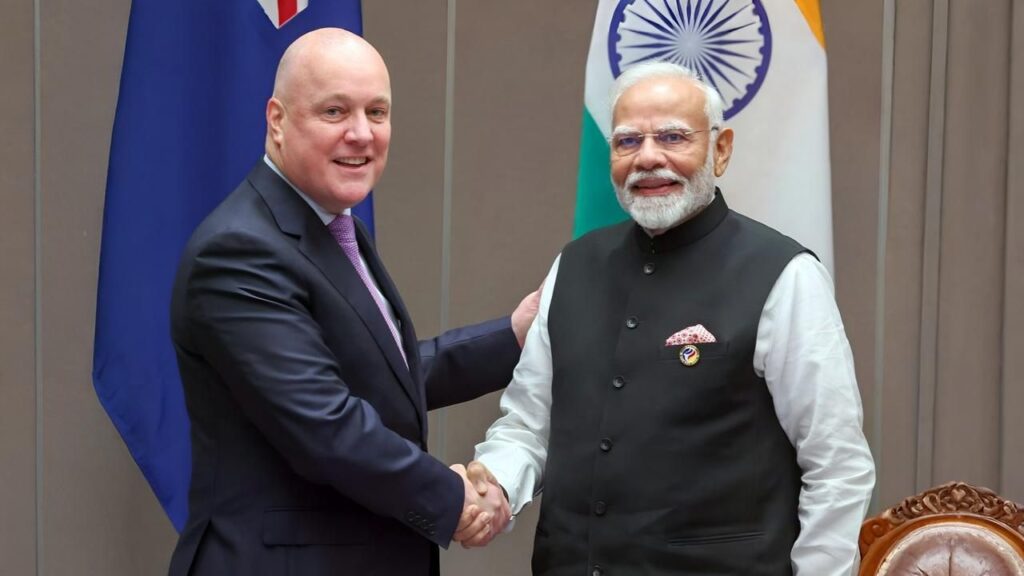


India–New Zealand FTA: India and New Zealand concluded negotiations for a comprehensive Free Trade Agreement (FTA) on 22 December 2025, marking one of India’s fastest-negotiated trade deals and establishing zero-duty access for all Indian exports to the Pacific nation.
The agreement, announced simultaneously in New Delhi and Wellington, will eliminate tariffs on 100% of Indian goods entering New Zealand while protecting India’s sensitive agricultural sectors, particularly dairy. New Zealand has committed to investing USD 20 billion in India over 15 years.
The pact is expected to be formally signed in the first quarter of 2026 and will require ratification through domestic processes in both countries before implementation, which officials estimate will take seven to eight months.
India New Zealand FTA: Zero-Duty Market Access for Indian Exports
Under the agreement, India gains immediate duty-free access to the New Zealand market for all goods exports, according to the Ministry of Commerce and Industry. New Zealand had maintained tariffs of up to 10% on approximately 450 tariff lines covering key Indian exports, including textiles, apparel, leather products, ceramics, carpets, and automobile components. The average applied tariff of 2.2% in 2025 will be eliminated from the date the agreement enters into force.
New Zealand will provide duty-free access across 8,284 tariff lines from day one of implementation, covering labour-intensive sectors such as textiles, leather, footwear, engineering goods, marine products, and processed foods.
India’s exports to New Zealand stood at USD 711 million in 2024–25, registering a 32% increase from the previous year. Total merchandise trade between the two countries reached USD 1.3 billion in 2024–25, up 49% from USD 873 million in 2023–24.
India Protects Dairy, Agriculture Through Strategic Exclusions
India has excluded 29.97% of its tariff lines from the agreement to protect domestic farmers and sensitive industries. The exclusion list includes dairy products such as milk, cream, whey, yoghurt, and cheese, as well as animal products except sheep meat, vegetable products including onions, chickpeas, peas, corn, and almonds, sugar, artificial honey, and certain metals and minerals.
The Commerce Ministry said the exclusions ensure protection of key agricultural sectors while maintaining India’s food security priorities. Dairy products, which constitute a significant portion of New Zealand’s export capability, remain fully protected under the agreement.
India will provide market access for 70.03% of its tariff lines, covering approximately 95% of bilateral trade value. Of these, 30% of tariff lines will see immediate duty elimination, covering products such as wood, wool, sheep meat, and raw leather hides. Another 35.6% of tariffs are subject to phased elimination over periods ranging from three to 10 years, including petroleum oil, malt extract, vegetable oils, and selected electrical and mechanical machinery.
Managed Market Access for Select Agricultural Goods
India has agreed to provide limited market access for specific New Zealand agricultural products including apples, kiwifruit, Manuka honey, and albumins through a Tariff Rate Quota (TRQ) system with Minimum Import Prices (MIP) and seasonal restrictions.
For kiwifruit, India maintains a 33% import duty with current imports from New Zealand at 5,840 metric tonnes. Under the FTA, India will provide duty concessions for up to 6,250 MT in the first year, increasing to 15,000 MT in the sixth year with zero duty and a minimum import price of USD 1.80 per kilogramme.
New Zealand currently exports 23,602 tonnes of apples to India at 50% import duty. India has agreed to provide duty concessions on a quota of 32,500 MT in the first year, rising to 45,000 MT in the sixth year at 25% duty and a minimum import price of USD 1.25 per kilogramme.
These quotas are linked to Agricultural Productivity Partnership action plans and monitored by a Joint Agriculture Productivity Council. The partnerships include establishment of Centres of Excellence, improved planting material, capacity building for growers, and technical support for orchard management and post-harvest practices.
New Zealand Gains Phased Access to Indian Market
New Zealand will receive duty-free access for 54.11% of its exports to India from day one of implementation, according to Ministry data based on 2024 trade figures. These goods include sheep meat, wool, coking coal, and forestry and wood products. Zero-duty access for New Zealand exports will increase to 79% after 10 years.
Import duties on avocados and persimmons will be eliminated over 10 years. Duties will also be removed on iron, steel, and scrap aluminium items over 10 years or less, meeting demands from Indian industry for cost-effective manufacturing inputs.
Products facing tariff reductions include wine, pharmaceutical drugs, polymers, and aluminium and steel articles, covering 4.37% of product lines.
Services Sector Opens New Opportunities
New Zealand has offered market access commitments across 118 services sectors with Most-Favoured Nation treatment in 139 sectors, representing the country’s best-ever offer to any trading partner.
For the first time, New Zealand has signed an annex on Health and Traditional Medicine Services to facilitate trade in Ayurveda, yoga, and other traditional medicine services with India. The landmark provision promotes global recognition of India’s AYUSH systems, supports medical value travel, and reinforces India’s position as a hub for health, wellness, and traditional medicine services.
India’s services exports to New Zealand grew by 13% in 2024 to reach USD 634 million. Major sectors include travel, information technology, and business services.
Student Mobility and Professional Pathways Expanded
New Zealand signed an Annex on Student Mobility and Post Study Work Visa for the first time with any country. Indian students will be permitted to work up to 20 hours per week while studying, with protection from future policy changes. Extended post-study work visas will be available for STEM Bachelor’s degree holders for three years, Master’s graduates for up to three years, and Doctorate holders for up to four years.
A quota of 5,000 visas will be allocated annually for skilled Indian professionals for stays of up to three years. Eligible sectors include iconic Indian occupations such as AYUSH practitioners, yoga instructors, Indian chefs, and music teachers, as well as information technology, engineering, healthcare, education, and construction.
New Zealand will also provide 1,000 Working Holiday Visas annually allowing young Indians multiple entries for a period of 12 months.
USD 20 Billion Investment Commitment
New Zealand has committed to investing USD 20 billion in India over 15 years, strengthening long-term economic and strategic cooperation. The investment pledge is expected to support infrastructure development, manufacturing, and services sectors in India.
The FTA includes provisions for cooperation in AYUSH, audiovisual industries, tourism, sports, and traditional knowledge systems. Engagement with New Zealand’s indigenous Maori communities will promote cultural exchange and mutual respect for traditional knowledge.
Financial Services Integration
On 22 December 2025, India and New Zealand also concluded negotiations on the Financial Services Annex of the FTA. The annex establishes market access commitments, regulatory transparency, and bilateral cooperation frameworks to facilitate increased investment and institutional presence.
India has offered enhanced Foreign Direct Investment limits in banking and insurance, alongside a liberalised bank branch licensing framework allowing up to 15 bank branches to be established over a four-year period. This represents a significant expansion from the previously offered GATS limit of 12 branches.
Currently, two Indian banks—Bank of Baroda and Bank of India—maintain subsidiary operations in New Zealand with a combined total of four branches. No New Zealand banks or insurance companies currently operate in India.

Sectoral Gains Across Indian Economy
- Textiles and Clothing: India exported USD 36.9 billion worth of textiles in 2024–25, up 6.1% from the previous year. Exports to New Zealand rose from USD 98.14 million to USD 103.14 million. New Zealand eliminated tariffs across 1,057 tariff lines, representing 13% of total tariff lines, with pre-FTA peak tariffs of up to 10%. New Zealand’s total textile and clothing imports averaged USD 1.90 billion over the last three years.
- Engineering Goods: India’s engineering exports reached USD 77.5 billion in 2024–25, up 20.3% from USD 64.4 billion in 2023–24. Exports to New Zealand increased from USD 47.76 million to USD 68.26 million. The agreement covers 1,396 tariff lines, eliminating duties that previously peaked at 10%. New Zealand’s engineering imports averaged USD 11 billion annually.
- Leather and Footwear: India exported USD 5.5 billion in leather and footwear products in 2024–25. Exports to New Zealand stood at USD 8.52 million. The FTA eliminates tariffs across 181 tariff lines covering footwear, leather goods, and accessories. New Zealand’s imports in this category averaged USD 510 million annually.
- Pharmaceuticals: India’s pharmaceutical exports totalled USD 24.5 billion in 2024–25, up 10.8% from USD 22.1 billion in 2023–24. Exports to New Zealand stood at USD 57.52 million. The agreement covers 90 tariff lines with elimination of duties that previously peaked at 5%. New Zealand’s pharmaceutical imports averaged USD 1.4 billion annually.
- Marine Products: India exported USD 7.0 billion in marine products in 2024–25, up from USD 6.8 billion in 2023–24. Exports to New Zealand rose from USD 15.35 million to USD 15.89 million. The FTA covers 363 tariff lines, eliminating duties that previously peaked at 5%. New Zealand’s marine imports averaged USD 260 million annually.
- Agriculture: India’s agricultural exports reached USD 51.8 billion in 2024–25, up 7.3% from USD 48.3 billion in 2023–24. The agreement covers 1,379 agricultural tariff lines, representing 17% of all product lines, with elimination of tariffs that previously peaked at 5%. Benefits extend to fruits and vegetables, coffee, tea, cocoa, spices, cereals, and processed foods.
- Plastics and Rubber: India exported USD 13 billion in plastics and rubber products in 2024–25. Exports to New Zealand increased from USD 18.87 million to USD 23.66 million. The FTA covers 397 tariff lines, eliminating duties that previously peaked at 10%. New Zealand’s imports in this sector averaged USD 2.05 billion annually.
Regulatory Safeguards and Intellectual Property Protection
The agreement includes dedicated annexes for pharmaceuticals and medical devices providing expedited regulatory pathways and recognition of inspections from trusted regulators including the United States, European Union, United Kingdom, and Canada.
New Zealand has made a binding commitment to amend its laws within 18 months to provide European Union-level protection for India’s Geographical Indications (GIs), strengthening intellectual property rights for Indian products.
Customs and trade facilitation provisions include advance rulings, electronic documentation, and faster clearance times within 48 hours, reduced to 24 hours for perishable goods. Robust Rules of Origin frameworks prevent circumvention and ensure integrity of preferential access.
India’s Expanding Trade Network
The India-New Zealand FTA represents India’s third free trade agreement concluded in 2025, following the India-United Kingdom Comprehensive Economic and Trade Agreement signed in July and the India-Oman Comprehensive Economic Partnership Agreement concluded earlier in December.
India has steadily expanded its global trade partnerships in recent years. The country signed the India-EFTA Trade and Economic Partnership Agreement with Switzerland, Norway, Iceland, and Liechtenstein in 2024, the India-United Arab Emirates Comprehensive Economic Partnership Agreement in 2022, the India-Australia Economic Cooperation and Trade Agreement in 2022, and the India-Mauritius Comprehensive Economic Cooperation and Partnership in 2021.
India’s Commerce Minister Piyush Goyal said the government is also working on trade agreements with the United States and Canada. The push for bilateral trade deals comes amid rising protectionism and uncertainty stemming from United States President Donald Trump’s tariff policies, which have levied 50% tariffs on Indian goods exports.
Global Trade Context
The announcement comes as governments across the globe seek to diversify trade links due to uncertainty driven by United States tariff policies. India’s Prime Minister Narendra Modi has placed the push to broaden export destinations at the centre of economic strategy, including recent trade talks with Russian President Vladimir Putin earlier in December.
New Zealand Prime Minister Christopher Luxon said in a statement that his country’s exports to India are forecast to increase by NZD 1.1 billion to NZD 1.3 billion annually over the next two decades as a result of the deal. “Boosting trade means more Kiwi jobs, higher wages and more opportunities for hard-working New Zealanders,” Luxon said.
However, the deal has drawn criticism from New Zealand First party leader Winston Peters, who said the agreement “gives too much away, especially on immigration,” according to The New Zealand Herald.
Timeline and Implementation
The negotiated texts may be published following mutual agreement and formal joint announcement. The agreement will be signed upon completion of domestic processes in both countries. Entry into force will occur after ratification, with the timeline envisaged for 2026.
The agreement will be reviewed after one year of implementation to assess progress and address any emerging issues.
Background: India-New Zealand Bilateral Relations
New Zealand is India’s second-largest trading partner in Oceania. With a per capita income of USD 49,380, New Zealand is among the higher-income economies in the region. In 2024, New Zealand’s imports stood at USD 47 billion, while exports totalled USD 42 billion.
New Zealand invests nearly 8% of its GDP annually overseas, with total overseas investment valued at USD 422.6 billion as of March 2025. Approximately 300,000 persons of Indian origin and non-resident Indians live in New Zealand, constituting nearly 5% of the country’s population.
India and New Zealand merchandise bilateral trade increased from USD 855 million in 2015–16 to USD 1,298 million in 2024–25. Indian exports increased by 130% over this period while imports increased by only 7.21%. In 2024–25, India’s exports to New Zealand exceeded imports, maintaining a positive trade balance.
Total bilateral trade in goods and services reached USD 2.4 billion in 2024, according to government data.
What Happens Next
The India-New Zealand FTA is expected to be formally signed in the first quarter of 2026 following completion of domestic legal and administrative processes in both countries. After signing, the agreement will require ratification through parliamentary and legislative procedures.
Implementation is expected to take approximately seven to eight months from the date of conclusion. Once in force, immediate duty elimination will apply to designated tariff lines, with phased reductions following agreed timelines ranging from three to 10 years.
The Joint Agriculture Productivity Council will oversee implementation of agricultural cooperation action plans and monitor tariff rate quota utilisation. A broader institutional framework will track overall agreement implementation and address trade-related issues.
FAQs
1. What does the India-New Zealand FTA provide?
The Free Trade Agreement, concluded on 22 December 2025, eliminates tariffs on 100% of Indian exports to New Zealand. New Zealand has also committed to investing USD 20 billion in India over 15 years. The agreement provides immediate duty-free access for Indian goods including textiles, engineering products, leather, footwear, pharmaceuticals, and marine products.
2. Which Indian sectors are protected in the deal?
India has excluded 29.97% of its tariff lines to protect sensitive sectors. Dairy products including milk, cream, cheese, yoghurt, and whey remain fully protected. Other exclusions include most animal products except sheep meat, vegetable products such as onions, chickpeas, peas, corn, and almonds, sugar, artificial honey, and certain metals and minerals.
3. When will the FTA be implemented?
The agreement is expected to be formally signed in the first quarter of 2026 after completion of domestic processes in both countries. Following ratification through parliamentary procedures, implementation is estimated to take seven to eight months. Once in force, immediate duty elimination will apply to designated products, with phased reductions over three to 10 years for others.
4. What opportunities does the FTA create for Indian students and professionals?
Indian students can work up to 20 hours per week while studying in New Zealand, with extended post-study work visas of three to four years depending on qualification level. The agreement provides 5,000 skilled worker visas annually for sectors including AYUSH practitioners, yoga instructors, Indian chefs, IT professionals, engineers, and healthcare workers. Additionally, 1,000 Working Holiday Visas will be available annually for young Indians.
5. How much does India currently trade with New Zealand?
India’s merchandise exports to New Zealand reached USD 711 million in 2024–25, up 32% from the previous year. Total bilateral merchandise trade stood at USD 1.3 billion in 2024–25, registering 49% growth from USD 873 million in 2023–24. India’s services exports to New Zealand totalled USD 634 million in 2024, with major sectors including travel, IT, and business services.