


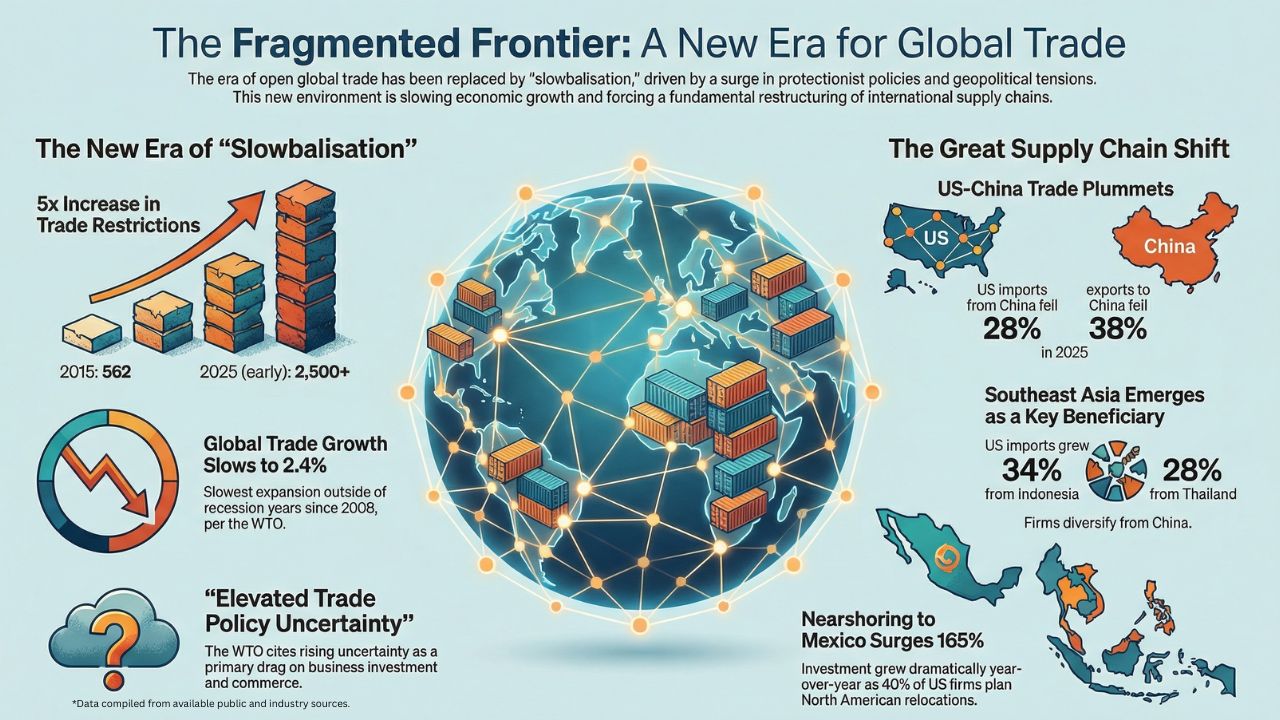
Global trade is undergoing its most dramatic transformation in decades. Between January and October 2025, more than 2,500 trade restrictions were imposed worldwide, nearly five times the 562 recorded during the same period in 2015, according to World Bank data. This surge in protectionist measures, coupled with intensifying geopolitical rivalries and ongoing conflicts, is fundamentally reshaping how nations trade, invest, and cooperate economically.
The era of hyper-globalisation that defined the late 20th and early 21st centuries has given way to what economists call “slowbalisation“, a fragmented global economy characterised by regional blocs, friendshoring strategies, and heightened economic nationalism.
Trade Growth Slows Amid Tariff Escalation
Global merchandise trade growth is projected to reach just 2.4% in 2025, according to the World Trade Organisation’s October 2025 outlook. This represents a significant downward revision from earlier forecasts and marks the slowest expansion outside of recession years since 2008.
The WTO attributes this slowdown primarily to escalating trade barriers. In the first ten months of 2025 alone, trade restrictions accumulated at unprecedented rates, creating what the organisation terms “elevated trade policy uncertainty” that continues to weigh on business investment and cross-border commerce.
The International Monetary Fund projects global economic growth will weaken to 2.3% in 2025, the slowest rate since 2008, excluding outright recessions, before a tepid recovery in 2026-2027. According to the IMF’s October 2025 World Economic Outlook, this deceleration affects most economies and leaves global output materially below January projections.
US-China Trade War Enters New Phase
The economic relationship between the world’s two largest economies has fundamentally shifted. US imports from China fell 28% year-over-year in 2025, while US exports to China declined 38%, according to supply chain analytics firm project44. This marks one of the most significant bilateral trade contractions in recent decades.
China currently faces a composite 55% tariff on exports to the United States, consisting of a 25% Section 301 tariff, a 20% fentanyl-related levy, and a 10% reciprocal tariff, according to UCLA Anderson School of Management’s Fall 2025 US-China Economic Update. This follows a volatile year that saw tariffs peak at 145% before a negotiated truce was reached in June 2025.
The tariff framework, finalised through negotiations in Geneva and London, represents a temporary stabilisation rather than a resolution of underlying tensions. According to reports, China has pledged to deliver rare earth minerals and continue student exchanges, but deeper issues around supply chain diversification and intellectual property remain unresolved.
Supply Chains Restructure Across Asia
Southeast Asian economies have emerged as major beneficiaries of the US-China trade realignment. Indonesia recorded 34% growth in US imports during 2025, whilst Thailand saw a 28% increase, according to project44 data. Vietnam, Malaysia, and the Philippines also posted significant gains as manufacturers accelerate diversification away from China.
However, this shift comes with complications. The United States has implemented a 40% penalty on transhipment, goods that route through intermediary countries to avoid tariffs, particularly targeting Vietnam, Malaysia, Thailand, Indonesia, and the United Arab Emirates. According to UCLA Anderson, these economies are increasingly viewed as conduits for Chinese exports attempting to circumvent duties.
Research published in ScienceDirect reveals that whilst US-China decoupling in bilateral trade is real, supply chains remain deeply intertwined with China. Countries replacing China as direct suppliers to the United States tend to be heavily integrated into Chinese supply networks and are experiencing faster import growth from China themselves. In strategic industries, the data suggests that displacing China on the export side requires embracing China’s supply chains.
Nearshoring and Reshoring Gain Momentum
A 2025 Deloitte study predicts that 40% of US companies will relocate at least part of their supply chains to North America by 2026. Mexico has emerged as a primary beneficiary, with nearshoring investment growing approximately 165% year-over-year in the first quarter of 2025, according to Mexico Business News.
However, structural challenges persist. US labour costs average $25 to $30 per hour compared to roughly $6 to $7 in China, according to Supply Chain Management Review. Nearly 500,000 manufacturing jobs remain unfilled because modern factories require digital, robotics, and AI skills that current training systems cannot supply at scale.
The Rhodium Group notes that Mexico’s advantages under the United States-Mexico-Canada Agreement (USMCA) are becoming less clear as new Section 232 national security tariffs emerge. While the US has created partial USMCA exemptions for 25% automobile and auto parts tariffs, Mexican car exports now compete against European Union and Japanese exports at only 15%.
Europe Navigates Energy Crisis and Trade Pressures
The European Union faces growth forecasts between 0.8% and 1.6% for 2025, according to Lazard’s geopolitical outlook. High energy prices and competitive pressures from China and the United States are challenging European industry, whilst potential US tariffs could worsen these difficulties.
The Russia-Ukraine conflict continues to reshape European energy markets. According to the International Energy Agency, Russian natural gas met less than 10% of the EU’s total gas demand in 2023, down from approximately 25% in 2022 and over 40% before the invasion. The United States has reinforced its position as the EU’s largest liquefied natural gas (LNG) supplier.
Despite these disruptions, the EU’s export-to-GDP ratio has edged upward over the 2024-2026 forecast horizon, according to the European Commission’s Autumn 2025 Economic Forecast. Approximately 60% of EU exports remain within the bloc, a proportion broadly unchanged since the 1990s.
Global Value Chains Demonstrate Resilience
Research from the World Bank, IMF, and OECD confirms that global value chain (GVC) trade flows are less responsive to short-term barriers than traditional trade. Much GVC trade involves intra-firm transactions where multinational corporations exchange intermediate goods between subsidiaries in different countries. This trade is generally less price-sensitive and more resistant to tariffs, as companies often absorb short-term cost increases rather than disrupt established supply chains.
However, the World Bank notes that global trade policy uncertainty in the 2020s has averaged nearly five times the level of the 2000s. The multilateral trading system faces severe strain, with the WTO’s dispute-settlement mechanism remaining paralysed and progress toward broader reform slowing.
Energy Markets Remain Volatile
The Ukraine conflict has triggered what the IEA terms “the first truly global energy crisis.” Two years after Russia’s February 2022 invasion, energy prices have pulled back from record highs, but trends vary widely among regions, and prices remain elevated in many parts of the world.
Russia has successfully re-routed oil exports to Asia despite sanctions, remaining the world’s third-largest oil producer and second-largest exporter in 2023, according to the IEA. However, Russian oil export revenues tumbled by USD 4.2 billion monthly year-over-year in 2023 as the country faced price caps and reduced access to Western markets.
Ukraine’s energy sector continues to face severe challenges. According to the Brookings Institution analysis from October 2025, Ukraine faced power deficits of 2-3 gigawatts during peak demand hours in the last heating season. Russia’s occupation of the Zaporizhzhia nuclear power plant, Europe’s largest, deprived Ukraine of a quarter of its generating capacity.
Multipolarity Replaces Western-Dominated Order
The Elcano Global Presence Index, tracking globalisation from 1990 to 2024, documents a 1.4% retreat in the globalisation process between 2023 and 2024. The economic dimension fell 3.5% due to sharp drops in energy and primary goods exports and a contraction in global manufactures trade.
The data reveals a transition from the bipolar world of the 1990s, dominated by the United States and the former Soviet Union, through the multipolarity that characterised peak hyper-globalisation, towards what analysts describe as a new fragmented order. The United States, China, and the European Union are each seeking to exercise global leadership, but through increasingly separate spheres of influence.
According to the World Economic Forum’s January 2025 Annual Meeting themes, the global security order has become too fragmented to either maintain or negotiate peace. More than 110 armed conflicts are taking place worldwide, with state-based armed conflict now the top risk for 2025, according to the Global Risks Report.
Emerging Markets Face Divergent Prospects
The gap between advanced economies and many low-income countries continues to widen. According to the IMF, least developed countries (LDCs) face particular challenges from the fragmented trade environment. Whilst LDC exports are forecast to grow 6.1% in 2025, these nations remain vulnerable to commodity price volatility and reduced access to financing.
Asia is anticipated to be the key long-term growth engine, according to S&P Global. The WTO forecasts that Asia will record the fastest export volume growth of any region in 2025 at 5.3%, matched only by Africa. These regions are expected to be followed by South and Central America and the Caribbean at 2.4%, the Middle East at 2.0%, and Europe at 0.7%.
Technology Competition Intensifies
Artificial intelligence has emerged as a new battleground for geopolitical competition. According to EY’s 2025 Geostrategic Outlook, biotech is also growing as a strategic sector as countries recognise its importance to economic growth, national security, and human health.
The United States has positioned AI development as a top national imperative, according to BlackRock’s December 2025 Geopolitical Risk Dashboard. This approach to trade, industrial policy, and alliances marks a decisive break from the post-Cold War order and the US role therein.
Export controls on critical technologies, including semiconductors and AI-related hardware, are forcing companies to rethink cross-border research and development collaboration. This not only slows innovation but creates fragmented ecosystems in areas like telecommunications and green energy.
Outlook: Fragmentation Likely to Persist
The World Bank projects that global growth will slow to 2.3% in 2025, the lowest rate since 2008, excluding recessions, before a tepid recovery in 2026-2027 that will leave global output materially below earlier projections. Progress by emerging market and developing economies in closing per capita income gaps with advanced economies and reducing extreme poverty is anticipated to remain insufficient.
Trade growth is expected to slow in 2026 as the global economy cools and the full impact of higher tariffs is felt for a complete year. The WTO forecasts world commercial services trade volume growth will slow from 6.8% in 2024 to 4.6% in 2025 and 4.4% in 2026.
Economists at Economist Impact note that global growth for 2025 is projected to remain steady at 2.7%, reflecting a stable yet cautious economic environment. However, interest rates are expected to stay higher than in the 2010s, driven by tight labour markets and supply chain risk management costs.
BlackRock identifies three core themes characterising geopolitical risks in 2025: the United States resetting trade deals, industrial policy and alliances; intensifying US-China competition with AI at its core; and continued volatility from conflicts in Ukraine, the Middle East, and other regions.
What Happens Next
The immediate outlook depends heavily on the evolution of trade policy globally. According to the World Bank, if trade restrictions escalate or policy uncertainty persists, growth could turn out lower, whilst financial stress could build.
WTO notes that if reciprocal tariffs and spreading trade policy uncertainty materialise as proposed, they could reduce world merchandise trade growth by an additional 1.5 percentage points in 2025, potentially leading to a 1.5% decline in trade volumes.
KPMG research suggests that businesses must treat geopolitical risk as a fundamental part of business strategy. Companies that build holistic geopolitical risk management approaches, including nearshoring, supplier diversification, technology investment, and strategic pricing, are proving that resilience is key to thriving in a tariff-driven world.
The era of unfettered globalisation has been replaced by a more fragmented, security-focused trade regime. Moving forward, the market’s performance will increasingly be tied to supply chain resilience and domestic manufacturing capacity rather than the lowest possible production costs.