
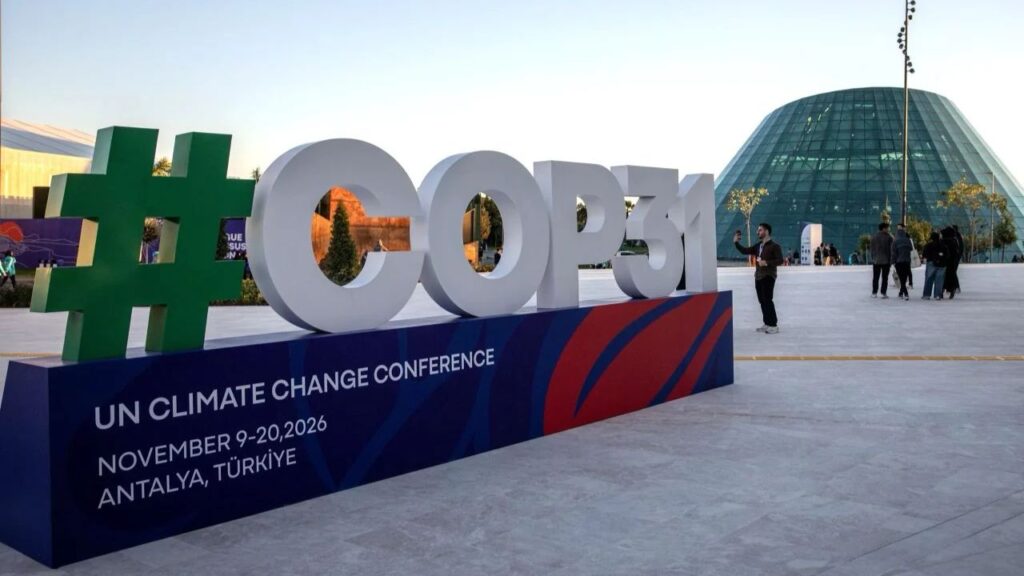


Despite two weeks of negotiations and extended discussions, countries failed to reach consensus on the summit’s overarching political agreement. Disagreements over fossil fuels, climate finance and the future of the energy transition exposed deep divisions in international climate diplomacy.
The 31st Conference of the Parties to the United Nations Framework Convention on Climate Change (COP31), held in Antalya, Türkiye, concluded on 22 November 2026 without an overarching political agreement, raising fresh questions about the effectiveness of international climate negotiations.
The summit, which brought together representatives of nearly 200 countries, was expected to advance global climate action through stronger commitments on emissions reduction, energy transition, climate finance and adaptation. Instead, it ended after more than two weeks of negotiations, including nearly two days of overtime discussions, without agreement on its proposed high-level political declaration, commonly known as the Cover Decision.
The breakdown marked the first failure to secure an overarching consensus outcome at a UN climate summit since COP15 in Copenhagen in 2009. However, it is important to distinguish between the failed political agreement and the wider negotiations: COP31 did achieve progress on several individual agenda items.
So, what exactly happened in Antalya, why did countries fail to agree, and what does this mean for the future of climate action?
Why did COP31 fail to reach a final agreement?
The central disagreement revolved around one of the most consequential questions in climate diplomacy: whether the world should explicitly commit to transitioning away from fossil fuels.
Coal, oil and natural gas remain the principal drivers of greenhouse gas emissions. At COP28 in Dubai in 2023, countries had agreed to transition away from fossil fuels in energy systems in a just, orderly and equitable manner. However, translating that commitment into a more detailed implementation roadmap has remained politically contentious.
At Antalya, several countries, particularly the European Union and climate-vulnerable nations, pushed for a clear reference to fossil fuels and a stronger pathway towards reducing dependence on them.
On the other hand, Saudi Arabia and other oil-producing countries opposed language that could be interpreted as restricting the future role of fossil fuels in the global economy.
The disagreement became the principal obstacle to adopting the proposed Cover Decision.
In the final stages, the negotiating leadership circulated compromise proposals, but the text failed to bridge the differences. The eventual draft did not explicitly mention fossil fuels or reaffirm a transition away from them.
Ireland’s Climate Minister Darragh O’Brien, speaking on behalf of the European Union, said the bloc could not accept a climate agreement that made no reference to fossil fuels.
The European Union, alongside several other countries, rejected the proposed text, arguing that it weakened previously established commitments and failed to reflect the urgency of the climate crisis.
Climate finance: Another major point of disagreement
While fossil fuels dominated the political debate, climate finance remained another significant sticking point.
Developing countries have consistently argued that they need substantial financial support from developed economies to reduce emissions, adapt to climate impacts and address climate-related losses and damages.
The proposed Antalya agreement included a commitment to triple adaptation finance. However, developing countries raised concerns that the proposal did not clearly establish the baseline from which the increase would be calculated.
Without a defined starting point, timeline and implementation framework, questions remained over how meaningful the proposed increase would be.
For climate-vulnerable countries, particularly those facing rising sea levels, extreme weather events, droughts and agricultural disruptions, predictable and accessible finance is essential.
The disagreement highlighted a longstanding divide in climate negotiations: developing countries are expected to strengthen their climate commitments while continuing to demand greater financial and technological support from wealthier nations.
Carbon removal and electrification added to the debate
Other contentious proposals further complicated the negotiations.
The draft included references to accelerating carbon-removal technologies, which can help remove carbon dioxide from the atmosphere. Supporters consider these technologies an important component of climate mitigation, particularly when combined with substantial emissions reductions.
However, critics expressed concerns that excessive reliance on carbon removal could provide justification for continuing fossil fuel production rather than prioritising direct emissions cuts.
Another proposal, advanced by Türkiye, sought to increase electricity’s share of global final energy consumption to 35 per cent by 2035, compared with approximately 23 per cent currently.
Although electrification can accelerate the adoption of electric vehicles, cleaner industrial processes and low-carbon heating systems, questions were raised about financing, infrastructure readiness and the capacity of developing economies to achieve such a transition.
These disagreements reflected the different economic circumstances, energy requirements and development priorities of participating countries.
What was actually achieved at COP31?
Despite the failure to reach an overarching political agreement, COP31 was not entirely without outcomes.
According to the UNFCCC, countries reached decisions on several mandated negotiating issues, including climate finance, adaptation, mitigation, technology, transparency and the second Global Stocktake.
Some important developments included:
1. Progress on Just Transition: Countries agreed to extend the UAE Just Transition Work Programme for another three years with strengthened modalities. They also decided to operationalise the Just Transition Mechanism through a phased approach. The mechanism is intended to facilitate international cooperation, technical assistance, capacity building and knowledge sharing. Its adoption is expected at COP32.
2. Adaptation finance: Negotiations advanced efforts to improve access to climate finance and strengthen support for adaptation. Discussions also covered the transition of the Adaptation Fund to exclusively serve the Paris Agreement.
3. Strengthening adaptation frameworks: Countries advanced work on operationalising the 59 Belém Adaptation Indicators, including mechanisms to share experiences and address challenges in their implementation.
4. Climate technology: Further steps were taken to strengthen access to climate technologies, advance the Belém Technology Implementation Programme and connect technological solutions with financing.
5. Action Agenda: The summit also recorded progress outside the formal negotiations, including new investments and initiatives supporting electrification and climate action across different economic sectors.
These outcomes demonstrate that technical cooperation and implementation-oriented initiatives can continue even when countries fail to reach agreement on broader political questions.
What did the UN and world leaders say?
UN Secretary-General António Guterres expressed deep disappointment over the failure to reach consensus, warning that climate impacts are intensifying while greenhouse gas emissions remain dangerously high.
He reiterated that the absence of political consensus does not change the scientific evidence or the urgency of climate action.
UN Climate Change Executive Secretary Simon Stiell also acknowledged the setback but highlighted the progress achieved on individual negotiating issues and the Action Agenda.
The outcome triggered a wider debate about the decision-making structure of international climate negotiations.
Under the consensus-based system, countries must broadly agree before major decisions can be adopted. While this approach ensures that participating nations have a voice, it can also allow disagreements involving a small number of countries to prevent an agreement supported by many others.
Following the summit, the European Union indicated that it would explore reforms to the COP process, including greater transparency and more effective decision-making. It also emphasised the importance of coalitions of willing countries pursuing climate action beyond formal negotiations.
What happens next? The road to COP32
The immediate focus now shifts to COP32, scheduled to take place in Addis Ababa, Ethiopia, in 2027.
The next summit will inherit several unresolved questions from Antalya, particularly the future of fossil fuels, climate finance for developing countries, adaptation support and the implementation of existing commitments under the Paris Agreement.
For developing economies, the challenge will be to balance economic growth, energy security, poverty reduction and climate responsibility.
The failure at COP31 does not invalidate the Paris Agreement or erase commitments made at previous climate conferences. However, it highlights the growing difficulty of translating international consensus into concrete action.
The Bigger Picture: Can climate diplomacy deliver?
COP31 has exposed a fundamental challenge facing global climate governance: the world broadly recognises the urgency of climate change, but countries remain divided over how the transition should be financed, implemented and distributed.
For developing countries, a just transition cannot simply mean moving away from fossil fuels without considering energy access, employment, industrial development and affordability. Equally, the continued dependence on high-emission energy systems creates increasing environmental, economic and public health risks.
The real test of international climate cooperation will therefore lie not merely in negotiating ambitious declarations but in delivering measurable progress through finance, technology transfer, institutional capacity and practical implementation.
Antalya may have ended without a common political agreement, but the climate crisis has not paused for diplomacy.
The question confronting the international community is no longer simply whether countries recognise the climate challenge, but whether they can overcome competing national interests to act collectively at the scale and speed that science demands.