
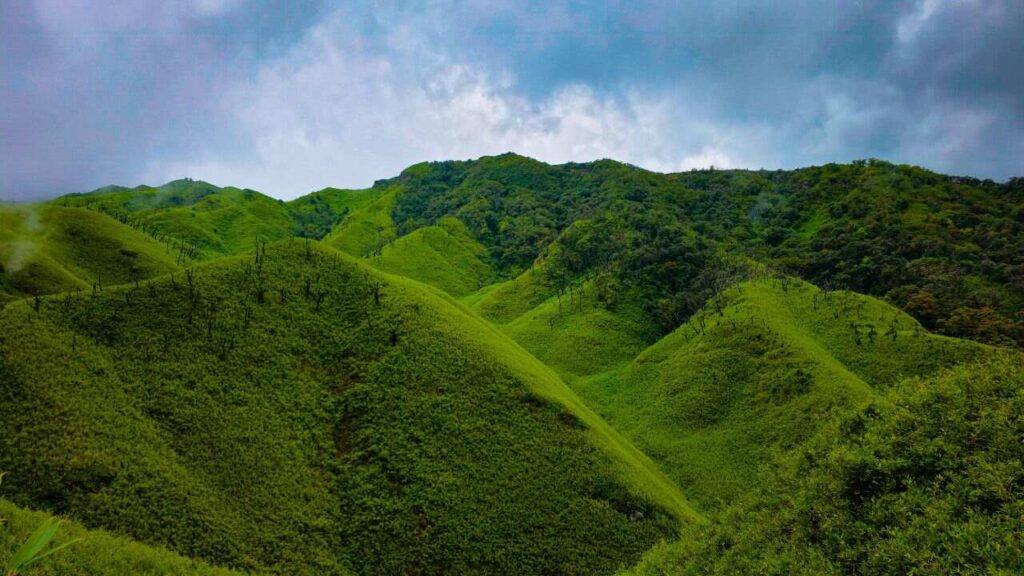


Aravalli Range: In a major policy reversal following nationwide protests, the Union Ministry of Environment, Forests, and Climate Change ordered a complete ban on granting new mining leases across the entire Aravalli range on December 24, 2025. The move came just over a month after the Supreme Court accepted an elevation-based definition of the Aravalli hills, a ruling that sparked widespread demonstrations. Environmental groups and opposition leaders had warned that the November 20 order could leave large parts of the ancient mountain range vulnerable to ecological damage. The decision has reignited a long-running debate over how to balance environmental protection with mineral extraction in one of the world’s oldest geological formations.
Centre’s Complete Mining Ban
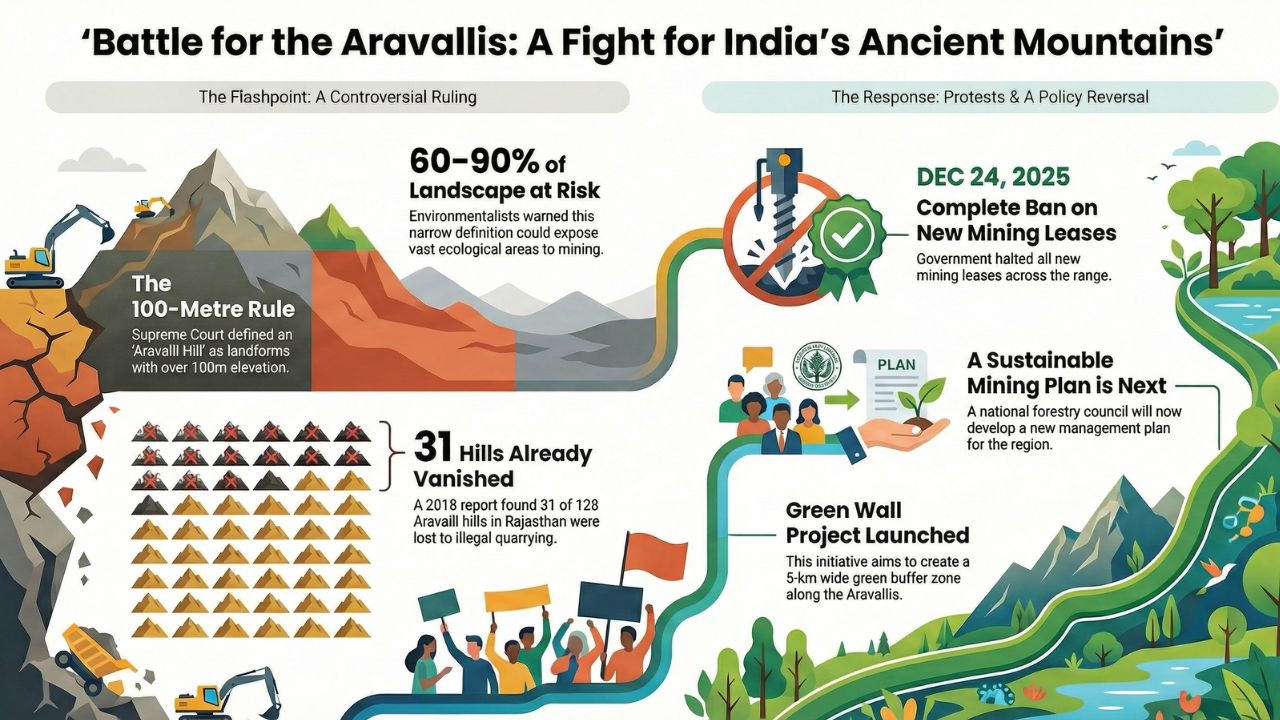
The Ministry of Environment, Forest and Climate Change, on December 24, 2025, announced a comprehensive ban on granting new mining leases across the entire Aravalli range, covering Delhi, Haryana, Rajasthan, and Gujarat.
According to the official statement released, the directions aim to protect the Aravallis as a continuous geological ridge and stop unregulated mining from Gujarat to the National Capital Region. It has also directed the Indian Council of Forestry Research and Education (ICFRE) to identify additional ecologically sensitive areas where mining should be prohibited, beyond existing restrictions.
The management plan will be placed in the public domain for stakeholder consultation and will assess cumulative environmental impact, ecological carrying capacity, and identify conservation-critical areas.
For existing mines, state governments have been instructed to strictly enforce environmental safeguards in line with Supreme Court directions, with tighter regulations to ensure sustainable mining practices.
What the Supreme Court Decided
The Supreme Court accepted a uniform definition recommended by a committee led by the Ministry of Environment, Forest and Climate Change (MoEF&CC). According to the new framework, an “Aravalli Hill” is defined as any landform in designated Aravalli districts with an elevation of 100 metres or more above local relief. An “Aravalli Range” comprises two or more such hills located within 500 metres of each other.
The definition applies across four states, Delhi, Haryana, Rajasthan, and Gujarat, which together encompass the approximately 692-kilometre mountain range. The apex court also directed that a Management Plan for Sustainable Mining (MPSM) be prepared by the Indian Council of Forestry Research and Education (ICFRE) before any new mining leases can be granted.
The judgment came in response to two long-standing environmental cases: M.C. Mehta v. Union of India (1985) and T.N. Godavarman Thirumalpad v. Union of India (1995), which have been monitoring mining activities in the Aravallis. The court noted that different states had been using inconsistent definitions, creating regulatory loopholes that enabled illegal mining operations.

Why the Aravallis Matter
The Aravalli Range is approximately 3.2 billion years old, making it one of the oldest fold mountain systems on Earth. The range stretches from Delhi through Haryana and Rajasthan to Gujarat, with its highest peak, Guru Shikhar in Mount Abu, reaching 1,722 metres.
The mountain range serves critical ecological functions. It acts as a natural barrier preventing the eastward expansion of the Thar Desert into the fertile Indo-Gangetic plains, protecting densely populated regions including Delhi-NCR. The Aravallis support groundwater recharge systems and are the source of rivers such as the Chambal, Sabarmati, and Luni.
The region is rich in minerals, including sandstone, limestone, marble, granite, lead, zinc, copper, and tungsten, making it attractive for mining operations. However, the range also supports significant biodiversity, with over 200 bird species and endangered mammals such as leopards, hyenas, and jungle cats.
Environmental Concerns
Environmental activists have raised alarm that the 100-metre elevation criterion could exclude low-lying ridges, forested outcrops, and catchment areas that perform vital ecological functions. Neelam Ahluwalia, founder of People for Aravallis, warned that “nature doesn’t work on a tape measure” and removing protection from smaller formations could damage the entire ecosystem.
According to environmental groups, the new definition could leave up to 60-90 percent of the Aravalli landscape vulnerable. In a December 2025 opinion piece, environmentalists noted that the definition adopts a narrow technical approach rather than recognising the range’s ecological continuity.
A Supreme Court-appointed committee reported in 2018 that 31 out of 128 Aravalli hills in Rajasthan had completely disappeared over 50 years due to illegal quarrying, and 10-12 large gaps had opened in the range. Activists fear the new definition could accelerate this destruction.
Congress leader Sonia Gandhi described the ruling as a “death warrant” for the hills, stating that “India’s oldest mountain range is bleeding as a result of licensed and illegal mining and real estate development with hill after hill across Haryana, Rajasthan and Gujarat being razed to the ground.”
Government’s Position
Union Environment Minister Bhupender Yadav has strongly defended the new definition, stating that it strengthens rather than weakens protection. In a December 22, 2025, statement, Yadav said that mining would be permitted in only 0.19 percent of the total Aravalli area, approximately 277.89 square kilometres out of 1,43,577 square kilometres, and only after the MPSM is completed.
“With this comprehensive definition and strict provisions, 90 percent of the area is completely protected,” Yadav told news agency ANI. He emphasised that the definition aims to stop illegal mining, which he identified as the main threat to the range.
The minister explained that the definition provides clarity where previously each state used different criteria, creating confusion and enabling illegal operations. He stated that mining is completely prohibited in core and inviolate areas, including protected areas, eco-sensitive zones, tiger reserves, and wetlands.
Rajasthan Deputy Chief Minister Prem Chand Bairwa similarly claimed that approximately 98 percent of the range is protected, with the remaining area unlikely to cause environmental harm.
The Supreme Court has imposed a temporary freeze on issuing new mining leases until the ICFRE completes its sustainable mining plan. Existing legal mines must comply strictly with environmental safeguards to continue operations.
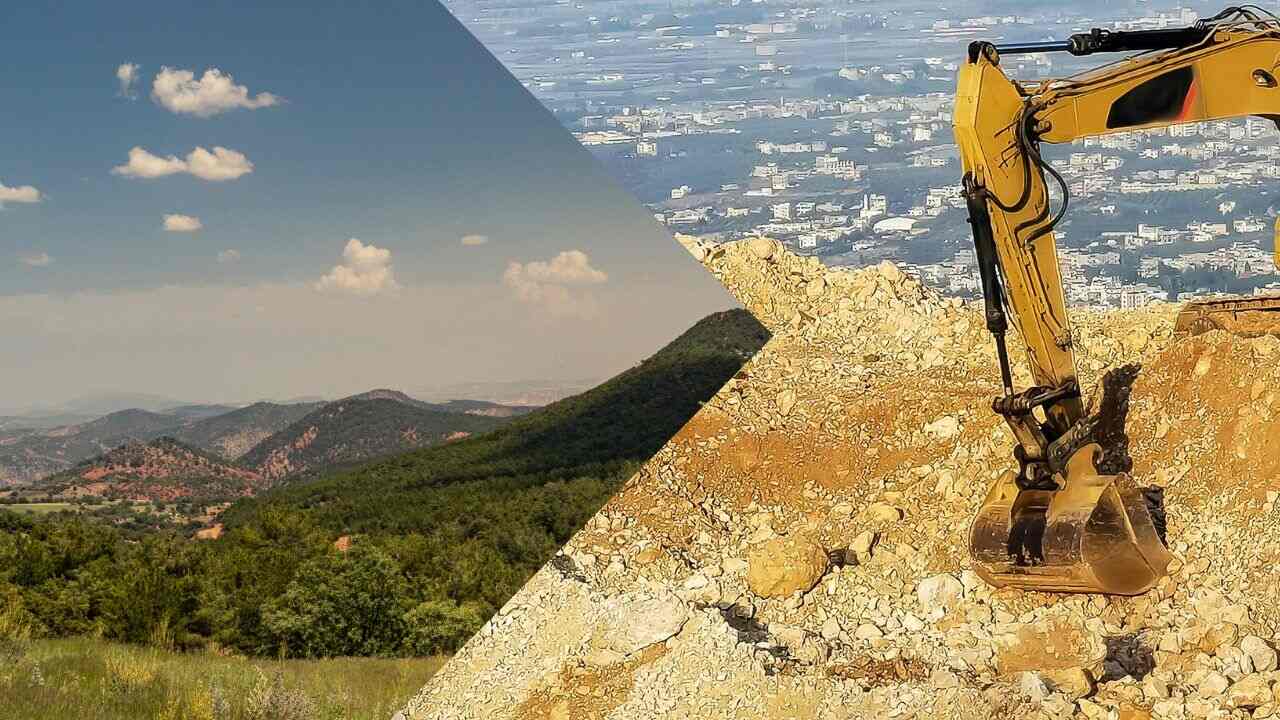
The Protests and Political Response
The ruling has sparked protests across northern India under the #SaveAravalli campaign. On December 21, 2025, activists staged demonstrations in Gurugram and Udaipur, holding placards reading “Save Aravalli, Save the Future” and “No Aravalli, No Life.”
In Jaipur, citizens held a silent vigil at Central Park on December 25, 2025, led by G.S. Bapna, the former Advocate General of Rajasthan. In Sikar, protesters climbed Harsh Mountain, a 945-metre peak within the Aravalli system, to register their opposition. Clashes were reported in Jodhpur where police detained several protesters.
Former Rajasthan Chief Minister Ashok Gehlot joined the campaign on December 18, 2025, changing his social media display picture to show solidarity and urging citizens to do the same. He warned that the changes pose a major threat to North India’s future.
Republic TV launched the #SaveAravallisSaveAQI campaign, which resonated with residents in Kotputli, Rajasthan, who expressed concerns about air pollution and water security.
The ruling Bharatiya Janata Party (BJP) has dismissed the criticism as political posturing. Senior BJP leader Rajendra Rathore stated that the 100-metre criterion is not limited to height alone, noting that all slopes and terrain within 500 metres between two hills remain outside the mining zone.
Previous Legal History
The Supreme Court banned mining in Haryana’s Faridabad, Gurugram, and Mewat districts in 2009. In May 2024, the court prohibited the grant and renewal of mining leases across the Aravalli range and directed the Central Empowered Committee (CEC) to conduct a detailed examination.
Earlier, only Rajasthan had a formally notified definition based on a 2002 State Committee Report using Richard Murphy landform classification. That definition identified hills as landforms rising 100 metres above local relief and prohibited mining on hills and their supporting slopes.
The inconsistency in definitions across states led to the formation of a multi-agency committee in May 2024, which submitted its report in October 2025 proposing the elevation-based framework.
Conservation Initiatives
Complementing the judicial action, the Centre launched the Aravalli Green Wall Project in June 2025. The initiative aims to increase green cover in a five-kilometre buffer zone across 29 districts in the four states. The project aims to restore 26 million hectares of degraded land by 2030, aligning with India’s commitments to land degradation neutrality under the UN Convention to Combat Desertification.
Five Ramsar wetland sites in the Aravalli region—Sultanpur, Bhindawas, Asola, Siliserh, and Sambhar—have been declared during the current government’s tenure, according to Minister Yadav.
What Happens Next
The December 24 announcement of a complete ban on new mining leases represents a significant policy shift that directly addresses concerns raised by environmental activists. However, the matter remains pending before the Supreme Court, with review petitions expected from various stakeholders.
Key immediate actions include:
The ICFRE must complete its comprehensive Management Plan for Sustainable Mining, which will undergo public consultation before implementation. The plan will identify additional protected zones beyond those currently restricted, potentially expanding the no-mining areas significantly. The timeline for this report remains unclear.
State governments across Delhi, Haryana, Rajasthan, and Gujarat must immediately halt processing of any new mining lease applications. Existing mining operations face enhanced scrutiny and must demonstrate strict compliance with environmental safeguards and Supreme Court directions.
Environmental groups have welcomed the Centre’s December 24 directive but continue to push for a complete review of the Supreme Court’s elevation-based definition through online petitions sent to approximately 30 officials and authorities including the Supreme Court.
The controversy has become a major political flashpoint, with opposition parties viewing the government’s swift policy reversal as validation of their protests. The Save Aravalli campaign is expected to continue monitoring implementation of the mining ban and the identification of additional protected zones.
The Aravalli issue represents a critical test case for how India balances development, mineral extraction, environmental protection, and the precautionary principle in an ecologically fragile region. The Centre’s latest directive suggests a policy recalibration favouring conservation over extraction, though activists remain vigilant about enforcement and long-term protection measures.
The fundamental debate continues: whether environmental protection should be defined by technical elevation measurements or by the broader ecological continuity and functions of the landscape. The outcome will have implications for environmental governance across India.
FAQs
- What is the Aravalli Range and where is it located?
The Aravalli Range is one of the world’s oldest fold mountain systems, running roughly 700 km from Delhi through Haryana and Rajasthan to Gujarat, forming a natural barrier between the Thar Desert and the Indo‑Gangetic plains. - What new step has the Centre taken on mining in the Aravallis?
The Union Environment Ministry has directed all concerned States to impose a complete ban on granting any new mining leases anywhere in the Aravalli Range. - Does mining stop completely in the Aravallis now?
No, the current move stops only new mining leases; existing legal mines can operate but must follow strict environmental safeguards and Supreme Court directions. - What is the Supreme Court’s 100‑metre rule for Aravalli hills?
The Supreme Court has accepted an elevation‑based definition where an “Aravalli Hill” is any landform in notified Aravalli districts that rises at least 100 metres above the surrounding terrain, and a “range” is two or more such hills within 500 metres. - Why are environmentalists still worried after the mining ban?
Activists fear the 100‑metre definition leaves many low ridges and ecologically crucial areas outside protection, warning that 60–90% of the broader Aravalli landscape could remain vulnerable to damage even if new leases are banned.