
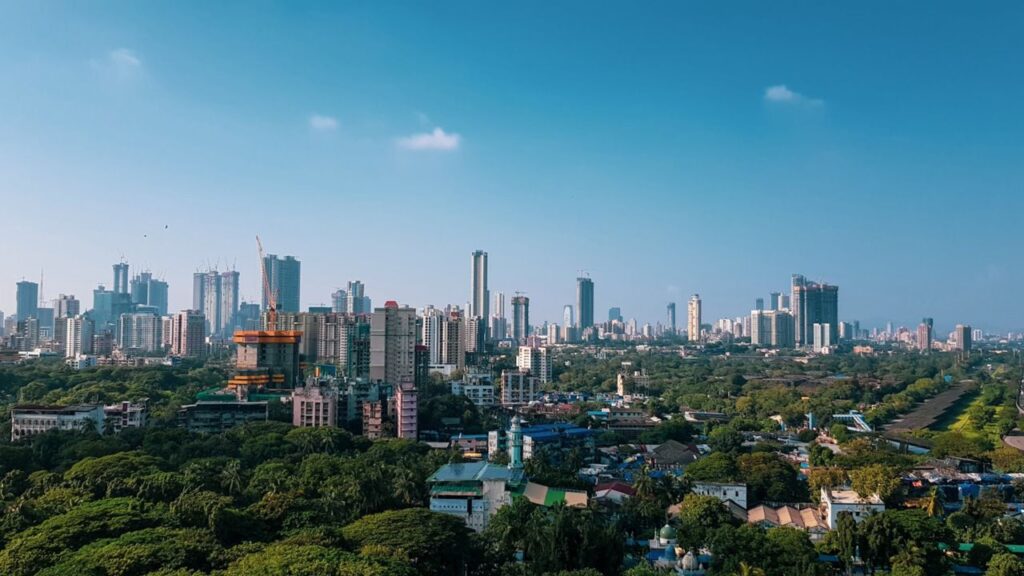


Mumbai, India’s financial capital and home to over 20 million people, is a global megacity that drives nearly 6% of India’s GDP and 33% of its tax revenue. Yet, this coastal city is increasingly vulnerable to climate shocks: urban flooding, extreme heatwaves, sea-level rise, and declining air quality already threaten lives, infrastructure, and economic stability.
To address these evolving risks, the Mumbai Climate Action Plan (MCAP 2022) was formulated by the Brihanmumbai Municipal Corporation (BMC) in partnership with the World Resources Institute (WRI) India. It lays out a roadmap to build a low-carbon, climate-resilient city by 2030, setting ambitious goals such as:
- 30% reduction in GHG emissions
- Unlocking 4.5 GW rooftop solar potential
- 100% waste segregation and landfill reduction
- 50% electrification of BEST bus fleet
- Strengthened flood resilience and heat adaptation
- City-wide real-time AQI monitoring
However, the core policy challenge is not in the vision but in implementation feasibility.
Can Mumbai execute these targets at the needed pace, scale, and equity?
This policy analysis evaluates MCAP’s progress sector-wise, identifies feasibility gaps, and recommends strategic course corrections.
Current Policy Approach (MCAP’s Six Pillars)
MCAP targets both mitigation and adaptation across:
- Energy & Buildings: Rooftop solar, green building codes
- Sustainable Mobility: Metro expansion, BEST electrification, EV incentives
- Urban Flooding & Water Security: Stormwater upgrades, blue-green infrastructure
- Solid Waste Management: Zero landfill, decentralised segregation
- Air Quality Improvement: Monitoring networks, dust and industrial emission control
- Sustainable Urban Planning: Heat Action Plan, risk-sensitive development
The policy intent is clear, but the execution trajectory is uneven.
Evidence-Based Assessment
- Energy & Buildings – Lowest Feasibility
MCAP identifies 4.5 GW rooftop solar potential, but current progress remains below 200 MW.
Key barriers:
- High-rise structural constraints and limited rooftop access
- Low financial incentives from power utilities (DISCOMs)
- High upfront costs for housing societies
Finding: Target misaligned with on-ground conditions; unrealistic without major reforms.
- Sustainable Mobility – Strongest Performing Sector
- 3,000+ electric BEST buses deployed (50% by 2027 target on track)
- Metro Lines 2A, 3, and 7 operational, with more under construction
- Mumbai leads Maharashtra in urban EV registrations
Challenges:
- Delays in metro construction increase car dependency
- Public charging infrastructure not evenly distributed
Finding: Most feasible sector with visible improvements.
- Urban Flooding & Water – High Risk, Slow Delivery
- Mumbai still reports 150+ chronic flooding spots annually
- BRIMSTOWAD drainage upgrades delayed for over a decade
Constraints:
- 19th-century drainage network
- High capital expenditure
- Slow adoption of blue-green infrastructure
Finding: Most urgent but structurally hardest to fix; severe feasibility gap.
- Solid Waste Management – Moderate Progress
- Segregation improved to 70%, but Deonar landfill remains active
- Uneven performance across wards
- Mechanisation threatens livelihoods of informal waste pickers
Finding: On the right track, but requires stronger social inclusion.
- Air Quality – Feasible but Fragmented
- AQI range: 140–170 (moderately polluted, better than NCR)
- Monitoring stations expanded, but enforcement remains weak
Coordination gap:
BMC, Maharashtra Pollution Control Board, and port/industrial authorities lack alignment.
Finding: Progress depends on inter-agency compliance, not technology alone.
Stakeholder Impact Analysis
| Stakeholder | Impact |
| Slum residents in flood & heat zones | Most climate-vulnerable; slow adaptation rollout |
| Housing societies | Financial and technical challenges for rooftop solar |
| Taxi and auto drivers | EV transition costs leading to livelihood insecurity |
| Informal waste workers | Risk of exclusion and socio-economic vulnerability |
| Commuters | Benefit from electric buses and metro expansion |
Feasibility is not just about infrastructure, but equity.
Cross-Sector Implementation Gaps
| Major Bottleneck | Implication |
| Funding constraints | Capital-heavy resilience projects delayed |
| Agency silos | Lack of coordinated execution (BMC–MMRDA–BEST–MPCB) |
| Citizen adoption | Low compliance in waste segregation and rooftop solar |
| Limited transparency | Absence of a public progress dashboard |
Policy Recommendations
- Create a real-time MCAP performance dashboard
Transparent progress monitoring to enhance accountability and citizen engagement. - Fast-track flood resilience investments
Prioritise BRIMSTOWAD with a ring-fenced climate budget. - Scaled incentive structure for rooftop solar
Capital subsidies, DISCOM net-metering, and simplified approvals. - Just transition for mobility and waste workers
Protect informal workers through training and cooperative integration models. - Unified Climate Governance Cell
Establish a single coordination authority under BMC to eliminate silo-based implementation.
Conclusion
MCAP 2022 is a timely and bold climate blueprint essential for a city at the frontline of sea-level rise and flood vulnerability. Evidence shows:
| Sector | Feasibility |
| Mobility | High |
| Air Quality | Moderate–High |
| Waste | Moderate |
| Flood Resilience | Low |
| Rooftop Solar | Very Low |
To be climate-ready by 2030, Mumbai must:
- Shift from planning to rapid execution
- Prioritise sectors with high climate-risk impact
- Ensure a just and equitable transition
- Strengthen governance and citizen participation
Only a focused, well-financed, and people-centric implementation strategy will allow MCAP to secure the future of India’s most economically vital city.
(Authored by Sahil Sawant, Project Associate, Civic Pride Organization)
References
- Brihanmumbai Municipal Corporation (BMC) & World Resources Institute India. (2022). Mumbai Climate Action Plan 2022: Towards a climate-resilient Mumbai [PDF]. Retrieved from
https://data.opencity.in/dataset/mumbai-climate-action-plan - C40 Cities. (2022). Mumbai Climate Action Plan: A robust and science-based roadmap committed to a net-zero and climate-resilient Mumbai by 2050. Retrieved from
https://www.c40.org/case-studies/mumbai-climate-action-plan/ - World Resources Institute India. (2022). Climate and air pollution risks and vulnerability assessment for Mumbai [PDF]. Retrieved from
https://www.wri-india.org/publications/climate-and-air-pollution-risks-and-vulnerability-assessment-mumbai