
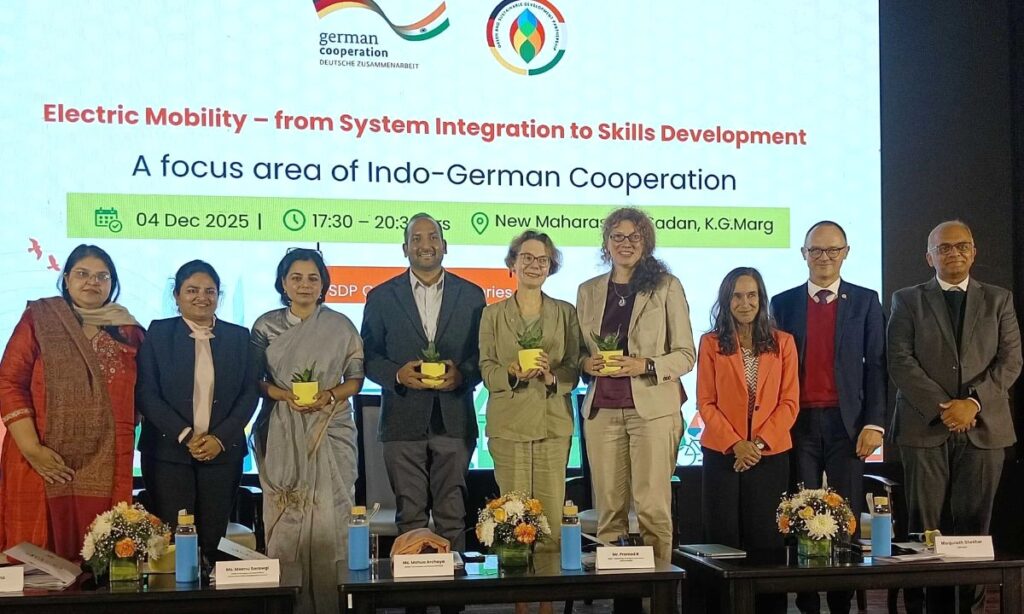


The Indo-German Partnership for Green and Sustainable Development (GSDP) hosted the ninth edition of the GSDP Conversation Series today at the Maharashtra Sadan under the theme ‘Electric Mobility: From System Integration to Skills Development.’ The high-level roundtable brought together senior officials from key central ministries, state and city administrations, public transport undertakings, distribution companies (DISCOMs), industry leaders, financiers, skill development institutions, and international partners to address the critical shift from fragmented pilots to a coordinated, ecosystem-wide transformation.
The discussion underlined that India can only achieve its ambitious electric mobility targets through integrated planning across various sectors, including renewable energy, transportation, manufacturing, finance, and skills. Moreover, stronger coordination among the central government, states, and cities is the key to successful implementation. Indo-German cooperation, rooted in long-standing collaboration on public transport modernisation, renewable energy, urban development and vocational education, provides a strong platform to jointly advance the next generation of electric mobility solutions in India.
In recent years, the Government of India has built a strong multi-ministerial policy framework for electric mobility, supported by key national initiatives including:
- PM eDrive Scheme (₹10,900 crore) for vehicle electrification and charging infrastructure
- PM eBus Sewa deploying 10,000 electric buses via public-private partnerships
- Payment Security Mechanism (₹3,435 crore) introduced in 2024 to de-risk large-scale e-bus operations
- 2024 Charging Infrastructure Guidelines by the Ministry of Power and BEE, establishing national standards for interoperability, safety, tariffs, and smart charging
During her keynote speech, Christine Toetzke, Director General for Asia, Latin America, Middle East & Eastern/Southeastern Europe, Federal Ministry for Economic Cooperation and Development (BMZ), Germany, said, “Germany and India share a long-standing partnership rooted in trust, ambition, and a shared vision for a greener future. The Green and Sustainable Development Partnership is central to our international engagement, reflecting our joint commitment to make development both climate-compatible and socially inclusive.”
“Electric mobility is not merely a technological shift, it is a transformation of how our societies move, how we design our cities, and how we create opportunities for future generations. As India advances this transition at remarkable scale and speed, Germany stands ready to support with system-level planning, vocational skills development, and innovation in areas such as battery management and circular economy solutions. Our cooperation is a long-term investment in cleaner air, safer mobility, and more equitable access to opportunity for all,” she added.
The topic of the session, titled “Electric Mobility- from System Integration to Skills Development”, comprised the following panel:
- Mr. Promod R, Head of Marketing, Strategy and Innovation, Bosch Mobility India
- Ms. Mahua Acharya, Co-Founder, Intent Platform; former CEO, CESL
- Meenu Sarawgi, Chief of strategy and operations, Automotive Skills Development Council
Moderated by:
- Ms. Swati Khanna, Senior Sector Specialist – Transport, KfW
- Mr. Manjunath Chande, Project Director, SUM-ACA (GIZ)
Senior officials emphasised the importance of aligning national schemes with local implementation capacity. They noted that India now requires system-wide approaches that combine depot electrification, grid readiness, multimodal integration, transparent procurement models and a skilled workforce.
Key Themes Discussed were:
- Multimodal Electrification: Integrating metro, bus, shared mobility and last-mile services into a unified electric transport system.
- Charging Infrastructure and Grid Readiness: Enhancing coordination with DISCOMs, ensuring land and power capacity, standardising charging systems and strengthening battery safety and circularity.
- Financing and Procurement: Improving bankability, payment security, risk sharing, contract structures and financial instruments for e-buses and commercial EVs.
- Skills and Gender Inclusion: Addressing shortages in EV engineering, charger installation, battery management, safety and digital mobility services while expanding opportunities for women.
- Indo-German Collaboration: Advancing cooperation in areas such as grid management, multimodal planning, standardisation, battery circularity and vocational training.
The dialogue reaffirmed the shared commitment of India and Germany to accelerate clean, efficient and inclusive mobility solutions. Stakeholders agreed on priority areas for continued collaboration and emphasised the role of the GSDP as a vital platform for coordinated action.
About GSDP
The Indo-German Partnership for Green and Sustainable Development (GSDP), launched in 2022, is a strategic cooperation framework supporting sustainable and climate-aligned development. The partnership advances solutions that contribute to the Sustainable Development Goals and the goals of the Paris Agreement.