
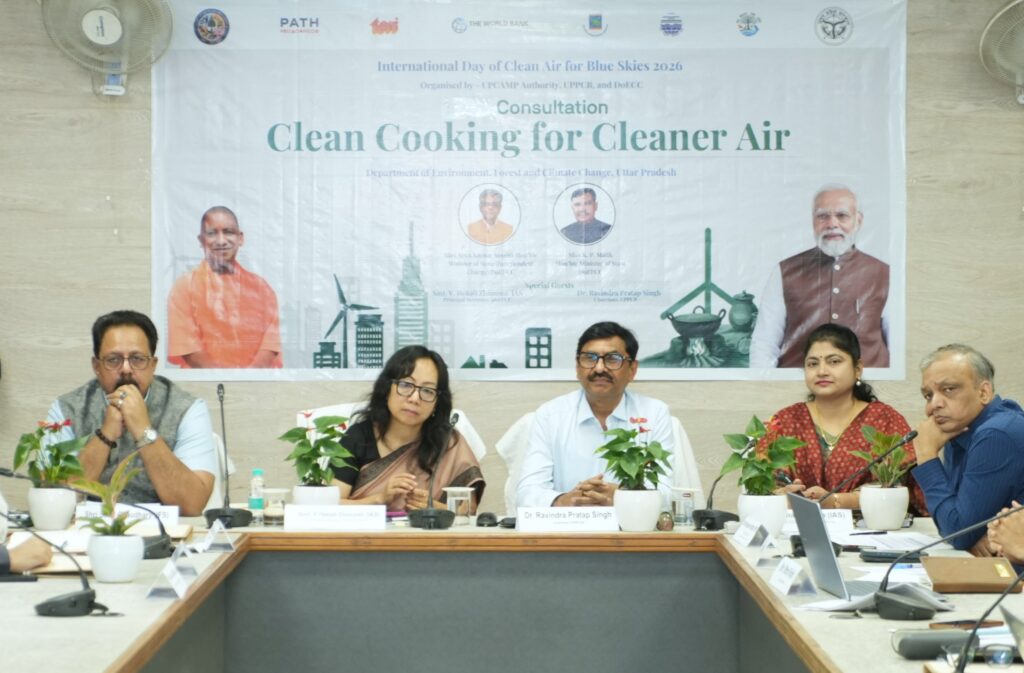


On the occasion of the International Day of Clean Air for Blue Skies 2026, the Uttar Pradesh Clean Air Management Project (UPCAMP) Authority organised a consultation on “Clean Cooking for Cleaner Air: Mobilising Partnerships and Resources in Uttar Pradesh” today at the Conference Hall, Directorate of Environment and Climate Change, Gomti Nagar, Lucknow.
The consultation was organised in collaboration with the Uttar Pradesh Pollution Control Board (UPPCB) and the Department of Environment, Forest and Climate Change, Government of Uttar Pradesh, along with development and technical partners, including The Energy and Resources Institute (TERI), PATH/CHRI, and the World Bank.
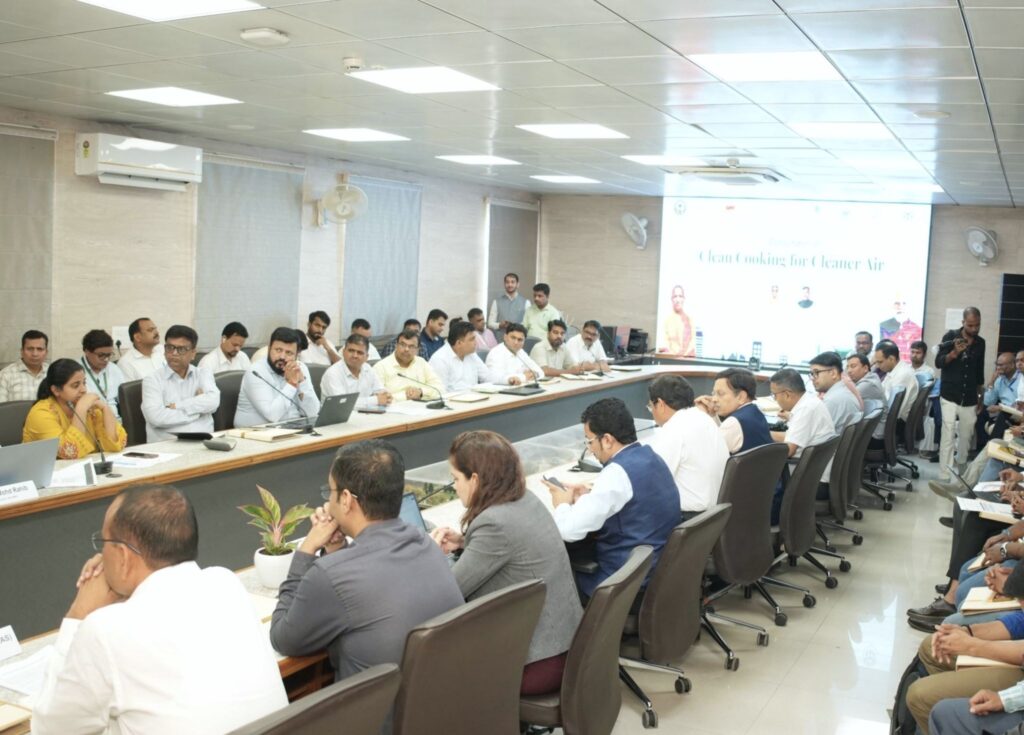
The consultation brought together senior government officials, corporate representatives, CSR stakeholders and technical partners to explore opportunities for strengthening partnerships and mobilising resources for the adoption and scale-up of clean cooking solutions across the State. Around 40 company representatives participated, including representatives from HCL Foundation, ITC, NTPC, Adani Foundation, Tata Steel, Indian Oil Corporation Limited, PepsiCo and several other corporate and CSR organisations.
During the inaugural session, Smt. V. Hekali Zhimomi, IAS, Principal Secretary, Department of Environment, Forest and Climate Change, Government of Uttar Pradesh, highlighted the close link between air pollution, public health and quality of life. She emphasised the need for locally appropriate solutions to address household cooking emissions and noted that CSR can support innovative technologies, community-level interventions and the scaling and replication of successful models. She also highlighted the potential of clean cooking investments to contribute simultaneously to better health, women’s empowerment, clean energy and climate action.
Addressing the consultation, Dr. Ravindra Pratap Singh, Chairman, Uttar Pradesh Pollution Control Board (UPPCB), congratulated the UPCAMP Authority for bringing together industry, government and policymakers. He highlighted the growing urgency of collective action on air pollution, particularly in view of rising concentrations of particulate matter such as PM10 and PM2.5. He urged industries and corporates to utilise CSR and Corporate Environmental Responsibility (CER) resources for initiatives that contribute directly to improved air quality and reduced emissions, including air-quality studies, research and clean cooking interventions.
Shri Sunil Chaudhary, PCCF & HoFF, highlighted the importance of incorporating the forestry perspective into clean cooking interventions. He noted that continued dependence on fuelwood among forest-fringe and tribal communities can have implications for both forest regeneration and public health. He stressed the need for convergence among government departments, technical institutions, corporates and CSR partners to promote alternative energy solutions and support communities dependent on fuelwood.
Shri Jaynath Yadav, Additional Mission Director, Uttar Pradesh State Rural Livelihood Mission (UPSRLM), highlighted the role of women’s self-help groups in advancing clean energy and improving rural livelihoods. He informed that UPSRLM currently has around 10.66 lakh self-help groups directly connected with 1.25 crore households, supported through village organisations and cluster-level federations. He noted that these groups can play an important role in promoting clean cooking and other clean-energy solutions. He also highlighted the roadmap for promoting Solar Sakhis and Solar Shops, with around 13,000 Solar Sakhis envisaged and approximately 1,652 Solar Shops planned across blocks.
Smt. B. Chandrakala, IAS, Secretary, Department of Environment, Forest and Climate Change, Government of Uttar Pradesh, and Chief Executive Officer, UPCAMP Authority, highlighted Uttar Pradesh’s leadership in adopting an airshed-based approach to air quality management with World Bank support. She noted that, with a population of over 250 million people, 75 districts and 826 blocks, managing air quality across the State is a significant challenge. Nearly 15 per cent of PM2.5 emissions in the State are linked to cooking and heating, while rural households continue to depend on fuelwood and traditional cookstoves for various cooking and heating needs.
She further highlighted that the six-year Uttar Pradesh Clean Air Management Project (UPCAMP), launched in June 2026, has nearly US$300 million in World Bank financing, along with an SMAP grant focused on clean cooking. Under the Program-for-Results approach, financing is linked to eight defined deliverables, making stakeholder participation critical to achieving the project’s objectives. She also highlighted partnerships with IIT Kanpur and 15 Regional Knowledge Centres to promote clean-air technologies and green jobs, and called upon corporates to view CSR through the broader lens of Corporate Environmental Responsibility.
The UPCAMP, being implemented by the Government of Uttar Pradesh with World Bank support, adopts an airshed-based and multisectoral approach to address major sources of air pollution, including household cooking. Under its clean cooking component, the project aims to enable the adoption of clean cooking solutions for nearly 3.9 million households in the State.
The consultation discussed the need for a context-specific and multi-technology approach to clean cooking. Potential solutions include electric cooking through induction cooktops, biogas plants, improved biomass cookstoves and solar cookers, depending on local needs and household preferences. The approach is supported by four key pillars: appropriate technology selection, robust distribution mechanisms, adequate financial incentives and behaviour change.
The consultation placed particular emphasis on the role of Corporate Social Responsibility (CSR) in complementing government efforts and addressing financing and implementation gaps. CSR investments can support the deployment, demonstration and scale-up of multiple clean cooking technologies under UPCAMP, while contributing to improved air quality and public health outcomes.
During the technical sessions, Mohd. Rahib, Deputy Chief Executive Officer, UPCAMP Authority, presented an overview of UPCAMP and its project priorities. Dr. Anju Goel, Senior Fellow & ADIR, Centre for Air Quality Research, TERI, presented the current status and key challenges related to clean cooking in Uttar Pradesh, while Krishna Kant Pandey, Consultant, PATH/CHRI, presented potential CSR and partnership opportunities in the clean cooking sector. Representatives of potential partners also shared their experiences and initiatives, facilitating discussion on existing models, implementation approaches and opportunities for collaboration.
An open discussion on partnership models and CSR opportunities followed the presentations. The discussions focused on potential areas of collaboration, including technology deployment, demonstration and pilot projects, last-mile delivery, behaviour change, innovation, financing and implementation support.
The consultation concluded with deliberations on the way forward and key action points for strengthening partnerships and mobilising CSR resources for clean cooking interventions in Uttar Pradesh. Shri Jag Pravesh, IAS, Special Secretary, Department of Environment, Forest and Climate Change, Government of Uttar Pradesh, and Additional Chief Executive Officer, UPCAMP Authority, delivered the vote of thanks.
The consultation is expected to contribute to the development of a coordinated roadmap for scaling clean cooking interventions under UPCAMP through sustained collaboration among government, corporates, technical agencies and other stakeholders. The initiative aims to accelerate the adoption of clean cooking technologies and contribute to improved air quality, public health and sustainable development across Uttar Pradesh.