
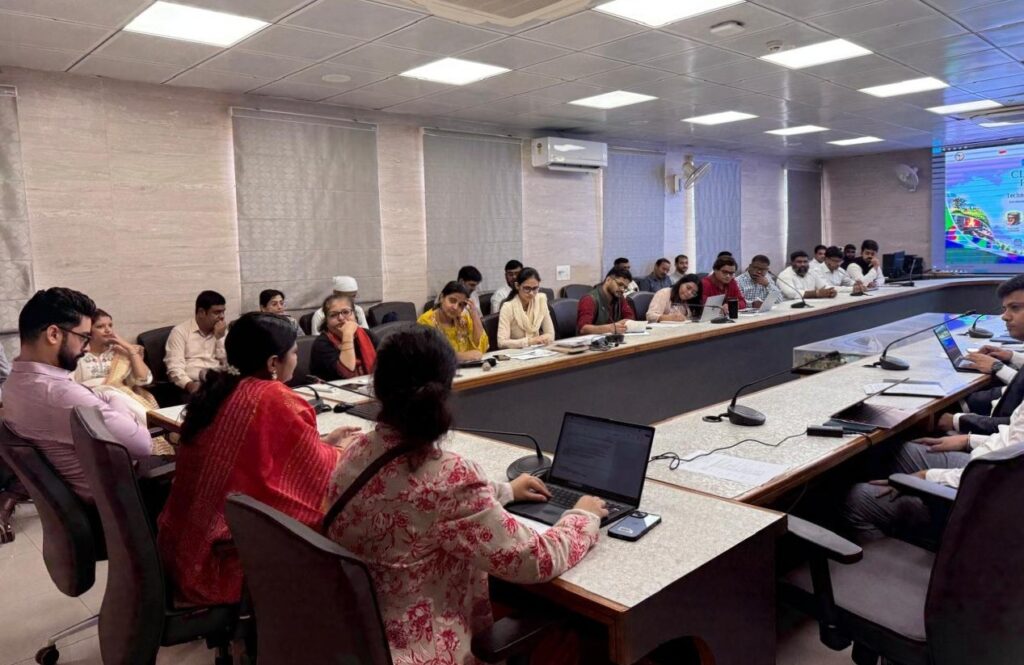


Lucknow, September 22, 2026: The Uttar Pradesh Clean Air Management Project (UPCAMP) Authority convened a stakeholder consultation on “Technology and Financing Pathways for the Clean Cooking Pilot” in Lucknow to advance the design of a practical, evidence-based clean cooking pilot for Uttar Pradesh.
The consultation was held at the Conference Hall, Paryavaran Nideshalaya, Vineet Khand-1, Gomti Nagar, Lucknow, bringing together representatives from the Government of Uttar Pradesh, World Bank, The Energy and Resources Institute (TERI), UP State Rural Livelihood Mission (UPSRLM), clean cooking technology providers, financial institutions, MFIs and NBFCs.
The consultation was chaired/opened by Smt. B. Chandrakala, Secretary, Department of Environment, Forest & Climate Change, Government of Uttar Pradesh and CEO, UPCAMP Authority, with the participation of Shri Jag Pravesh, Special Secretary, Department of Environment, Forest & Climate Change and Additional CEO, UPCAMP Authority, and Ms. Michelle Carvalho Metanias Hallack, World Bank. The UPCAMP Authority and TERI teams also participated throughout the consultation.
The consultation forms part of UPCAMP’s clean cooking component, which aims to facilitate adoption of clean cooking solutions for nearly 3.9 million households in Uttar Pradesh. TERI is supporting UPCAMP as the technical partner for development of the Clean Cooking Pilot, including assessment of household needs, technology options, financing mechanisms and implementation barriers.
Ms. Anju Goel, Senior Fellow & ADIR, Centre for Air Quality Research, TERI, presented findings from the household survey undertaken across the pilot districts. The consultation examined household cooking practices, fuel use, technology preferences, willingness to pay, affordability and after-sales requirements.
The discussions focused on four key technology pathways: improved cookstoves (ICS), family-size/community biogas, solar cooktops, and induction/electric cooking solutions. Survey findings indicated significant variation in technology preferences across districts, reinforcing the need for a demand-driven and context-specific approach rather than a uniform technology solution.
Affordability and financing emerged as important considerations. Stakeholders discussed several potential mechanisms, including Self-Help Group (SHG)-based financing, revolving funds, Kisan Credit Card (KCC) linkages, Direct Benefit Transfer (DBT), interest subvention, consumer finance, credit guarantees and blended financing approaches. The discussions also explored how existing SHG and Solar Sakhi/Solar Sanchalika networks could support demand aggregation, local demonstrations, distribution and after-sales services.
Participants highlighted that successful clean cooking adoption would require more than technology distribution. User awareness, behaviour change, reliable supply chains, electricity availability, appropriate technology selection, affordable financing, local servicing and continued handholding were identified as critical elements for sustained adoption.
Technology providers shared experiences relating to product performance, user training, maintenance, distribution models, battery-supported electric cooking, solar cooking, biogas systems, improved biomass cookstoves and digital monitoring solutions. The discussions also explored opportunities to reduce technology costs through programme-scale procurement and to develop financing models that could support repayment through manageable instalments and potential fuel-cost savings.
The consultation emphasised the importance of developing a self-sustaining and scalable pilot, rather than relying solely on grants or CSR-supported deployment. Stakeholders discussed the possibility of using limited catalytic support to enable affordable financing, with repayments potentially supporting subsequent beneficiaries through revolving mechanisms.
The inputs from the consultation will contribute to refining the UPCAMP Clean Cooking Pilot Design, including technology selection, beneficiary segmentation, financing architecture, institutional convergence, community mobilisation, behaviour change, distribution and monitoring mechanisms. Further consultations with technology providers, financial institutions, EESL, MFIs and other stakeholders are expected as the pilot design progresses.
The consultation underscored the shared objective of developing affordable, accessible, reliable and sustainable clean cooking solutions that can contribute to improved air quality, reduced household fuel burden and sustainable development across Uttar Pradesh.