



India, the world’s third-largest solar power producer, could generate 12 million tonnes of discarded panel waste by 2047, posing both an environmental challenge and a significant economic opportunity worth Rs 3,700 crore, according to the think tank Council on Energy, Environment and Water (CEEW).
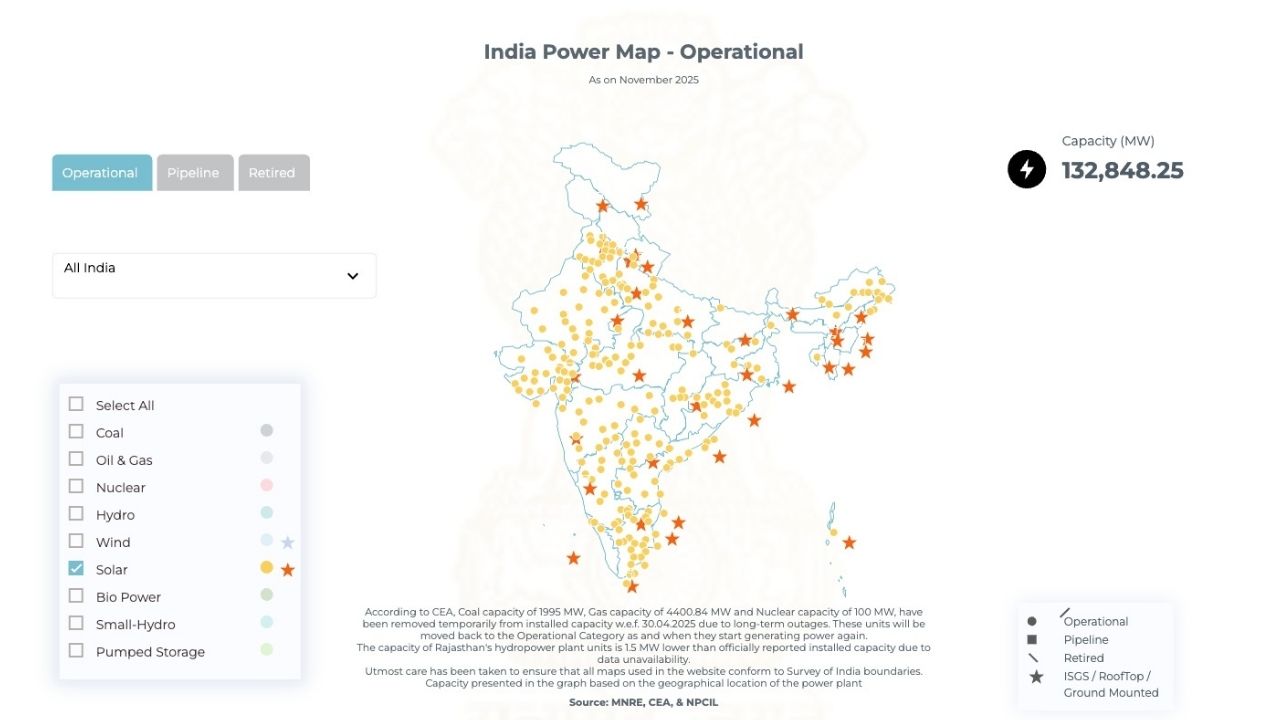
The country’s solar power capacity currently stands at 132.85 gigawatts as of November 2025, according to Ministry of New and Renewable Energy data. With most mega-solar installations commissioned during the mid-2010s approaching their 25-year operational lifespan, India faces an urgent need to establish a comprehensive recycling infrastructure before the disposal crisis intensifies.
Recovery of valuable materials, including silicon, copper, aluminium, and silver from discarded solar modules could meet 38 per cent of the sector’s manufacturing requirements by 2047. The recycling process could simultaneously prevent 37 million tonnes of carbon emissions by replacing virgin resource extraction with recovered materials.
The Hidden Cost of Clean Energy
India’s renewable energy capacity has witnessed explosive growth, with the country adding a record 34.4 gigawatts of solar and wind capacity in the first nine months of 2025, a 71% increase over the previous year. Solar now accounts for 51% of India’s total renewable energy capacity.
Fueled by government subsidies, nearly 2.4 million households have adopted solar energy, helping solar power contribute to more than 25% of the nation’s total energy mix. However, this rapid expansion masks a looming challenge: a growing solar waste crisis that India is currently ill-equipped to handle due to a lack of national funding and industrial-scale recycling infrastructure.
As of 2023, India generates approximately 110,000 tonnes of solar panel waste, a relatively manageable figure. But according to CEEW estimates, this could rise sharply to 661,000 tonnes by 2030, and exceed 12 million tonnes by 2047. Addressing this challenge will require an industrial-scale transformation, including the establishment of nearly 300 dedicated recycling facilities across the country, supported by strategic investments of Rs 4,200 crore over the next two decades.
The bulk of this waste will consist of crystalline-silicon modules, a result of India’s continued aggressive expansion of solar infrastructure.
Current Recycling Infrastructure Inadequate
India’s solar panel recycling sector remains in early developmental stages, with only a handful of commercial operators currently functioning. Formal recycling operations face substantial financial losses ranging from Rs 10,000 to Rs 12,000 per tonne under existing market conditions.
Purchasing waste modules constitutes the single largest operational expense, accounting for nearly two-thirds of total costs at approximately Rs 600 per panel. Additional expenses for processing, collection logistics, and disposal further compound the financial burden.
Economic viability requires either modules priced below Rs 330 or policy support mechanisms, including Extended Producer Responsibility certificate trading, tax incentives, and targeted research funding for improving silicon and silver recovery efficiency, according to the CEEW analysis.
A typical commercial recycling facility can annually recover approximately 24,468 tonnes of glass, 2,656 tonnes of aluminium, 1,405 tonnes of silicon, and nearly 50 tonnes of copper. For a nation seeking reduced dependence on imported raw materials, this recovery capacity represents strategic value for securing domestic supply chains.
Government Regulatory Framework
The Ministry of Environment, Forest and Climate Change notified the E-Waste (Management) Rules, 2022 on November 2, 2022. Management of solar photovoltaic modules, panels, and cells was incorporated under Chapter V of these regulations.
Under these rules, every manufacturer and producer of solar photovoltaic modules or panels or cells must maintain inventory systems, ensure proper processing of waste, and comply with standard operating procedures established by the Central Pollution Control Board.
The regulations mandate that recyclers of solar photovoltaic modules must achieve material recovery targets as specified by the Central Pollution Control Board. Producers are required to collect 20 per cent of e-waste based on their sales from two years prior for the financial year 2024-25, with collection targets remaining at 20 per cent for 2025-26.
The CEEW studies recommend establishing Extended Producer Responsibility targets specifically for solar waste collection and recovery under the existing e-waste framework. The research proposes creating a dedicated Circular Solar Taskforce under the Ministry of New and Renewable Energy to coordinate policy, financial, and industrial efforts.
Strategic Value for Manufacturing Self-Reliance
Recovered materials could substantially reduce India’s reliance on imported raw materials for solar manufacturing. The Ministry of Mines has identified silicon, copper, and aluminium as critical minerals essential for domestic manufacturing capabilities.
India’s solar module manufacturing capacity expanded from 38 gigawatts to 74 gigawatts during financial year 2024-25. The country ranks fourth globally in renewable energy installed capacity and third in solar power capacity, according to International Renewable Energy Agency statistics.
The CEEW studies, titled ‘How Big is the Solar Module Recycling Industry in India?’ and ‘How Much Does It Cost to Recycle a Solar Module in India?’, were prepared by researchers Akanksha Tyagi, Prashant Badal, and Ajinkya Kale.
Global Recycling Context and Innovation
India’s solar waste challenge mirrors worldwide trends. Globally, only approximately 10 per cent of photovoltaic panels undergo recycling, with the majority disposed through dumping, burning, or burial. The International Renewable Energy Agency projects cumulative global solar panel waste reaching 78 million tonnes by 2050.
The United States and China also face mounting volumes as their solar installations expand. However, regulatory responses vary dramatically. Europe leads with its Waste Electrical and Electronic Equipment Directive, requiring EU member states to achieve 85 per cent recovery targets and 80 per cent recycling rates. In 2022, European countries collected almost 50,000 tonnes of solar panel waste for recycling.
Recent technological advances demonstrate improved recovery potential. California-based startup PV Circonomy introduced highly automated recycling technology in February 2025, achieving 99.3 per cent material recovery rates while consuming only one kilowatt-hour per panel.
Indian e-waste recycler Attero signed a memorandum of understanding with the National Institute of Solar Energy in April 2025 to address domestic solar waste management challenges through collaborative research and technology development.
Infrastructure Development Recommendations
The CEEW studies propose several interventions to build viable recycling ecosystems. Recommendations include developing a centralized solar panel inventory to identify waste concentration hotspots and improve data transparency across the supply chain.
Producers should share detailed material composition data and design modules optimized for easy disassembly to facilitate efficient recycling processes. The framework emphasizes embedding circular economy principles directly into renewable energy missions from planning stages.
These combined interventions aim to establish robust collection systems, accelerate research and development in advanced material recovery techniques, and ensure resource resilience throughout India’s clean energy transition.
Path Forward
India’s solar energy expansion continues at an unprecedented pace, with projections indicating 45-46 gigawatts of new installations by end-2025. However, sustaining this green revolution requires immediate action to professionalize the recycling sector and establish manufacturer accountability across product lifecycles.
Without comprehensive infrastructure development and regulatory enforcement over the next decade, India risks transforming one environmental challenge into another, potentially undermining the sustainability credentials of its remarkable solar achievement.
The studies emphasise that recovered materials from end-of-life panels can create lasting economic value while supporting manufacturing self-reliance objectives. The window for establishing necessary frameworks narrows as the first major wave of panel retirements approaches within 10-15 years.