
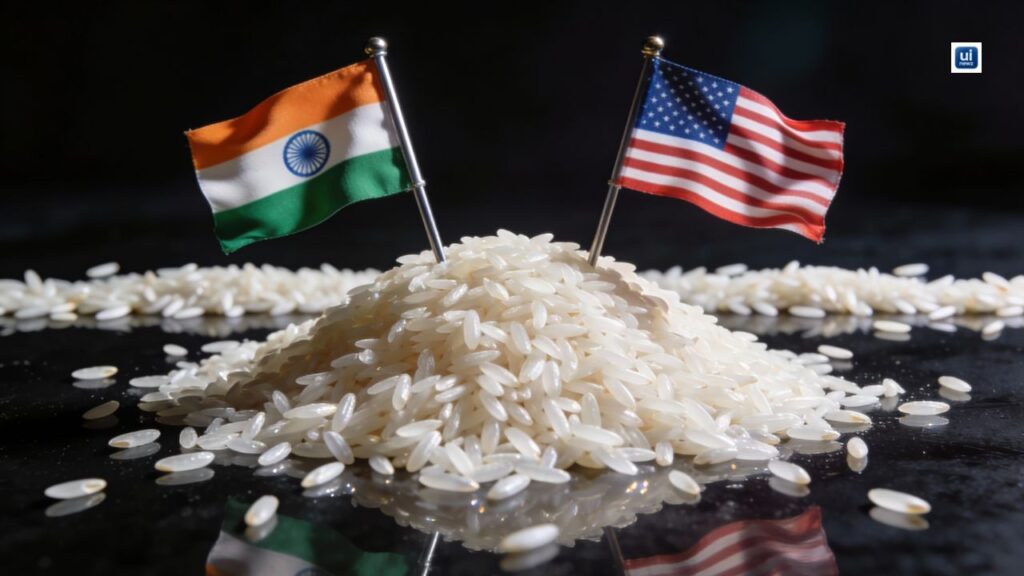


India on December 15, 2025, firmly rejected U.S. assertions that it is “dumping” rice in the American market, stating that shipments to the United States largely comprise premium-grade basmati rice sold at market-linked, higher prices. New Delhi maintained that there is no prima facie basis for initiating an anti-dumping investigation.
Trade Secretary Rajesh Agrawal told reporters that the United States has not launched any formal anti-dumping probe against Indian rice exports so far, countering speculation triggered by recent political statements in Washington.
How the dispute escalated
The issue gained momentum following public comments by U.S. political leaders and farm groups alleging that Indian rice is being sold below fair market value. These remarks have raised concerns over the possibility of additional U.S. tariffs on Indian rice imports. Washington has already imposed duties on certain Indian goods earlier this year, and talk of further trade restrictions has unsettled exporters and traders.
What India exports to the U.S.
India remains the world’s largest rice exporter, shipping more than 20 million tonnes globally in 2024–25. Exports to the U.S., however, account for only a small share of this volume and are overwhelmingly basmati in composition.
During 2024–25, India exported around 335,500 tonnes of rice to the U.S., of which over 274,000 tonnes were basmati. Officials argue that this limited market share and the premium nature of basmati undermine claims of dumping, which typically involve large volumes of subsidised or underpriced goods.
Industry reaction and market impact
Basmati exporters and industry bodies have pushed back strongly against the allegations. They emphasise that basmati rice is an aged, high-value grain and is not covered under India’s Minimum Support Price (MSP) regime, which applies to non-basmati rice varieties.
Exporters warn that unsubstantiated dumping claims or new tariffs could have spillover effects, encouraging similar trade actions in other markets. Such a development could hurt farmers and millers in key basmati-producing regions, including Punjab, Haryana, and western Uttar Pradesh. Industry associations have begun coordinating with the commerce ministry to brief U.S. stakeholders and clarify India’s position.
Policy and trade law pathways
Should the U.S. initiate a formal anti-dumping investigation, it would involve a detailed examination of pricing practices, subsidies, and alleged injury to domestic producers under U.S. trade law and WTO rules.
India’s current approach remains diplomatic—challenging the factual basis of the claims, highlighting basmati’s premium pricing and limited U.S. market share, and engaging trade officials to prevent escalation. Exporters have also indicated that dispute settlement options remain open if tariffs are imposed without clear legal justification.
What this means for farmers and consumers
Global basmati rice prices are highly sensitive to policy signals. Although U.S.-bound volumes are relatively small, any tariff-led contraction in demand or reputational impact could pressure prices and margins across the supply chain.
At the same time, demand for Indian basmati remains strong in West Asia, Europe, and Africa, suggesting that a swift diplomatic resolution could stabilise sentiment and keep global trade flows largely intact.
What to watch next
- Whether the U.S. Trade Representative or Commerce Department initiates a formal probe or releases data supporting dumping allegations
- Any changes in tariff levels or provisional trade measures affecting rice imports
- Statements from APEDA, AIREA, and India’s commerce ministry, alongside scheduled bilateral trade consultations
Analysis: A nuanced trade challenge
At its core, the dumping rhetoric risks oversimplifying a complex market reality. Basmati rice’s premium positioning, geographically limited production, and modest U.S. market presence do not fit the classic dumping framework. However, growing political pressure from U.S. farm lobbies and the broader politics of protectionism mean Indian exporters must remain vigilant—strengthening transparency, traceability, and compliance to safeguard market access.