
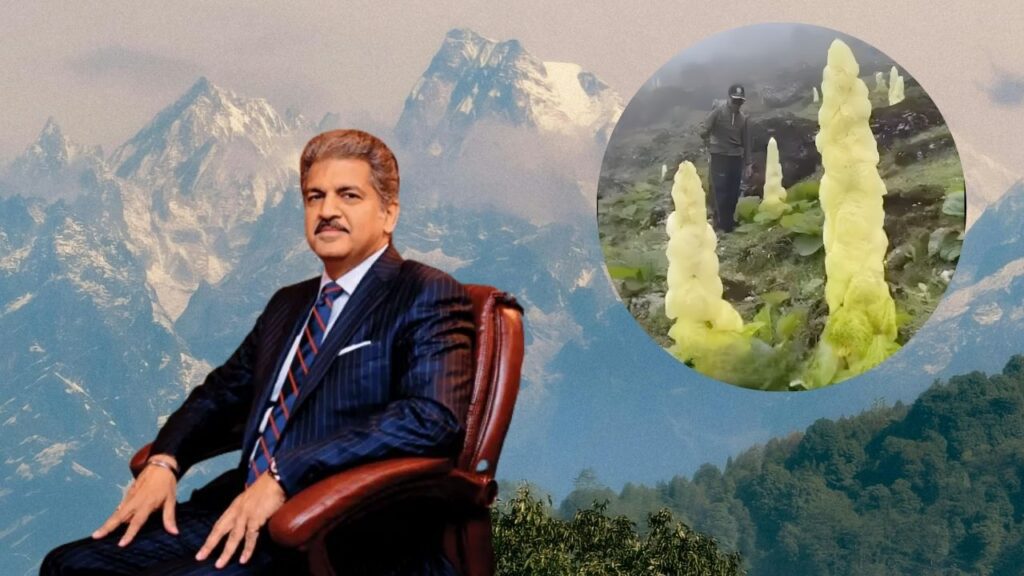


Industrialist Anand Mahindra drew attention to a rare Himalayan plant called Sikkim Sundari on December 21, 2025, expressing surprise that Indian biology textbooks rarely featured this extraordinary local species. The plant, scientifically known as Rheum nobile, grows at extreme altitudes in Sikkim and is known for its unique survival adaptations.
Mahindra posted a video on social media platform X, describing the plant as an “extraordinary marvel” he knew nothing about before. The Mahindra Group chairman questioned why such a remarkable native species remained largely absent from Indian school curricula, particularly when compared to exotic plants from distant regions.
Sikkim Sundari: Habitat and Geographic Spread
The Sikkim Sundari, also called the Noble Rhubarb or glasshouse plant, grows at altitudes between 4,000 and 4,800 meters in the Eastern Himalayas. According to botanical databases, the species is native to regions spanning northeastern Afghanistan through northern Pakistan, India (particularly Sikkim), Nepal, Bhutan, Tibet, and Myanmar.
Unique Natural Greenhouse Structure
The plant’s most distinctive feature is its translucent bracts, modified leaves that form a protective tower-like structure around delicate flowers. These semi-transparent bracts function as a natural greenhouse, allowing visible light to pass through while blocking harmful ultraviolet radiation and protecting the flowers from extreme cold and wind at high altitudes.
Rare Life Cycle and Flowering Pattern
Scientific research published in the Annals of Botany indicates that Rheum nobile is monocarpic, meaning it flowers only once before dying. The plant exists as a small rosette near the ground for approximately 30 to 35 years, quietly accumulating resources from its root system. In its final year, it produces a single massive flowering stem reaching 1 to 2 meters in height.
The flowering typically occurs between June and July. After producing thousands of seeds within its protective bracts, the plant completes its life cycle and dies. This reproductive strategy, known as semelparity, is considered an adaptation to harsh alpine environments where conditions are unpredictable.
https://x.com/anandmahindra/status/2002669139253490133?s=20
Historical Discovery by British Botanists
The species was first scientifically described by British botanists Joseph Dalton Hooker and Thomas Thomson in 1855, following expeditions to Sikkim between 1848 and 1850. Hooker noted the plant’s extraordinary appearance, describing its pale, translucent bracts forming towers that concealed flowers against glacial landscapes.
Local communities in Sikkim and Nepal traditionally consume the plant’s stems, known locally as “Chuka” or “Padamchal.” The stems are pleasantly acidic and eaten raw in salads or cooked as vegetables. The plant also has traditional medicinal uses in Tibetan medicine.
The video shared by Mahindra was credited to the Northeast India tourism account and showed the glowing, tower-like structure of the plant against mountain terrain. The post received strong engagement on social media, with thousands of users sharing facts about the species and expressing appreciation for India’s biodiversity.
Mahindra’s post sparked discussion about curriculum content in Indian schools and the need for greater awareness of native flora. Several users responded by sharing their own sightings of the plant during treks in Sikkim’s high-altitude regions.
Rheum nobile belongs to the Polygonaceae family and is considered endemic to the Eastern Himalayas. Conservation efforts focus on protecting the slow-growing species from disturbances such as grazing by yaks and habitat loss in its alpine environment.