
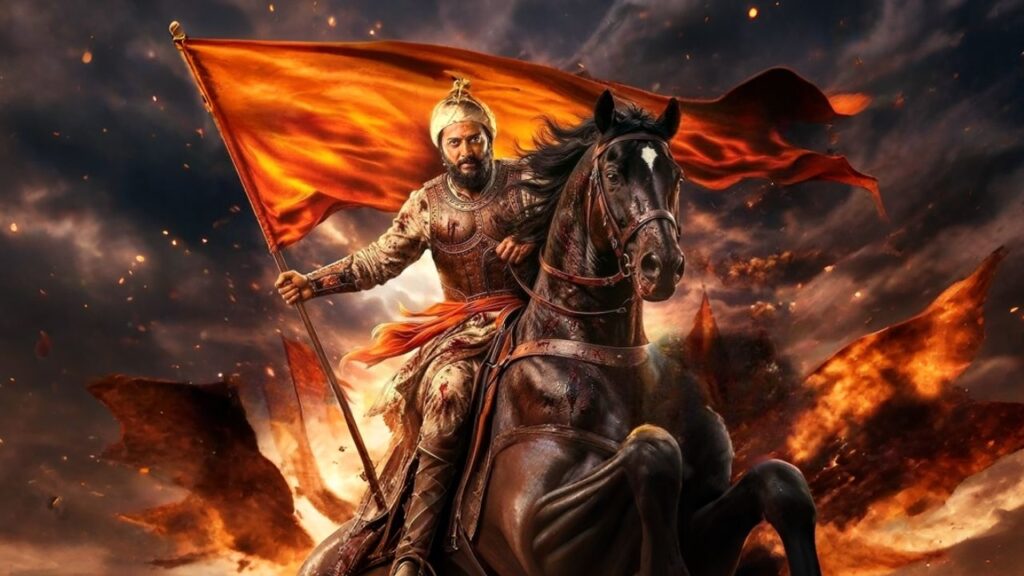


Raja Shivaji has finally arrived in theatres. If the packed morning shows, 7 AM screenings in Pune, and nearly 49,000 advance tickets are any indication, Maharashtra hasn’t just bought tickets, it has shown up for a feeling.
But before the lights dim and the screen fills with Riteish Deshmukh’s portrayal, it’s worth pausing to ask: who was the real Shivaji Maharaj? And why, nearly 350 years after his death, does his name still make an entire crowd fall silent?
A Boy Who Grew Up Watching an Empire Ignore His People
Shivaji Bhosale was born in 1630 at Shivneri Fort in the Pune district, to Shahaji Bhosale, a military commander, and Jijabai, a woman of fierce conviction and deep faith. His father spent most of his life serving the Adilshahi Sultanate of Bijapur. His mother raised him largely alone, in the shadow of forts and the stories of Hindu gods and warrior kings.
Maharashtra at this time was squeezed from every side, the Mughal Empire to the north, the Bijapur Sultanate to the south, and the Nizamshahi slowly crumbling. The common people, the farmers and craftsmen of the Deccan, had no king of their own.
Jijabai made sure her son understood that.
Sixteen and Already Dangerous
By the time Shivaji was 16, he had taken his first fort, Torna, in 1646, with a small, loyal band of Mavla warriors, men from the local hills who were fast, fearless, and knew every ridge and valley of the Sahyadris.
This was not a revolt. It was a philosophy made into action. Shivaji called it Swarajya, self-rule, a kingdom of one’s own people, for one’s own people. He didn’t just capture forts. He rebuilt them, stocked them, and turned the entire mountain range into a chain of strongholds that no conventional army could easily dismantle.
Within a decade, the Bijapur Sultanate was alarmed enough to send its most feared general, Afzal Khan, to crush this young upstart once and for all.
The Meeting That Became Legend
In 1659, Afzal Khan marched with 10,000 soldiers toward Shivaji’s territory, destroying temples along the way to bait him into open battle. Shivaji did not take the bait.
Instead, he arranged a “peace meeting” at Pratapgad Fort. The two men came supposedly unarmed. What happened next has been debated by historians, but in the most widely accepted account, Afzal Khan struck first. Shivaji, wearing armour beneath his robes and armed with a concealed weapon called the wagh nakh (tiger claws), killed the general and routed the entire Bijapur army that day.
It wasn’t just a military victory. It announced to every kingdom in the Deccan: this man cannot be underestimated.
Aurangzeb’s Greatest Headache
The Mughals watched Shivaji’s rise with growing unease. In 1666, Emperor Aurangzeb summoned him to Agra, a city deep in Mughal territory, and had him placed under house arrest. Most men would have negotiated their surrender there.
Shivaji smuggled himself out in a fruit basket.
He returned to Maharashtra, rebuilt his forces, and by 1674 was crowned Chhatrapati, sovereign king, at Raigad Fort, in a ceremony that was as much a cultural declaration as a political one. For the first time in generations, the Deccan had a Hindu king who answered to no sultan, no emperor.
More than a Warrior
What separates Shivaji from most conquerors of his era was his governance. He built one of India’s earliest organised naval fleets to counter Portuguese and British coastal influence, earning him the title Father of the Indian Navy. He treated prisoners of war humanely. Women captured in battle were protected and returned with respect, a standard almost unheard of in 17th-century warfare. He appointed people based on merit, not caste or birth.
He died in 1680 at Raigad at the age of 50. But by then, he had done something no one had managed in centuries; he had given the people of the Deccan a sense that they belonged to something of their own.
Why It Still Matters
Every generation finds a reason to return to Shivaji. Sometimes it is pride, sometimes politics, sometimes genuine curiosity about a man who built an empire with loyalty and geography rather than inherited wealth.
Raja Shivaji, the film may be three hours long, but the story it draws from is a lifetime that still hasn’t finished being told.