



Most tech talks are carefully managed performances. Polished slides, rehearsed answers, a product reveal to close on a high note. Sam Altman’s January 27th session was none of that. It was an hour of developers asking the questions they’d been afraid to ask out loud, Is my job disappearing? Is AI going to break the economy? Are we already too late? and a CEO who, for once, didn’t bother softening the answers. What followed wasn’t a pep talk. It was a wake-up call dressed as a Q&A.
Altman didn’t flinch. He didn’t soothe. He laid out a pragmatic, sometimes uncomfortable roadmap of what the next two years actually look like, and it’s neither the utopia his fans imagine nor the apocalypse his critics predict. It’s something more nuanced, and therefore more demanding.
Here are the 8 truths from that session and what they actually mean for anyone trying to navigate the AI era.
1. More AI Means More Engineers, Not Fewer
The loudest fear in every developer forum right now is that AI will make software engineers obsolete. Altman’s answer, grounded in economic history, is almost the opposite.
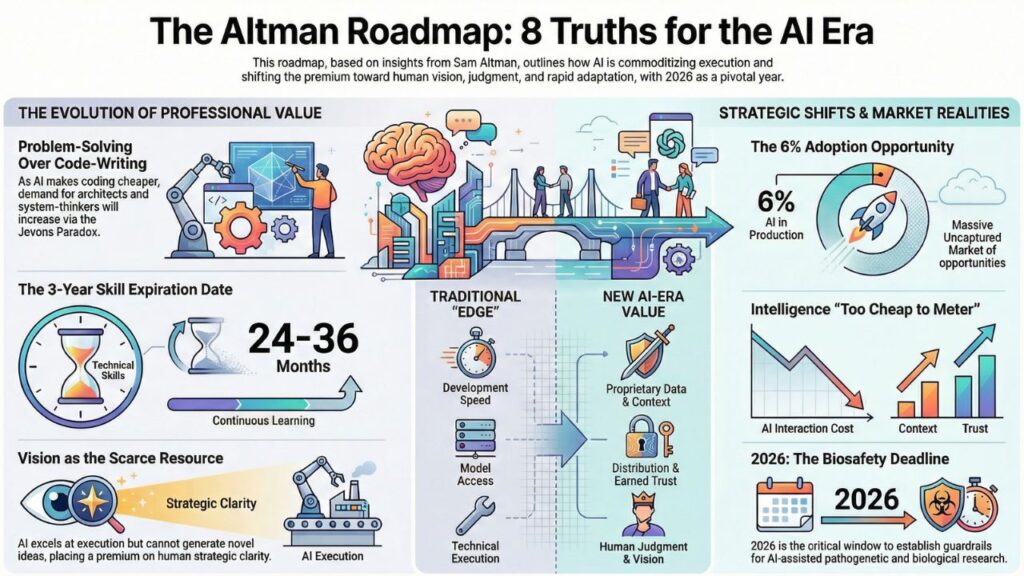
He referenced the Jevons Paradox, a 19th-century economic principle that says when a resource becomes cheaper and more efficient, total consumption of that resource increases, not decreases. The steam engine made coal more efficient, so people used more coal. AI makes coding cheaper, so companies will build far more software, creating more demand for human engineers, not less.
The catch? The nature of engineering work is shifting. The developer who thrives won’t be the one who types the fastest; they’ll be the one who architects the best systems, asks the sharpest questions, and catches what the AI gets wrong. Code-writing is becoming a commodity. Problem-solving is becoming the product.
2. Your Skills Have a Two-to-Three-Year Shelf Life
This is the truth that stings most. The skills making you valuable today, specific frameworks, languages, and tools, may no longer be differentiators within 24 to 36 months.
It’s not that knowledge becomes useless; it’s that the baseline keeps rising. What was an advanced skill a year ago is now table stakes. This means continuous learning isn’t just career advice anymore, it’s survival. The professionals who will thrive are those who treat learning as a permanent operating mode, not a phase before employment.
3. Enterprise AI Adoption Is Shockingly Low, and That’s the Opportunity
Despite the AI headlines dominating every business publication, the reality on the ground is startling: only about 6% of companies are actually deploying AI in production environments. The hype is enormous; the adoption is thin.
Altman sees this gap not as a failure but as the largest uncaptured opportunity in technology right now. The companies that move from experimentation to integration in 2026 won’t just gain efficiency; they’ll likely set the benchmarks that define their entire industry for a decade. The window is open. It won’t stay that way.
4. Biological Safety Is the Crisis We’re Ignoring
If there’s a single area where Altman drops all optimism and speaks in urgent tones, it’s this one. AI models are advancing to the point where they can meaningfully assist with biological research, designing proteins, modeling pathogens, and accelerating the kind of scientific reasoning that once required years of specialized training.
The same capability that could help cure diseases could help design them.
Altman was unambiguous: 2026 is the critical year to establish guardrails around AI-assisted biology. Not 2030. Now. For anyone working at the intersection of AI, healthcare, or life sciences, understanding biosafety frameworks isn’t a nice-to-have; it’s becoming a professional obligation.
5. Building Fast Is No Longer Your Edge
The startup playbook used to reward speed above everything. Whoever ships first wins. But when AI can compress months of development into days, speed becomes table stakes, not a competitive advantage.
Altman challenged founders with a pointed question: If anyone can build your app in a weekend with AI, what else do you actually have?
The answer determines survival. Distribution networks, earned trust, community, institutional knowledge, proprietary data, and deep domain expertise are the things AI cannot replicate overnight. Building a product is easier than ever. Building a business that matters still requires the things that have always mattered.
6. Intelligence Is Becoming Too Cheap to Meter
Altman borrowed a phrase from the early nuclear industry: “too cheap to meter.” It described a future where energy would be so abundant that tracking usage would cost more than the energy itself. He believes AI inference, the cost of actually running an AI model, is heading toward that same threshold.
Within the next 24 months, the marginal cost of an AI interaction could approach zero for many applications. The implications are enormous. Business models built on price-per-query will collapse. The value in AI won’t reside in the model itself; it will reside in the context, the integration, the trust, and the specific outcomes the AI enables. If intelligence is free, what you’re really selling is judgment.
7. AI Amplifies Execution But Can’t Replace Vision
This is perhaps the most underappreciated truth from the session, and the most dangerous to ignore.
AI is extraordinarily good at executing a well-defined idea. It is not good at generating genuinely novel ones. That gap creates a new kind of risk: the perfect execution of a bad idea. When building something took months, flawed concepts tended to die in the development stage, too expensive, too slow to see through. Today, a bad idea can be beautifully built and deployed in hours, then judged by the market at full speed.
This puts an enormous premium on the quality of thinking before you build. Vision, taste, and strategic clarity are becoming the scarcest and most valuable skills in the room.
8. The Structural Rules of Success Haven’t Changed
After seven uncomfortable truths, here’s the one that grounds all of them: the fundamental rules of building something people actually want haven’t changed at all.
Altman was clear that while AI has transformed how fast products are built, it has not made finding users, building trust, or establishing brand loyalty any easier. In fact, as the barrier to entry drops, the noise increases, making genuine resonance harder, not simpler.
He posed a question every founder and knowledge worker should be asking themselves right now: “If the next version of AI becomes dramatically more powerful, will your company, your career, be more valuable, or less?”
If your answer requires the AI to stay weak, you’re in the wrong position.
The Bottom Line
Sam Altman didn’t walk into that San Francisco room to calm anyone down. He walked in to describe the world as he sees it, which is a world in motion, one where comfort is the enemy and adaptation is the currency.
AI will not destroy everything. AI will not save everything. But it will change almost everything, and the pace of that change is no longer hypothetical. It’s operational.
The question is not whether your industry will be disrupted. It will be. The question is whether you’re one of the people shaping what comes next, or one of the people surprised by it.
In 2026, that distinction has never mattered more.